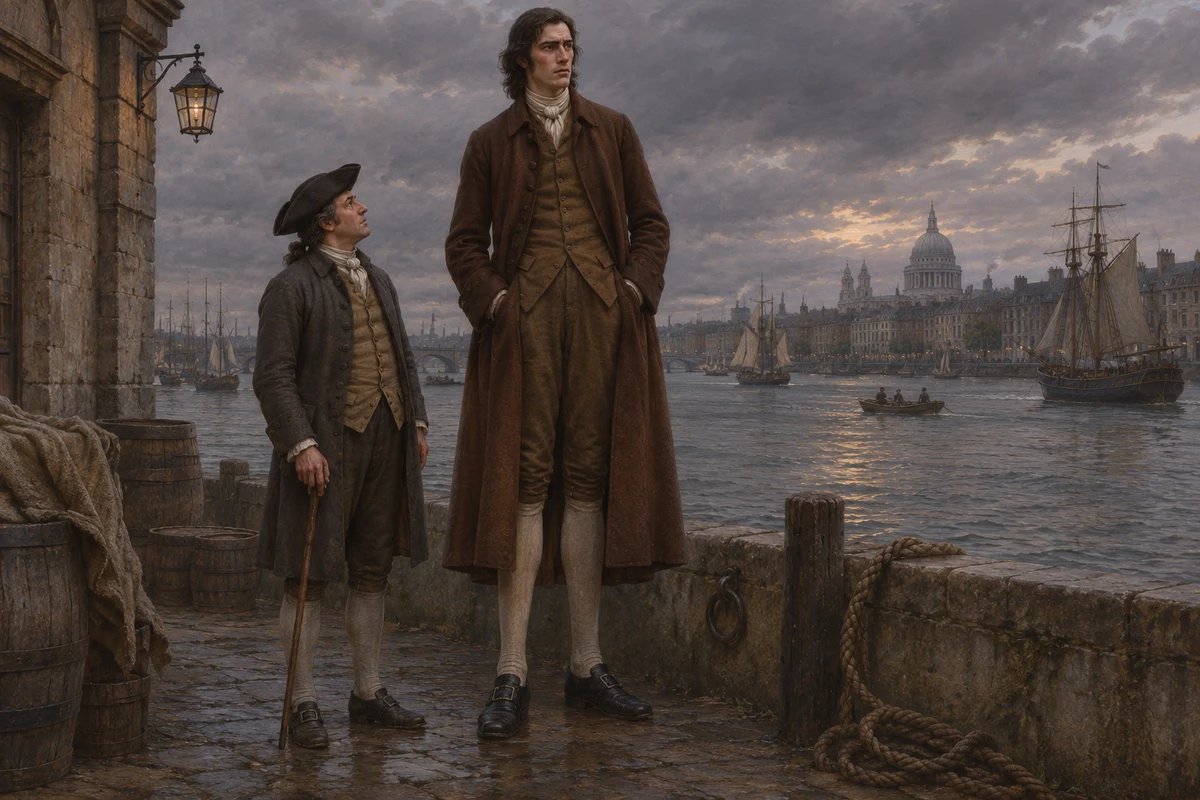
Charles Byrne was famous throughout Georgian London for his extraordinary height. But as his health declined, he became convinced that an eminent surgeon wanted his body for an anatomical collection. He reportedly arranged to be buried at sea to prevent it. What happened instead would haunt the history of British medicine for more than two centuries.
The man who was afraid of what would happen after death
In the summer of 1783, a young Irishman lay dying in London.
His name was Charles Byrne.
He was only about twenty-two years old, but he had already become one of the most recognisable attractions in the British capital.
Standing approximately seven feet seven inches tall, Byrne was advertised as the Irish Giant.
People paid money simply to see him.
His extraordinary height had made him famous, but it had also attracted the attention of a man whose interest was far more disturbing.
John Hunter, one of Britain's most celebrated surgeons and anatomists, wanted Byrne's body.
Not to bury it.
To dissect it, preserve the skeleton and add it to his anatomical collection.
According to historical accounts, Byrne knew of Hunter's interest and was horrified by the prospect.
He reportedly asked his friends to arrange a burial at sea, beyond the reach of surgeons and body snatchers.
It was a desperate attempt to control what happened to him after death.
But Byrne's final wish would not be fulfilled.
Instead, his skeleton became one of the most famous exhibits in the history of British medicine.
A giant from rural Ireland
Charles Byrne was born in 1761 near Littlebridge, close to Lough Neagh in Ireland.
His remarkable growth began during childhood.
Modern medical research indicates that he lived with pituitary gigantism, associated with excessive production of growth hormone.
The condition can cause extraordinary height, enlargement of bones and soft tissues, and serious health complications.
In Byrne's lifetime, however, the medical causes of such growth were poorly understood.
To eighteenth-century audiences, someone of his height seemed almost supernatural.
Stories about giants had circulated in Irish folklore for centuries.
Ancient tales described enormous warriors, legendary ancestors and extraordinary beings who shaped the landscape.
Byrne's unusual appearance made him a living curiosity in a society already fascinated by such stories.
As a young man, he recognised that his height could provide a livelihood.
He travelled to Britain and began exhibiting himself to paying audiences.
The strange business of being extraordinary
Eighteenth-century Britain had a flourishing market for public curiosities.
Travelling entertainers displayed unusual animals, mechanical wonders, wax figures, optical illusions and people whose bodies differed from what audiences considered ordinary.
Such exhibitions were not always straightforward stories of exploitation.
Some performers negotiated their own appearances, earned substantial incomes and used their public identities to achieve a degree of independence.
Others faced intense scrutiny, financial insecurity and degrading treatment.
Charles Byrne's career belonged to this complicated world.
He appeared in Edinburgh before moving to London, where his extraordinary height attracted considerable attention.
Visitors paid to see the Irish Giant.
Newspapers and advertisements helped spread his reputation.
His height was sometimes exaggerated in promotional accounts, but surviving skeletal measurements establish that he was genuinely exceptionally tall.
The Royal College of Surgeons of England gives his height as approximately seven feet seven inches, or 2.31 metres.
For Georgian audiences, he was an astonishing sight.
For Byrne, the exhibitions offered a way to earn money.
But his fame also made his body valuable to people whose interests extended beyond entertainment.
The surgeon who collected the unusual
John Hunter was one of the most influential medical figures of eighteenth-century Britain.
Born in Scotland in 1728, he became a pioneering surgeon and anatomist whose work helped transform the study of human and animal bodies.
He believed that understanding anatomy required close examination of physical structures.
Hunter assembled an enormous collection of anatomical preparations, preserved organs, animal specimens and human remains.
His collection became an important resource for medical education.
But the methods used to acquire specimens reflected a period when the bodies of poor, marginalised and socially vulnerable people were frequently treated as resources for scientific investigation.
Consent was often absent or disregarded.
Human remains could be obtained through grave robbing, informal payments and arrangements with undertakers.
Hunter's interest in Charles Byrne was therefore not simply curiosity.
A skeleton demonstrating extraordinary growth would be an exceptionally valuable addition to his collection.
And Byrne was aware of the danger.
A final wish: bury me beneath the sea
According to historical accounts, Byrne became increasingly anxious about the possibility of his body being acquired by anatomists.
He reportedly instructed his friends to arrange a burial at sea.
The reasoning was simple.
A grave could be opened.
A coffin could be stolen.
But a body committed to deep water would be much harder to recover.
The story has become one of the most famous episodes in the history of medical ethics.
There is an important qualification.
No written instruction signed by Byrne survives.
The burial-at-sea request is known through historical testimony and subsequent accounts.
Nevertheless, the story is sufficiently well established that the Royal College of Surgeons acknowledges the reported wish in its official history of the case.
Byrne died in London in June 1783.
His friends reportedly attempted to carry out his request.
But John Hunter had other plans.
The coffin that went to sea without its occupant
The traditional account of what happened next is extraordinary.
Hunter arranged to obtain Byrne's body before it could be buried.
Historical accounts describe a payment of £500, an enormous sum at the time.
The body was removed from the coffin and taken into Hunter's possession.
Some versions of the story describe the coffin being filled with stones or other weights so that Byrne's friends would not realise what had happened.
The weighted coffin was then reportedly taken to the coast and committed to the sea.
But Charles Byrne was not inside it.
The precise details of the substitution vary between accounts, and not every dramatic element can be independently verified.
What is established is that Hunter acquired Byrne's body despite the reported burial wishes.
He prepared the skeleton for his anatomical collection.
The acquisition became one of the most troubling episodes associated with his career.
A skeleton hidden from public view
Hunter did not immediately exhibit Byrne's remains.
According to historical accounts, he kept the skeleton concealed for several years.
By the later 1780s, however, it had become part of his celebrated anatomical collection.
The skeleton was displayed in Hunter's museum in Leicester Square.
It was an extraordinary object for medical study.
It was also the remains of a man who had reportedly done everything he could to prevent precisely this outcome.
The irony is difficult to escape.
During his lifetime, Byrne had earned money by allowing people to look at his extraordinary body.
After his death, other people controlled that body and continued exhibiting it.
The distinction between voluntary performance and posthumous display lies at the heart of his story.
The giant in the surgeon's portrait
One particularly revealing piece of historical evidence survives in a famous painting.
In 1786, Sir Joshua Reynolds painted a portrait of John Hunter.
The surgeon is shown seated in his study, surrounded by objects associated with scientific investigation.
In the background, partly obscured, are the long bones of an enormous skeleton.
They belong to Charles Byrne.
The detail is easy to overlook.
But it is one of the most unsettling visual records of the relationship between the surgeon and the man whose remains he acquired.
Byrne had become an object within Hunter's professional identity.
The skeleton represented scientific achievement, anatomical curiosity and the prestige of an important medical collection.
Yet it also represented a person whose reported wishes had been ignored.
Two centuries in a museum
After Hunter's death in 1793, his collection was acquired by the British government and entrusted to the institution that became the Royal College of Surgeons of England.
Byrne's skeleton remained one of its best-known specimens.
For generations, medical students, researchers and members of the public could view the remains.
The skeleton provided evidence of the physical effects of extreme growth.
Modern researchers were eventually able to investigate the medical condition responsible.
Studies of Byrne's remains helped establish links between his pituitary disorder and inherited genetic changes found in some families from Northern Ireland.
Research involving DNA recovered from his teeth contributed to understanding familial pituitary disease.
This work provided a genuine scientific argument for preserving the specimen.
But it also raised an uncomfortable question.
Did the scientific value of Byrne's remains justify keeping and exhibiting them against his reported wishes?
And did scientific research require public display at all?
The debate that lasted more than two hundred years
As medical ethics changed, the treatment of Charles Byrne's remains attracted increasing criticism.
Doctors, historians, ethicists and members of the public questioned whether his skeleton should remain in a museum.
Some argued that the appropriate response was to honour his reported wish for burial at sea.
Others maintained that the remains had continuing scientific value and should be preserved for research.
The debate was not simply about eighteenth-century behaviour.
It concerned the responsibilities of modern institutions that had inherited collections assembled under very different ethical standards.
In 2011, medical ethicists writing in the British Medical Journal argued that Byrne's skeleton should be removed from display and buried at sea.
The question became increasingly difficult for the museum to ignore.
The decision that changed the story in 2023
In January 2023, the trustees of the Hunterian Collection announced that Charles Byrne's skeleton would not return to public display when the redeveloped Hunterian Museum reopened.
It was a significant decision.
For more than two centuries, Byrne's remains had been exhibited as an important anatomical curiosity.
Now the museum acknowledged the sensitivities surrounding their acquisition and display.
However, the decision did not mean that Byrne's remains were buried.
The trustees chose to retain the skeleton in storage, where it could remain available for legitimate medical research.
The decision therefore represented a compromise.
Public exhibition would end.
Scientific retention would continue.
Campaigners who supported burial at sea welcomed the removal from display but continued to question whether retaining the remains respected Byrne's wishes.
The controversy revealed how difficult it can be to resolve ethical problems inherited from the distant past.
Was Charles Byrne really seven feet seven inches tall?
Accounts of Byrne's height have varied considerably.
Some eighteenth-century advertisements and later retellings gave exaggerated measurements.
This was hardly surprising.
The commercial appeal of exhibiting a giant depended partly on the impression of extraordinary size.
But modern measurements of Byrne's skeleton provide a more reliable basis.
The Royal College of Surgeons records his height as approximately 2.31 metres, or seven feet seven inches.
That makes him extraordinarily tall even by modern standards.
The cause of his growth was not supernatural.
Medical investigation established that he had a pituitary condition associated with gigantism and acromegaly.
The scientific explanation does not make his life any less remarkable.
It simply reminds us that the extraordinary bodies displayed in historical exhibitions belonged to real people with medical conditions, personal ambitions and individual experiences.
The forgotten person behind the curiosity
Charles Byrne's life was brief.
He was born in rural Ireland, travelled to Britain, earned a living from his extraordinary height and became a celebrity in Georgian London.
But the event for which he is most often remembered happened after his death.
His body became an anatomical specimen.
His skeleton became a museum attraction.
His reported burial wish became the centre of a debate about consent, scientific research and human dignity.
For more than two centuries, people discussed what could be learned from his remains.
Far fewer asked what Charles Byrne himself had wanted.
His story is therefore about much more than an unusually tall man.
It is about the difference between being seen and being understood.
It is about the power of celebrated institutions over individuals whose bodies were regarded as extraordinary.
And it is about whether the wishes of someone who died centuries ago should still matter today.
Charles Byrne spent his life being looked at. His final request, according to the historical accounts, was simply that people should stop looking at him after he died.
More than two hundred years later, that request remains at the heart of his extraordinary story.
What the evidence tells us
WELL SUPPORTED: Charles Byrne lived in eighteenth-century Ireland and Britain, exhibited himself as the Irish Giant, died in 1783 and had his remains acquired by anatomist John Hunter.
WELL SUPPORTED: Byrne's skeleton became part of Hunter's anatomical collection and was displayed for generations.
WELL SUPPORTED: In January 2023, the trustees of the Hunterian Collection decided that his skeleton would no longer be publicly exhibited. It was retained for potential medical research.
SUPPORTED BY HISTORICAL TESTIMONY: Byrne reportedly requested burial at sea to prevent anatomists obtaining his body. No signed written instruction survives.
TRADITIONAL ACCOUNT: Hunter arranged for Byrne's body to be removed from its coffin and replaced with weights before the coffin was committed to the sea. The central acquisition is established, but individual details of the substitution come from historical accounts that vary.
COMMON MISCONCEPTION: Byrne's remains were buried at sea following the 2023 decision. They were removed from public display but retained in the collection.
Historical sources and further reading
1. Royal College of Surgeons of England, Statement on the Skeleton of Charles Byrne from the Board of Trustees of the Hunterian Collection, 11 January 2023.
2. British Medical Journal, Should the Skeleton of “the Irish Giant” Be Buried at Sea?, 2011.
3. Medical Law Review, Charles Byrne, Last Victim of the Bodysnatchers: The Legal Case for Burial, 2021.
4. Smithsonian Magazine, Why the Hunterian Museum Is Removing the Skeleton of 'Irish Giant' Charles Byrne From View, 2023.
5. St George's University Hospitals NHS Foundation Trust, The Tallest Man in England.
6. Sir Joshua Reynolds, John Hunter, 1786, Royal College of Surgeons of England collection.