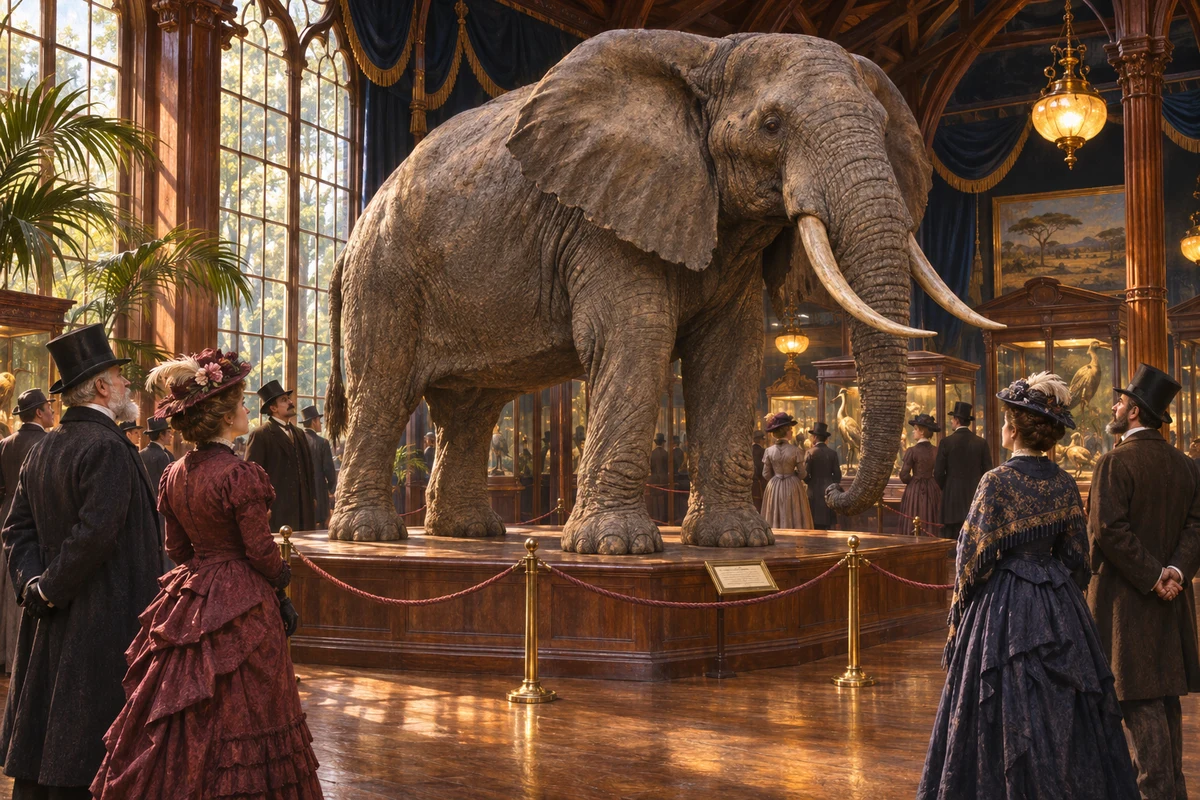
Jumbo was one of the most famous elephants in the world. When he was killed by a train in 1885, his career might have ended. Instead, P. T. Barnum arranged for his remains to become another extraordinary attraction.
THE SHORT ANSWER
Barnum put Jumbo’s remains on display because the elephant’s fame could survive his death. Having the skin mounted and the skeleton assembled allowed the circus to offer two versions of its lost celebrity: the familiar outward appearance and the extraordinary structure beneath it.
The result combined commercial spectacle, natural history and public affection. Later, Jumbo’s remains entered museum collections, while his image became the mascot of Tufts University.
The preservation and exhibitions are documented. The accompanying story that Jumbo died deliberately rescuing a smaller elephant belongs to the much less reliable world of Barnum’s publicity.
WHAT WE KNOW
The elephant who was too famous to die
On 15 September 1885, a railway accident in St. Thomas, Ontario, killed an elephant who had become an international celebrity.
His name was Jumbo.
He had arrived at London Zoo in 1865 and become a favourite with visitors. Children rode on his back. When the zoo sold him to Barnum in 1882, the decision provoked a public campaign to keep him in Britain.
Barnum understood the value of that attachment. The controversy helped announce his acquisition before American audiences had seen the elephant.
Jumbo subsequently travelled with the circus. His name, his size and his recognisable identity made him more than another animal in a menagerie.
Then came the collision.
Jumbo and a smaller elephant called Tom Thumb were being taken towards their railway transport when a freight train struck them. Jumbo died; Tom Thumb survived.
For Barnum, the loss presented an unusual problem. His attraction was dead, but the public still wanted to see him.
Two exhibits from one elephant
The work of preservation was entrusted to Henry A. Ward’s establishment in Rochester, New York.
Ward’s business supplied natural-history specimens to museums. Preparing Jumbo therefore connected the circus with an established trade in preserved animals, rather than requiring an entirely new kind of enterprise.
The hide was mounted to recreate the elephant’s external appearance. The bones were prepared and assembled separately. Carl Akeley, then a young taxidermist who would later become an important museum figure, helped with the work.
By 1886 the two versions were ready for exhibition.
Ohio Memory preserves a promotional publication, The Life and Death of Jumbo, associated with a circus visit to Zanesville that June. It brings the story and the specimen together: an account of the famous elephant’s life, a dramatic death narrative and a description of the preparation of his remains.
A visitor could encounter Jumbo as both celebrity and anatomy lesson.
HOW IT BECAME A HABIT
When natural history joined the show
Displaying a preserved animal was already familiar in nineteenth-century museums. Jumbo’s unusual distinction was that audiences knew who this particular elephant had been.
A generic skeleton invited questions about an animal’s structure. Jumbo’s skeleton also carried a biography.
The distinction mattered commercially. People were being offered an encounter with the remains of a celebrated individual, rather than simply a large example of a species.
Surviving advertising at London Museum shows how effectively those appeals could be combined. One poster presents the skeleton as a spectacular attraction and identifies Ward as the scientist responsible for mounting it.
Science supplied authority. Celebrity supplied recognition. The circus supplied an audience.
Viewed this way, the preserved Jumbo was a continuation of the same publicity system that had made the living elephant famous.
THE STORY EVERYONE TELLS
Jumbo’s last heroic act
In the version Barnum promoted, Jumbo met his death while saving Tom Thumb from the approaching train.
It gave the accident a reassuring shape. The famous elephant had become a brave protector, sacrificing himself for a vulnerable companion.
The smaller elephant was an animal, not Charles Stratton, the performer Barnum had exhibited as General Tom Thumb.
The rescue narrative appears in promotional material, including the publication discussed by Ohio Memory and a programme held by London Museum. It is consequently a documented part of Jumbo’s public story.
That does not establish that the rescue happened.
Publicity is excellent evidence for what an audience was told. It needs checking before being treated as evidence for what an elephant actually did.
WHAT THE EVIDENCE ACTUALLY SAYS
An attempted escape, rather than a sacrifice
A contemporary local account points in a different direction.
The St. Thomas Times material transcribed by St. Thomas Public Library describes Jumbo trying to obey his keeper and reach an escape route at the end of the circus train when he was struck.
The same reporting describes crowds gathering around the body and souvenir hunters removing bristles. Public fascination had continued almost immediately after death, even before a formal exhibition could be prepared.
Tufts’ historical account also summarises a witness’s description of Jumbo fleeing the danger and failing to find his way off the track.
These accounts support a frightened animal attempting to escape. They do not substantiate a deliberate act of self-sacrifice.
The evidence label is WELL SUPPORTED for the main history: the fatal collision, preservation and subsequent display. It does not certify every detail of Barnum’s accompanying narrative.
Nor do preparations for preserving Jumbo prove that his death was arranged. Museums and showmen could plan for an animal’s eventual death without causing it. A claim of deliberate killing would require separate evidence.
The museums wanted him too
Jumbo’s afterlife was more complicated than a showman simply keeping an exhibit on the road.
Correspondence examined by Smithsonian Institution Archives records plans for the skeleton to go to the Smithsonian, with the hide destined for Tufts. Those intentions became entangled in disagreements over institutional cooperation and specimen exchanges.
The skeleton ultimately went to the American Museum of Natural History in New York. Its photographic catalogue identifies Jumbo’s skeleton in an entrance-hall display photographed on 23 January 1895.
The mounted hide reached Tufts in 1889, although Jumbo’s exhibition history also included a later return to Britain.
These destinations reveal how readily one animal could move between commercial entertainment, scientific collecting and institutional prestige.
WHY IT STUCK
The elephant who became a good-luck charm
At Tufts, Jumbo acquired a role that Barnum’s circus could hardly have scripted more effectively.
He became the university’s mascot. Students associated the mounted elephant with good luck, tugging his tail or placing pennies in his trunk before examinations and sporting contests.
Here the story moves from showmanship into curious custom: a preserved circus celebrity became something students approached for reassurance.
The mounted hide was destroyed in the Barnum Hall fire of 1975. Jumbo’s original tail, removed earlier, survived separately. Ashes collected from the ruins were kept in a peanut-butter jar and became part of the university’s continuing traditions.
The train accident had ended Jumbo’s life. It had not ended the uses people found for him.
Barnum’s decision makes sense within that uncomfortable history. Jumbo could still attract attention, educate, advertise and inspire affection after death. The same remains could be a scientific specimen to one visitor and a beloved personality to another.
The elephant could no longer perform. His fame was still doing the work.
RELATED CURIOSITIES
What Were Victorian Circus Posters Really Selling?
Why Did Maud Wagner Cover Her Body in Tattoos?
Why Did Victorians Give Each Other Jewellery Made from Hair?
SOURCES & FURTHER READING
London Museum — Jumbo the Elephant. Includes surviving advertising and a programme promoting the preserved elephant.
https://www.londonmuseum.org.uk/collections/london-stories/jumbo-the-elephant/
St. Thomas Public Library — Transcription of St. Thomas Times reporting, collected under 24 September 1885. Contemporary reporting on the accident, crowds and preservation.
Ohio Memory, Ohio History Connection — “The Greatest, Gentlest, and Most Famous and Heroic Beast That Ever Lived”. Discusses the surviving Life and Death of Jumbo publication and the 1886 exhibition.
https://ohiomemory.ohiohistory.org/archives/3237
Tufts Digital Library — Concise Encyclopedia of Tufts History: Jumbo. Death accounts, preservation, museum display and student traditions.
https://dl.tufts.edu/teiviewer/parent/f1881x54h/chapter/J00021
Smithsonian Institution Archives — Everyone Loves a Circus. Correspondence about Jumbo’s remains and competing museum arrangements.
https://siarchives.si.edu/blog/everyone-loves-circus
American Museum of Natural History, Digital Collections — Second floor, 77th Street Entrance Hall, 1895. Catalogue record identifying Jumbo’s skeleton in a dated museum photograph.
https://digitalcollections.amnh.org/asset-management/2URM1T9XX559
Andrew McClellan — P. T. Barnum, Jumbo the Elephant, and the Barnum Museum of Natural History at Tufts University. Journal of the History of Collections, 24(1), 2012, pp. 45–62.