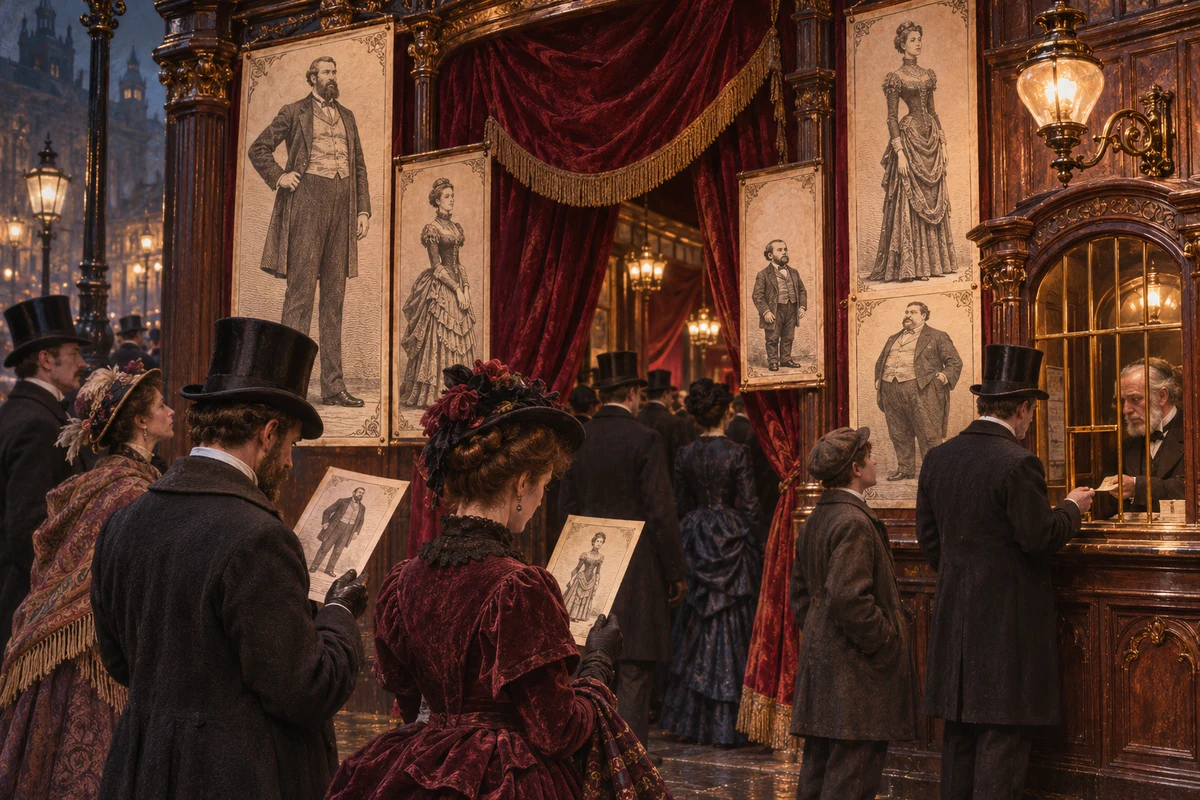
Victorian audiences paid to see people advertised as giants, miniature men, bearded women and extraordinary examples of human nature. But behind the sensational posters were real lives, complicated careers and a society fascinated by physical difference.
THE SHORT ANSWER
Victorians paid because showmen turned physical difference into an event: something astonishing to witness, discuss and occasionally boast about having seen. Advertising offered entertainment, apparent education and the excitement of encountering someone presented as unique.
These exhibitions could involve exploitation, deception and degrading treatment. They could also provide some performers with paid work, public recognition and opportunities unavailable elsewhere. Neither experience explains every life.
The important distinction is between a person’s body and the attraction constructed around it. A poster could turn a person into a supposed scientific mystery before the visitor had even bought a ticket.
WHAT WE KNOW
An extraordinary promise for one shilling
A surviving poster in Wellcome Collection advertises attractions at London’s Royal Aquarium, an exhibition and entertainment venue opened in 1876. Its named performers include Chang, Henrik Brustad and a man billed as the Chinese Tom Thumb. Admission was one shilling.
The poster combines a woodcut of Chang beside a guardsman with claims about exceptional height. Such comparisons helped make a body into a spectacle: familiar beside unfamiliar, ordinary beside extraordinary.
Its measurements belong to the advertisement. They should not automatically be treated as verified medical information.
This single sheet also complicates the familiar picture of a shabby tent beside a circus. Human exhibitions occupied substantial urban venues as well as travelling shows, music halls and shopfronts. Different settings offered different prices, audiences and claims to respectability.
They were not a Victorian invention. London’s earlier fairs had already made public entertainment out of unusual bodies. What nineteenth-century promoters developed was a vigorous market in named attractions, accompanied by portraits, handbills and carefully managed publicity.
HOW IT BECAME A HABIT
When the Queen had seen the attraction
Charles Sherwood Stratton, born in Connecticut in 1838, became internationally famous under the name General Tom Thumb. P. T. Barnum brought him to Britain in 1844, when he was six.
Stratton’s act involved singing, dancing, acting and impersonations. His stature supplied the advertising hook, but he performed routines rather than merely standing still.
His appearances before Queen Victoria helped Barnum turn an exhibition into a fashionable engagement. Royal attention was valuable publicity: seeing someone who had entertained the sovereign could become a social occasion in its own right.
An 1844 handbill preserved by Sheffield’s National Fairground and Circus Archive illustrates the unreliability of the surrounding biography. It presents Stratton as thirteen, despite his documented birth in 1838.
The child was real; the age supplied to customers was part of the sales pitch.
Wellcome also preserves an 1844 leaflet advertising his appearances at the Egyptian Hall in Piccadilly. Together, these objects show an attraction being packaged for repeated performances and an eager metropolitan audience.
Seeing a curiosity could therefore mean attending a recognisable entertainment, purchasing its printed story and joining a conversation already encouraged by the press and fashionable society.
THE STORY EVERYONE TELLS
The helpless exhibit and the cruel showman
The familiar version is straightforward. An unfortunate person is displayed by a brutal manager until a compassionate outsider intervenes.
There were people whose treatment makes that account entirely understandable. But as a universal explanation it leaves too little room for performers’ decisions, working relationships and differing circumstances.
Joseph Merrick, advertised as the Elephant Man, makes the problem particularly clear.
In 1884, Merrick approached Leicester music-hall proprietor Sam Torr about entering exhibition work. He subsequently appeared in a Whitechapel Road shop managed by Tom Norman. A pamphlet presented as Merrick’s autobiography was sold there, with Merrick receiving half its profits.
Those details matter. They show someone seeking an income in an extremely restrictive employment market, rather than simply being discovered and carried off by a showman.
They do not prove that he enjoyed complete freedom or that exhibition work was safe. London Museum records that a later manager robbed and abandoned him in Brussels. His circumstances combined initiative with profound vulnerability.
WHAT THE EVIDENCE ACTUALLY SAYS
Who wrote the story?
The evidence label is WELL SUPPORTED for the existence and commercial organisation of these shows. It does not certify every advertised biography or tell us what every performer felt.
Historian Nadja Durbach compares the sharply different accounts of Merrick left by Norman and the surgeon Frederick Treves. Treves cast his hospital care as rescue; Norman defended exhibition as a route to independence. Both had professional reputations to protect. Neither account gives unrestricted access to Merrick’s own perspective.
That disagreement also unsettles an easy division between enlightened medicine and ignorant entertainment. Doctors studied people encountered through exhibitions, while promoters used the authority of apparent medical interest to strengthen their attractions.
Scientific attention did not automatically remove the imbalance between the person looking and the person being looked at.
A darker surviving advertisement
Julia Pastrana’s publicity offers a different warning. A lithograph in Wellcome Collection shows her in fashionable dress, holding a fan or bouquet, while advertising her under the dehumanising description “the nondescript”. The image and wording pull in different directions: a recognisable woman, presented as something supposedly difficult to classify.
Another Wellcome item is more disturbing still: a leaflet advertising the exhibition of her mummified body at London’s Burlington Gallery, catalogued with the tentative date 1862.
It is direct evidence that commercial display could continue after death. It cannot tell us what Pastrana wanted during her life, and should never be used to imply her consent to what followed.
Reading a poster properly
An advertisement is excellent evidence of what customers were promised. It is much weaker evidence that the promise was true.
Descriptions of supposedly unprecedented height, extraordinary origins or prestigious encounters need checking against independent records. Where no such records survive, the honest conclusion is that the claim remains unverified.
The same caution applies to respectable-sounding presentation. An elegant costume, an exhibition gallery or a medical reference might reassure customers; none establishes fair treatment behind the scenes.
Equally, the historical term “freak show” describes a system of entertainment, not a natural category of people. Its performers had different bodies, backgrounds, skills and degrees of control over their working lives. Treating them as one undifferentiated group repeats something of the advertising’s own simplification.
WHY IT STUCK
The business of making people look
The attraction offered a powerful combination: a supposedly exceptional person, a story explaining why they mattered, and the chance to see for yourself.
We cannot recover every visitor’s motives from a ticket or handbill. Curiosity, amusement, admiration, discomfort and prejudice need not have been mutually exclusive. The surviving publicity reveals the appeal being offered, rather than a complete account of how each spectator responded.
Nor does an individual success story excuse the industry’s abuses. A performer could earn money while working within a society that sharply restricted other possibilities. Income and unequal power could exist together.
The question is therefore larger than why Victorians stared. It is who controlled the encounter, who supplied the explanation, and who received the money.
The posters survive because they were designed to make strangers memorable. Reading them carefully begins by restoring the people whom their extraordinary claims so often obscured.
RELATED CURIOSITIES
What Were Victorian Circus Posters Really Selling?
Why Did Maud Wagner Cover Her Body in Tattoos?
Why Did Victorians Fear Being Buried Alive?
SOURCES & FURTHER READING
Wellcome Collection — Royal Aquarium poster advertising Chang, Brustad and other performers; admission one shilling.
https://wellcomecollection.org/works/ts5xvvcz
University of Sheffield, National Fairground and Circus Archive — Charles Sherwood Stratton / General Tom Thumb biography and March 1844 handbill record.
https://archives.sheffield.ac.uk/agents/people/642
Wellcome Collection — Leaflet advertising General Tom Thumb at the Egyptian Hall, dated approximately 1844.
https://wellcomecollection.org/works/pqzzn9kz
London Museum — Joseph Merrick: ‘The Elephant Man’.
https://www.londonmuseum.org.uk/collections/london-stories/joseph-merrick-elephant-man/
Nadja Durbach, Spectacle of Deformity: Freak Shows and Modern British Culture, University of California Press, 2009 — publisher’s chapter extract, “Monstrosity, Masculinity, and Medicine”.
https://content.ucpress.edu/chapters/11252.ch01.pdf
Wellcome Collection — Julia Pastrana exhibition lithograph, reference 39121i.
https://wellcomecollection.org/works/xdj5ke9s
Wellcome Collection — Leaflet advertising the exhibition of Julia Pastrana’s mummified body, tentatively dated 1862.