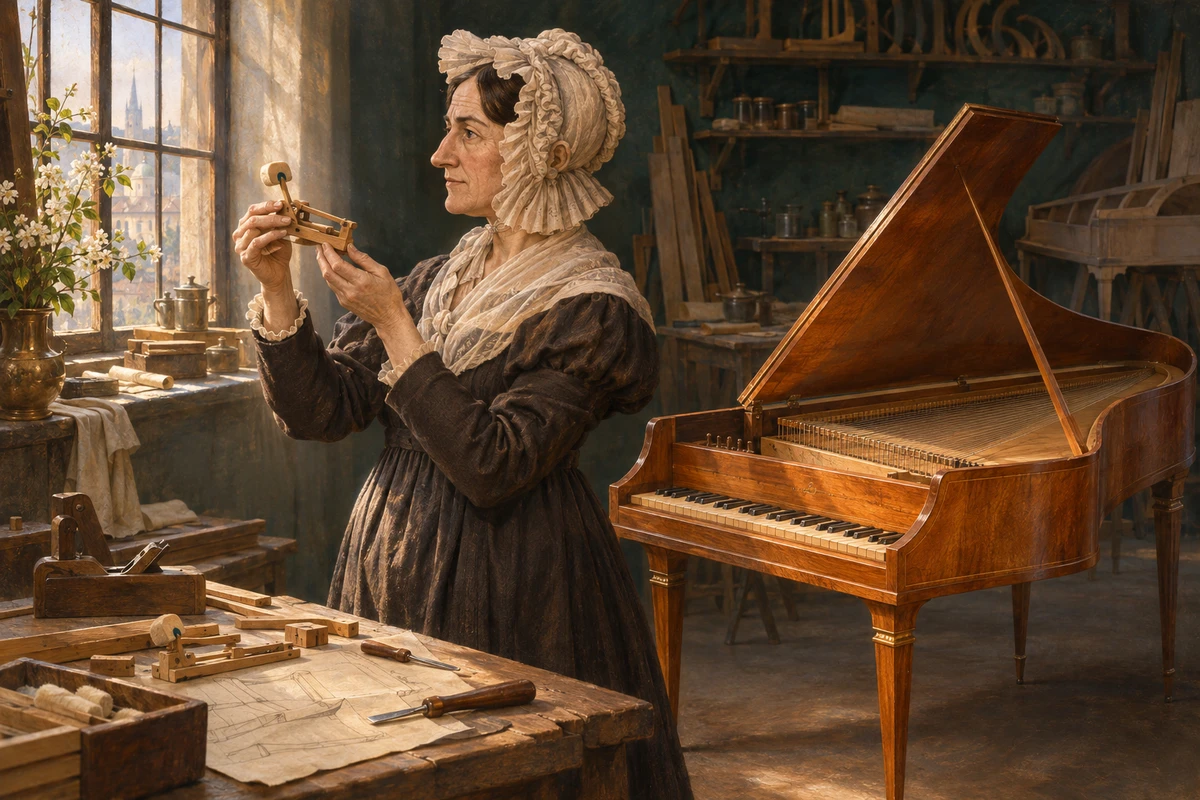
Nannette Streicher is often introduced through the famous man who asked for her help. Yet she was already an expert in something Beethoven needed: the making of a piano.
Her surviving instruments and the records of her workshop reveal a professional life that deserves to be heard beyond the composer’s doorstep.
THE SHORT ANSWER
Nannette Streicher, born Stein in Augsburg in 1769, was a pianist and a leading Viennese piano maker. Trained in her father’s craft, she continued the family business with her brother before establishing a separate enterprise with her husband.
She and Beethoven were close friends, and she helped him with practical difficulties. But her place in musical history also rests on instruments, technical judgement and a business that helped shape the world in which his music was performed.
WHAT WE KNOW
The family connection began with Johann Andreas Stein, an important keyboard-instrument maker. His daughter learned piano making as well as piano playing: two kinds of knowledge that could inform each other.
The Metropolitan Museum of Art holds a particularly useful piece of evidence. Its pianoforte, object number 64.252, is attributed to Stein, Frère et Sœur — brother and sister — and dated 1794–1802.
The Met’s account explains that Nannette and her brother Matthäus headed the workshop as their father’s health declined, continuing after his death. In 1794 she married Johann Andreas Streicher and the business moved to Vienna. The siblings worked together until 1802, when their businesses separated.
The dates matter. Nannette did not become a piano maker simply by marrying a man whose surname appeared on the instruments. Her professional experience preceded that marriage.
A WORKSHOP THAT ALSO HAD AN AUDIENCE
Beethoven-Haus describes the factory managed by Nannette as one of Vienna’s leading firms, operating in a city with more than a hundred piano manufacturers during Beethoven’s time.
This was a competitive trade. A piano had to satisfy the hands and ears of its purchaser as well as survive the mechanical demands placed on it. The museum’s exhibition guide records instruments made to customers’ requirements, including an elaborate commission in 1811.
The Streicher household was also a place to hear music. Their concerts developed into a dedicated hall in 1812, with room for about 300 listeners. The workshop’s products therefore belonged to a wider musical enterprise involving performers, customers and audiences.
That is a more substantial role than the familiar image of a helpful woman waiting in the background of a composer’s life.
AN INSTRUMENT THAT STILL EXPLAINS THE CRAFT
A fortepiano made by Nannette in 1814 survives in the Landesmuseum Württemberg’s collection. The museum’s description records a six-octave range and four pedals, offering effects beyond those most listeners associate with a present-day piano.
It also identifies a soundboard above the strings as her invention. This arrangement moderated the middle and lower registers while allowing the treble greater freedom, helping balance the instrument’s sound.
The point is not that every innovation belonged to one person working alone. Piano making was collaborative, and a workshop instrument embodies the labour of several hands. But this surviving example gives us something firmer than a general statement that Nannette was talented: a named maker, a dated instrument and a described acoustic solution.
THE STORY EVERYONE TELLS
The easiest introduction calls her Beethoven’s friend, helper or household adviser. There is real evidence behind that description.
Beethoven-Haus records more than sixty letters and notes in conversation books documenting the family’s close relationship with the composer. In 1817 and 1818, Nannette frequently advised him on household matters during the difficulties surrounding his guardianship of his nephew Karl.
Such assistance mattered. It should not be dismissed as trivial simply because it happened away from the concert platform.
The distortion comes when it becomes the whole biography. A woman who ran a piano-making business can disappear behind the domestic problems of the better-known man who wrote to her.
WHAT THE EVIDENCE ACTUALLY SAYS
The evidence label is WELL SUPPORTED. Instruments, collection records and correspondence document a piano maker with an independent professional career and a close connection to Beethoven.
One original note provides a small but revealing scene. Early in September 1824, Beethoven wrote to Nannette about arranging a visit to see the firm’s new instrument. The Beethoven-Haus catalogue connects it with the new patent pianoforte and explains that her son Johann Baptist had joined the company as a partner in 1823.
The letter is evidence of an ongoing relationship with the business. It is not permission to claim that Nannette personally built every piano Beethoven played, or that the firm supplied all the instruments he owned. Nor should a later family innovation automatically be assigned to her alone.
The stronger story does not require those exaggerations. She was already a significant maker in a musical culture that depended on skilled makers.
WHAT HER PIANOS CAN STILL TELL US
At LMU Munich, an 1825 Streicher instrument offers another perspective. Its overstriking action brings the hammers down onto the strings, rather than up from below. LMU dates the firm’s patent for this design to 1823.
In a 2025 interview, musicologist Hartmut Schick described the restored instrument’s contrasting registers: bassoon-like low notes, a flute-like upper range and a middle register suggesting a clarinet. It challenges the expectation that a piano’s ideal voice must be uniform from bottom to top.
This is a later product of the family business, not the 1814 instrument described above. Keeping the examples separate lets each tell its own part of the story: technical balance in one case, a different striking mechanism and range of colour in the other.
WHY SHE DESERVES TO BE REMEMBERED
Nannette died in 1833. Her son continued the business, and later generations carried the family name forward.
Her career offers a useful correction to the way musical history is often framed. Composers needed instruments, and instruments required decisions about materials, mechanisms, touch and tone. The finished score cannot tell that whole story.
Beethoven’s letters help bring Nannette into view. Her pianos give us a reason to keep looking after we have put the letters down.
RELATED CURIOSITIES
How Did a Woman Born Without Arms Become a Celebrated Royal Portrait Painter?
Who Was the Inventor Who Entered a Poisonous Tunnel to Save Strangers?
How Did a Children’s Author Become a Secret Radio Operator in Nazi-Occupied Paris?
SOURCES & FURTHER READING
1. The Metropolitan Museum of Art — “Pianoforte”, Stein, Frère et Sœur, 1794–1802, object 64.252: family business and surviving instrument.
https://www.metmuseum.org/art/collection/search/503049
2. Beethoven-Haus Bonn — exhibition guide on Beethoven and the Streicher family: workshop management, commissions, concert hall and business succession.
3. Landesmuseum Württemberg, via Google Arts & Culture — “Fortepiano”, Nannette Streicher, 1814: pedals, compass and soundboard design.
https://artsandculture.google.com/asset/fortepiano-nannette-streicher/BgF12DIhB-wyNA?hl=en
4. Beethoven-Haus Bonn — Nannette Streicher portrait record and biographical commentary: training, friendship and household correspondence.
https://www.beethoven.de/en/media/view/5994904807276544
5. Beethoven-Haus Bonn — Beethoven’s note to Nannette Streicher, early September 1824, HCB Br 255: original document and catalogue commentary.
https://www.beethoven.de/en/media/view/6206191562653696?page=0
6. LMU Munich — “Historic grand piano: ‘You almost become a little addicted to this sound’”, 7 May 2025: restored 1825 instrument and the overstriking action.
7. Greifenberger Institut für Musikinstrumentenkunde — “Stein’s successors”: Nannette’s training, professional background and the family’s instrument-making tradition.