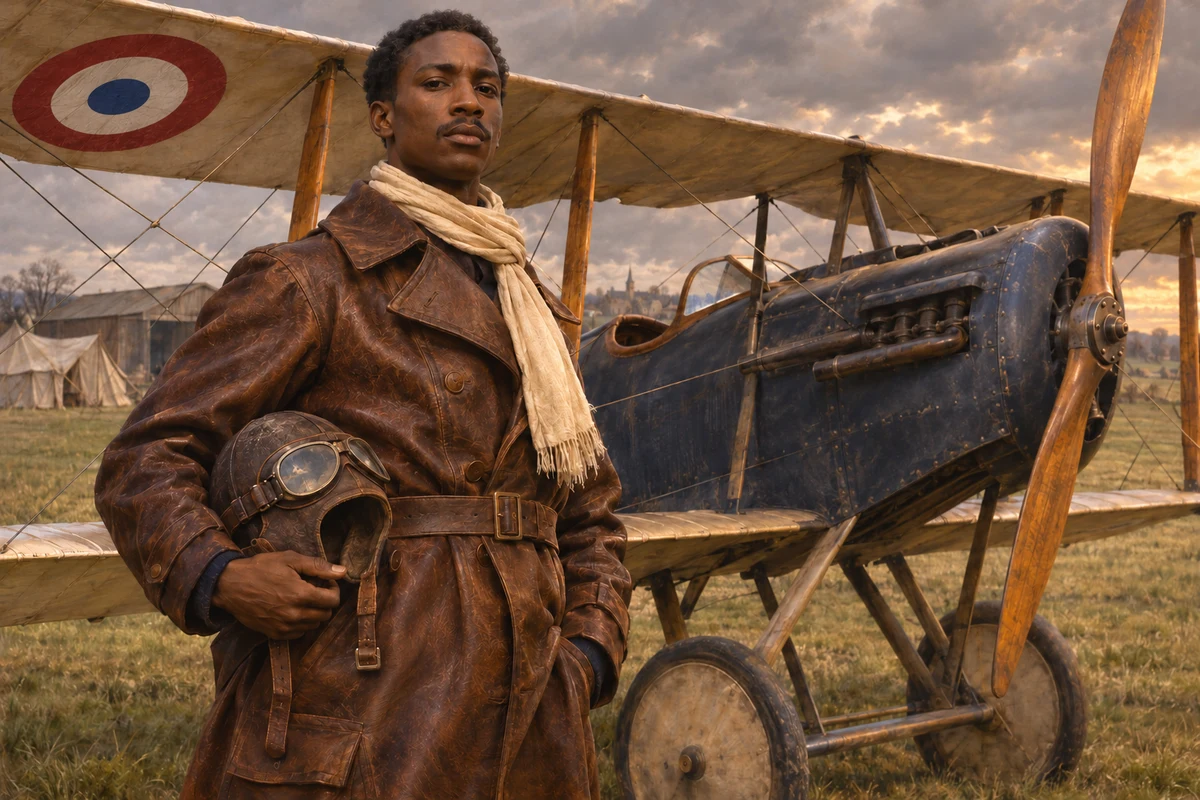
Eugene Bullard escaped the racial violence of the American South, became a decorated French soldier, flew combat aircraft in the First World War and later owned a fashionable Paris nightclub. Yet when he returned to America, the pioneering aviator found himself living in relative obscurity.
The war hero America forgot
In 1954, a distinguished group of French war veterans gathered beneath the Arc de Triomphe in Paris.
Among those chosen to take part in a ceremony at the Tomb of the Unknown Soldier was a Black American named Eugene Bullard.
To France, he was a decorated veteran who had fought for the country in two world wars.
He had served in the trenches, flown military aircraft, survived serious wounds and become a familiar figure in the extraordinary nightlife of interwar Paris.
But across the Atlantic, in the country of his birth, relatively few people knew his name.
His story is one of the strangest contradictions in twentieth-century military history.
An American became one of the earliest Black combat pilots in the world.
Yet he had to fly for another country to do it.
A boy searching for freedom
Eugene Jacques Bullard was born in Columbus, Georgia, in the 1890s.
Historical sources disagree over whether his birth year was 1894 or 1895, although 1895 is frequently given.
His father had been enslaved, and Eugene grew up in a society shaped by segregation, racial discrimination and the threat of violence.
As a young boy, he became determined to escape.
Accounts of his early life describe an extraordinary journey away from Georgia, through the American South and eventually across the Atlantic.
In 1912, he reached Britain after travelling aboard a merchant ship.
He found work in entertainment and boxing, experiences that helped him support himself while exploring a world far removed from his childhood.
Eventually, he arrived in France.
There, he encountered a society that was far from free of racism but offered possibilities that had seemed closed to him in America.
He became a professional boxer.
He learned French.
And he began building a life in the country that would eventually regard him as a hero.
From prizefighter to soldier
When the First World War began in 1914, Bullard volunteered to fight for France.
He joined the French Foreign Legion and served in some of the war's most brutal fighting.
At Verdun in 1916, French and German forces endured months of devastating artillery bombardment and infantry combat.
Bullard was seriously wounded.
His military service brought him decorations, including the Croix de Guerre.
For many soldiers, such wounds would have ended their military careers.
For Bullard, they led to an entirely different form of warfare.
While recovering, he pursued an opportunity to join French military aviation.
It was an astonishing transition.
A young man who had escaped Georgia as a child was about to enter one of the newest and most dangerous branches of modern warfare.
The Black pilot in the skies over France
Military aviation was still in its infancy.
Aircraft were fragile machines constructed from wood, fabric, wire and relatively primitive engines.
Pilots flew in open cockpits, exposed to freezing temperatures, mechanical failure and enemy gunfire.
There were no parachutes routinely issued to French fighter pilots during much of the war.
Yet flying offered an entirely new kind of military identity.
In 1917, Bullard qualified as a pilot and joined the French flying service.
He became the first African American military pilot known to have flown combat missions.
He flew with the Lafayette Flying Corps, the broader grouping of American volunteers serving in French aviation units.
His combat service began in August 1917.
Bullard flew SPAD fighter aircraft and participated in operations against German forces.
Some accounts credit him with one or more aerial victories, but the precise claims differ between historical sources.
His confirmed significance does not depend on the number of enemy aircraft he may have destroyed.
He had achieved something unprecedented for a Black American in military aviation.
And he had done it while the armed forces of his homeland maintained racial barriers.
Why wouldn't America let him fly?
In April 1917, the United States entered the First World War.
American volunteers serving with French forces now faced the possibility of transferring into their own country's military.
Bullard sought to serve as an American military aviator.
But the United States Army did not accept him into its aviation service.
Racial discrimination prevented Black Americans from enjoying the same opportunities as white pilots.
The contrast was striking.
France had trained Bullard, placed him in military aircraft and allowed him to fly combat missions.
His own country would not give him an equivalent opportunity.
The exclusion was not a judgement that he lacked the necessary experience.
He already possessed it.
It was a reflection of the racial policies and prejudices of the American military establishment.
Bullard's French flying career ended later in 1917 after a dispute involving a French officer. He returned to infantry service.
But his place in aviation history was secure.
The fighter pilot who became a Paris nightclub owner
After the war, Bullard returned to civilian life in France.
And his story took another remarkable turn.
He became involved in the flourishing nightlife of Paris, particularly in Montmartre.
During the 1920s, Paris was a magnet for musicians, writers, artists and expatriates.
Jazz was transforming popular entertainment.
American performers, including Black musicians who encountered discrimination at home, found enthusiastic audiences in the French capital.
Bullard worked in nightclubs and eventually owned establishments of his own, including Le Grand Duc.
His venues became part of the vibrant world of interwar Paris.
Among the cultural figures associated with his circle were Josephine Baker, Langston Hughes and F. Scott Fitzgerald.
The former fighter pilot had become a businessman and nightclub impresario.
It is difficult to imagine a more extraordinary transformation.
A child who had fled the American South was now helping shape the social world of one of Europe's most celebrated cities.
When war returned to France
Bullard's peaceful years did not last.
As Europe moved towards another war in the late 1930s, he became involved in activities opposing Nazi influence.
Accounts describe him gathering information in the Paris social circles he knew so well.
Some later biographies portray him as an important intelligence operative.
The broad outlines of his anti-Nazi involvement are supported by historical accounts, although particular espionage episodes are not always independently documented.
When Germany invaded France in 1940, Bullard again took up arms.
He served with French forces and was wounded during the campaign.
With German troops advancing, remaining in occupied France became increasingly dangerous.
Bullard eventually escaped through Spain and Portugal and returned to the United States.
He had fought for France in two world wars.
Yet his homecoming was far from triumphant.
From Paris celebrity to New York obscurity
Back in America, Bullard found himself in a society where racial segregation and discrimination remained deeply entrenched.
The man who had flown fighter aircraft over France and entertained celebrated artists in Paris worked in comparatively modest jobs.
He was employed as a security guard and longshoreman, among other occupations.
His extraordinary military career brought little public recognition in the United States.
One particularly disturbing incident occurred in 1949, when Bullard was beaten during violence surrounding a Paul Robeson concert in Peekskill, New York.
The episode illustrated the racial hostility that continued to shape American public life.
Bullard had survived the battlefields of Europe.
But he had not escaped the prejudices he had first encountered as a child in Georgia.
France remembered
Although Bullard lived in relative obscurity in America, France did not forget him.
In 1954, he participated in a ceremony at the Tomb of the Unknown Soldier beneath the Arc de Triomphe.
In 1959, he was made a Knight of the Legion of Honour, one of France's most prestigious distinctions.
For Bullard, these honours represented recognition from the country in which he had spent so much of his extraordinary life.
He died in New York in October 1961.
He was buried with military honours in his French legionnaire's uniform.
But his story did not end there.
In 1994, more than three decades after his death, the United States Air Force posthumously commissioned Eugene Bullard as a second lieutenant.
The country that had once refused him the opportunity to serve as a military pilot had finally recognised his pioneering place in aviation history.
The man behind the legend
Eugene Bullard's life contains enough remarkable episodes to resemble an adventure novel.
He was a runaway, boxer, soldier, pilot, nightclub owner and wartime opponent of Nazi Germany.
His story has sometimes been embellished in popular retellings, particularly concerning aerial victories, secret intelligence missions and the precise details of his early travels.
Those uncertainties matter.
But they do not diminish the extraordinary events that can be documented.
Bullard served France in two world wars.
He became a pioneering Black combat aviator.
He received French military honours.
He helped shape the cultural life of interwar Paris.
And he was denied opportunities in America because of his race.
Perhaps the most revealing fact about Eugene Bullard is not that he achieved so much.
It is that his achievements could be celebrated in one country while remaining largely unrecognised in another.
He crossed the Atlantic searching for freedom, found a place in the skies above France, and spent much of his life waiting for the country of his birth to recognise what he had accomplished.
What the evidence tells us
WELL SUPPORTED: Bullard's service in the French Foreign Legion, his 1917 combat flying, his French military decorations, his Paris nightclub career and his posthumous 1994 US Air Force commission.
DOCUMENTED WITH QUALIFICATIONS: His involvement in anti-Nazi intelligence activities and the precise details of his combat record. Sources differ over particular missions and aerial victories.
COMMON MISCONCEPTION: Bullard was a pilot in the United States military during the First World War. He flew for France, not the United States.
HISTORICAL UNCERTAINTY: His birth year is given as 1894 or 1895 in different institutional records.
Historical sources and further reading
- Smithsonian National Air and Space Museum — Eugene J. Bullard.
- National Museum of the United States Air Force — Eugene Jacques Bullard.
- National Aviation Hall of Fame — Eugene Bullard.
- National WWII Museum — Eugene Bullard: Hero of Two World Wars.
- Phil Keith and Tom Clavin, All Blood Runs Red: The Legendary Life of Eugene Bullard (2019).