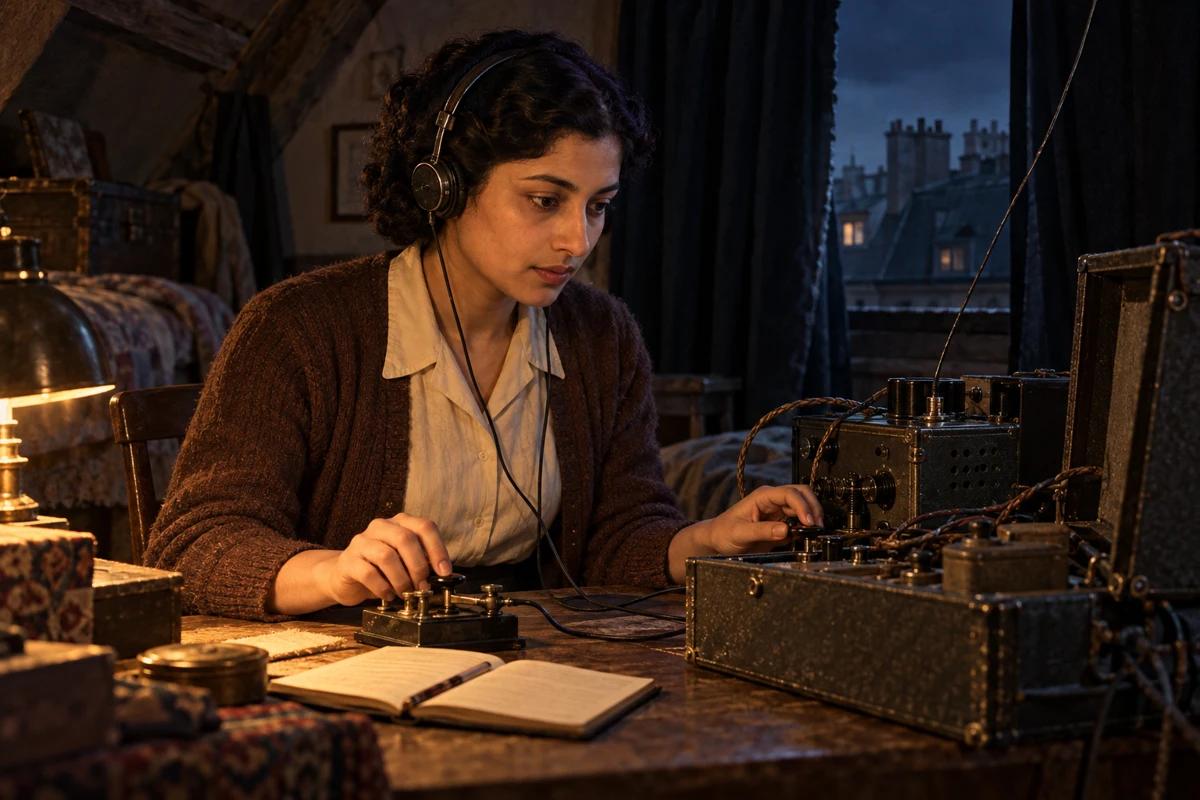
Before the war, Noor Inayat Khan wrote stories for children. In 1943, she returned to France carrying a false identity and instructions for sending secret messages to London.
Soon the agents around her were being arrested. The writer who had escaped occupied France now chose to stay there.
THE SHORT ANSWER
Noor’s fluency in French and training as a wireless operator made her valuable to Britain’s Special Operations Executive, which supported resistance in occupied countries. In June 1943 she became the first female wireless operator sent by SOE into occupied France.
Working as “Madeleine”, she maintained communications after the collapse of the Prosper network made the Paris area exceptionally dangerous. Offered a return to Britain, she chose to continue. She was captured in October 1943 and murdered at Dachau in September 1944.
WHAT WE KNOW
Noor was born in Moscow on 1 January 1914 to an Indian father, Inayat Khan, and an American mother, Ora Ray Baker, also known as Amina Begum. Her father was a musician and Sufi teacher.
The family lived in Britain before settling in France. Noor grew up near Paris, studied music and child psychology, and began writing for children. Her Twenty Jataka Tales, retellings of traditional Buddhist stories, appeared in 1939.
This was a real literary career interrupted by war. The book existed before “Madeleine” did.
After France fell in 1940, Noor escaped to Britain. She joined the Women’s Auxiliary Air Force and trained in wireless work. Her technical skills, French and familiarity with life in France subsequently brought her into SOE.
FROM STORYTELLER TO MADELEINE
Her religious upbringing valued peace. Joining the struggle against Nazism was nevertheless a conscious decision to act against oppression.
That decision did not remove the practical demands of the job. A clandestine wireless operator had to encode messages, handle equipment, maintain a convincing civilian identity and transmit without leading German search teams to the door.
Noor’s surviving mission orders put those responsibilities plainly. Dated 9 June 1943, they assigned her to work for an organiser known as Cinema, Henri Garry, in the Le Mans region, approaching the circuit through Paris.
Her papers named her Jeanne Marie Renier. Within the organisation she would be Madeleine.
The instructions also made her responsible for technical decisions about wireless security. She was to encode messages herself, limit contacts outside her circuit and keep transmissions brief.
These were safeguards for a life in which a radio could connect an agent to London and expose her location to the enemy.
A NETWORK COLLAPSES
Noor was flown into France by Lysander aircraft on the night of 16 June 1943. She did not parachute in, although that detail sometimes appears in retellings.
Soon afterwards, arrests devastated the Prosper network and disrupted the wider SOE organisation around Paris. Contacts who had seemed secure could no longer be trusted to remain free.
London offered her a way out. She asked to stay.
For roughly three months she continued wireless work while changing locations and avoiding capture. Her role became especially important as other communications links disappeared.
A 1945 report by SOE chief Colin Gubbins records that she kept moving with her equipment and maintained contact with London until her arrest in October 1943. The report recommended an honour while her ultimate fate was still unknown.
THE STORY EVERYONE TELLS
Noor is often introduced as the “spy princess”: a gentle children’s author who became an unlikely secret agent.
The contrast is memorable, but it can hide the abilities that made her useful. She spoke the language, knew the country and had trained for the technical work. Courage mattered because she possessed skills worth keeping in the field.
Another familiar description calls her the only British agent left in Paris. That is too sweeping. The more defensible claim concerns her position as a remaining SOE wireless link after the arrests, not every British intelligence operation in the city.
WHAT THE EVIDENCE ACTUALLY SAYS
The central story is WELL SUPPORTED. Her mission orders establish her assignment and identities. The later service reports support her decision to remain and the continuation of her communications.
Her captivity requires a different kind of evidence. After her arrest she attempted escape, was recaptured and was transferred to Pforzheim in Germany. She was held in isolation and treated as a dangerous prisoner.
In September 1944 she was taken to Dachau with three other women agents: Yolande Beekman, Madeleine Damerment and Eliane Plewman. They were executed on 13 September. Noor was 30.
Accounts of her final treatment and the reported last word “Liberté” come through post-war testimony and later retellings. The word should be described as reported, rather than presented as a securely recorded final utterance.
Her courage does not depend on reconstructing a speech at the moment of death.
WHY HER STORY RETURNED TO VIEW
Noor was not wholly forgotten after the war. France awarded her the Croix de Guerre, and Britain awarded the George Cross posthumously in 1949. Jean Overton Fuller’s biography Madeleine followed in 1952.
Public familiarity was another matter. Later research and campaigning helped bring her life to a wider audience. A memorial was unveiled in London’s Gordon Square in 2012, and English Heritage installed a blue plaque at 4 Taviton Street in 2020.
The children’s author and the wireless operator belong in the same biography. One tells us about the life she was building. The other records what she chose to risk when that world was threatened.
RELATED CURIOSITIES
How Did a Woman Disguised as a Man Sail Around the World?
How Did an Enslaved Man Sail a Confederate Ship to Freedom?
How Did a Woman Born Without Arms Become a Celebrated Royal Portrait Painter?
SOURCES & FURTHER READING
1. The National Archives — HS 9/836/5: Mission details for Noor Inayat Khan, 9 June 1943. Contemporary orders and transcript.
2. The National Archives — HS 9/836/5: Major Gubbins’ report, 6 October 1945.
3. English Heritage — Noor Inayat Khan (1914–1944): biography and blue plaque.
https://www.english-heritage.org.uk/visit/blue-plaques/noor-inayat-khan/
4. RAF Museum — RAF Museum displays Noor Inayat Khan’s George Cross, 3 December 2024. Includes the pilot’s logbook and flight details.
https://www.rafmuseum.org.uk/news/raf-museum-displays-noor-inayat-khans-george-cross/
5. South Asian Britain: Connecting Histories — Noor-un-Nisa Inayat Khan. Literary career and biographical bibliography.
https://southasianbritain.org/people/noor-un-nisa-inayat-khan/
6. Shrabani Basu, Second World War Experience Centre — Noor Inayat Khan – SOE. Biographical account and memorial campaign.