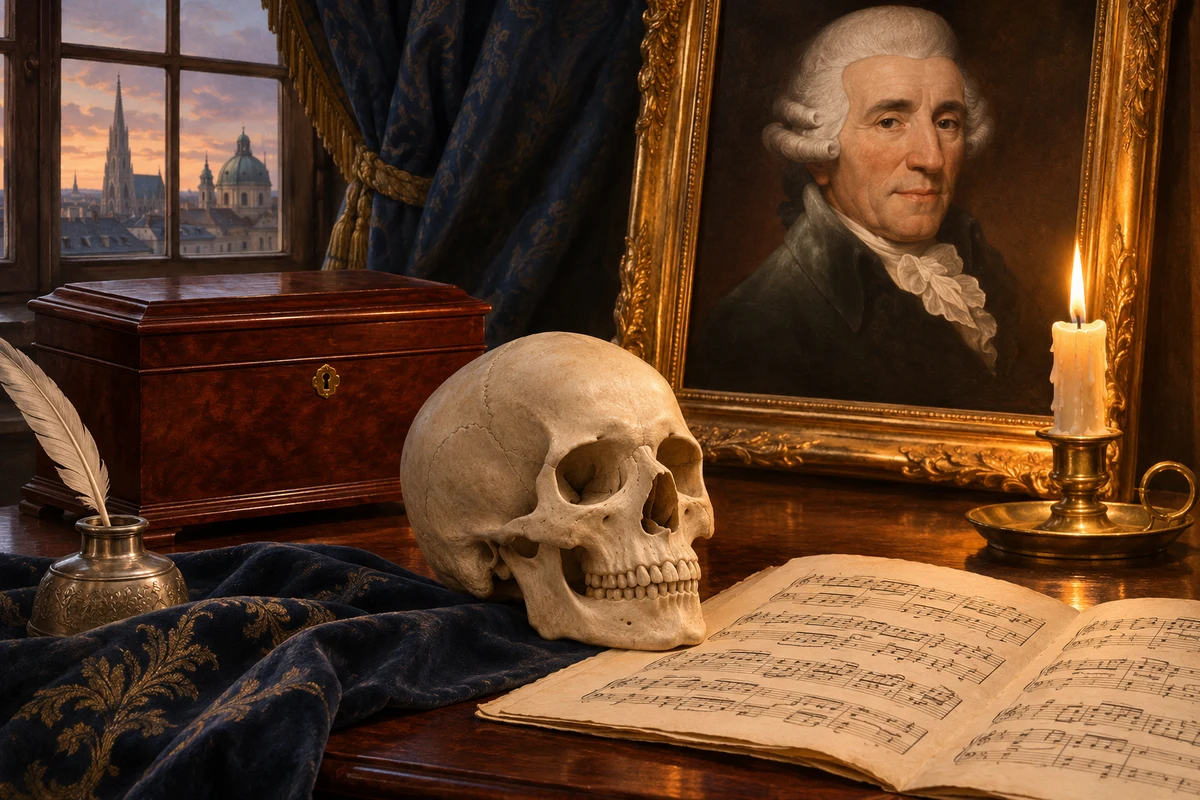
When Joseph Haydn died in 1809, admirers mourned one of Europe’s most celebrated composers. Some then found an extraordinary way to express their interest: they arranged for his head to be removed from his grave.
They hoped the shape of his skull would explain his musical genius. The result was a macabre journey through private collections and institutions that kept his head apart from his body for 145 years.
THE SHORT ANSWER
Haydn’s head was stolen shortly after his burial because followers of Franz Joseph Gall’s theories wanted to examine the skull of a musical genius.
The scheme is associated with Joseph Carl Rosenbaum, a former secretary to Prince Esterházy. Their interest belonged to the developing world of phrenology: the belief that mental qualities could be read from the shape of the skull.
The theft was real. The supposed ability to locate Haydn’s genius in the contours of his head was not.
His skull was finally reunited with his other remains in Eisenstadt in 1954.
WHAT WE KNOW
A funeral that did not end the story
Haydn died in Vienna on 31 May 1809. He was buried the following day in the Hundsthurm cemetery.
The International Joseph Haydn Foundation’s chronology records that Rosenbaum arranged for the head to be removed for examinations based on Gall’s skull theory. The theft took place within days of the burial.
This was not a search for an unknown person whose identity needed establishing. The attraction was precisely that everyone knew whose head it was.
A celebrated composer appeared to offer an unusually valuable test case. If exceptional musical ability had a recognisable physical location, surely Haydn would possess it.
The reasoning started with the answer the investigators wanted to find.
The missing head is discovered
In 1820, Haydn’s remains were transferred to Eisenstadt at the request of Prince Nikolaus II Esterházy. The move exposed the absence of the head.
Recovering the composer’s remains did not immediately recover his skull. The parish history of the Haydnkirche records that the body was eventually buried in the church crypt with a substitute head.
That detail gives the story a particularly unsettling quality. An apparently completed burial concealed an unresolved theft.
Haydn’s own head remained elsewhere.
HOW IT BECAME A HABIT
Reading a person through the skull
Phrenology promised to make the invisible visible.
Its followers connected particular mental faculties with particular regions of the brain, then treated the skull’s exterior as evidence of their development. A head could supposedly be read as a map of character, inclination and ability.
The attraction was easy to understand. Understanding a person is difficult. Measuring a surface looks reassuringly concrete.
But an observable measurement does not make the interpretation attached to it correct.
The Science Museum Group preserves a human skull marked with phrenological divisions, formerly belonging to the British Phrenological Society. Its catalogue explains how such objects were used in consultations and how the practice was dismissed as unfounded.
This is not Haydn’s skull. It is a surviving example of the kind of thinking that made his theft seem worthwhile to its perpetrators.
A marked head could appear to turn a theory into a tangible object. A famous person’s head offered something more: an apparent chance to connect known achievement with an anatomical feature.
For Haydn, public admiration became a reason why his remains were not left alone.
THE STORY EVERYONE TELLS
A skull, a hiding place and a very long delay
Popular retellings often linger over the most theatrical elements: ingenious hiding places, deceived officials and the thieves’ supposed discovery of an especially prominent region for music.
Those details help turn the episode into a dark comedy.
The central history, however, needs none of them to be extraordinary.
A composer’s head was stolen, his body was subsequently buried with a substitute, and the actual skull circulated separately for generations.
The gap between the theft and the final reunion was not a few years of confusion. It stretched from the Napoleonic era into the twentieth century.
People who had never heard Haydn perform inherited decisions about what should happen to a part of his body.
WHAT THE EVIDENCE ACTUALLY SAYS
From specimen to cultural possession
The story’s WELL SUPPORTED label applies to the theft and the documented separation and return of the skull. It does not endorse phrenology or certify every anecdote added to the episode.
Two kinds of evidence are especially useful.
First, Haydn’s institutional chronologies identify the theft and its connection with Gall’s theories. Second, the church where his remains now rest records the substitute head, the later attempts at recovery and the eventual reunion.
The parish history states that the skull reached the Gesellschaft der Musikfreunde in Vienna in 1895.
By then, its meaning extended beyond an attempted anatomical investigation. A part of a composer’s body had become something a musical institution possessed.
In 1932, Paul Esterházy commissioned a mausoleum in the Bergkirche, also known as the Haydnkirche. Building a suitable resting place still did not immediately bring the skull back.
The reunion finally took place in 1954. The sculptor Gustinus Ambrosi placed the skull in the sarcophagus with Haydn’s other remains.
The white marble tomb survives. Its musical associations include the opening notes of Haydn’s imperial hymn, incorporated into its decoration.
The theft should not be softened into an eccentric expression of respect. Whatever admiration motivated it, the act involved taking and retaining human remains.
WHY IT STUCK
The wrong place to look for music
The story joins two recognisable human impulses: wanting to understand genius and wanting to possess a physical connection with someone famous.
Phrenology offered the first a misleading method. Collecting offered the second a disturbing opportunity.
Haydn’s head moved between those interests while his music continued to be performed without it.
That is the quiet absurdity at the centre of the episode. The people examining the skull already had far better evidence of his musical ability.
They could have opened a score.
RELATED CURIOSITIES
Who Was the Woman Making Pianos in Beethoven’s Vienna?
Why Did a Sultan Own a Musical Tiger That Mauled a Soldier?
How Did a Blind Street Musician’s 1927 Recording End Up Travelling Between the Stars?
SOURCES & FURTHER READING
International Joseph Haydn Foundation — Chronicle, 1809: Haydn’s death, burial, the removal of his head and its reunion with his remains in 1954.
https://www.joseph-haydn.art/en/chronicle
Propstei- und Stadtpfarre Eisenstadt-Oberberg — Haydn-Mausoleum: the burial church’s account of the missing head, substitute, institutional custody and final reunion.
https://www.hdb-eisenstadt.at/pfarre/1040/josephhaydn/haydnmausoleum
Eisenstadt Tourism / Burgenland Tourismus — Haydnmausoleum: the 1820 transfer, the 1932 mausoleum and the 1954 burial.
https://www.eisenstadt-tourismus.at/besichtigungen/sehenswuerdigkeiten/haydnmausoleum
Science Museum Group — Human skull, marked with phrenological divisions, United Kingdom, 1821–1899, object 1999-398: surviving material evidence of phrenological practice.
Austrian Cultural Forum London — Bring me the head of Herr Haydn!: institutional background to the theft and later custody, accompanying a dramatised event. The dramatic characters are not historical evidence.