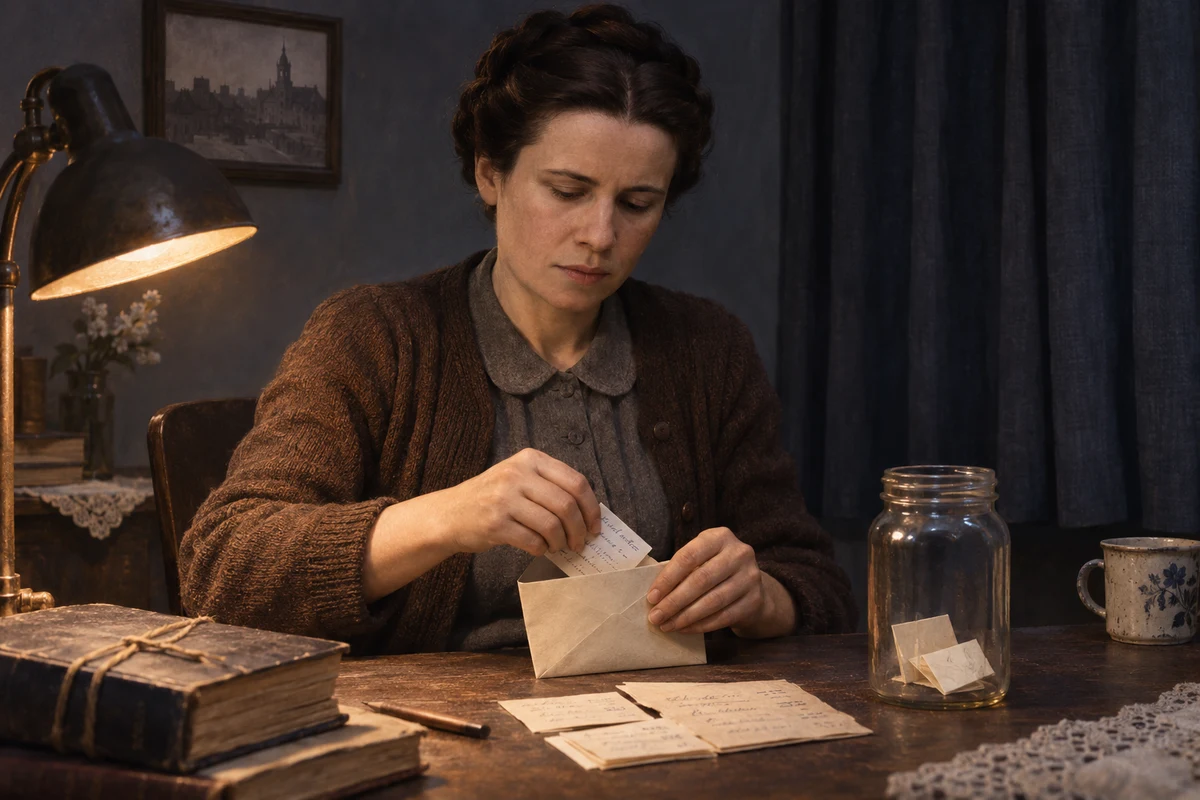
During the Nazi occupation of Poland, Irena Sendler helped Jewish children escape persecution and find safety under new identities. But she knew that survival might come at a terrible cost: children could lose their families, their names and the knowledge of where they came from. So she helped preserve the information that might one day give them their identities back.
The names that could not be forgotten
Somewhere in wartime Warsaw, lists of children's names had to be kept hidden.
They were dangerous documents.
If the German authorities discovered them, the information could expose Jewish children living under false identities, the families sheltering them and the underground workers organising their rescue.
Yet destroying the lists would create another tragedy.
Children who survived the war might never discover who they really were.
Irena Sendler, a Polish social worker working with the resistance, understood the dilemma.
Her network was helping children escape Nazi persecution, arranging false documents and finding hiding places.
But Sendler also wanted the children to have a future in which they could reclaim their real names.
The records became part of an extraordinary rescue operation.
In later years, the story would become famous as the tale of a woman who hid children's names in glass jars.
The historical reality was more complicated, more collaborative and, in many ways, even more moving.
A childhood lesson in compassion
Irena Sendler was born in Warsaw on 15 February 1910.
Her father, Stanisław Krzyżanowski, was a physician who treated patients regardless of their religion or ability to pay.
He died in 1917 after contracting typhus.
His example left a lasting impression on his daughter.
Sendler grew up in a Poland where antisemitism was a persistent feature of political and social life.
As a university student, she opposed discriminatory practices directed at Jewish students.
She later trained as a social worker and found employment in Warsaw's municipal welfare services.
Her work brought her into contact with people living in poverty and families who depended on public assistance.
These experiences gave her something that would prove invaluable during the war.
She understood how social welfare systems operated, knew people working in charitable institutions and had contacts who could help vulnerable families.
When Germany invaded Poland in September 1939, those connections became the foundations of a rescue network.
The city divided by a wall
In 1940, the German occupation authorities established the Warsaw Ghetto.
Hundreds of thousands of Jewish people were forced into a crowded district enclosed by walls and subjected to severe restrictions.
Food was desperately scarce.
Disease spread through overcrowded buildings.
Families struggled to survive under conditions deliberately imposed by the occupying regime.
Sendler used her welfare work and contacts to help Jewish residents.
She and her colleagues supplied food, money, medicines and other necessities.
Her professional position also helped her obtain access to the ghetto.
But the danger intensified dramatically in 1942.
During the mass deportations from Warsaw, German authorities sent hundreds of thousands of Jewish people to the Treblinka killing centre.
For children trapped inside the ghetto, the prospects of survival were devastatingly small.
Sendler and other members of the Polish underground began helping children escape and finding places where they could be hidden.
The impossible decision facing parents
Imagine being told that the only chance of saving your child was to send them away with a stranger.
You might never see them again.
You would not know where they were going.
You could not safely write to them or visit them.
And you might have to accept that they would be given a different name, a different family and a different public identity.
This was the terrible decision faced by Jewish parents during the Holocaust.
Some children were smuggled out of the Warsaw Ghetto through concealed routes.
Others passed through buildings with exits on both sides of the ghetto boundary.
Very young children could be hidden in boxes or transported with the assistance of medical and welfare workers.
Older children sometimes escaped by blending into groups of workers.
The methods varied according to circumstances.
There was no single secret passage or miraculous trick that made the operation possible.
Each escape required planning, trusted contacts and extraordinary courage.
And getting a child beyond the ghetto wall was only the beginning.
Saving a child meant creating an entirely new life
A Jewish child discovered outside the ghetto could be arrested and murdered.
Anyone sheltering that child also faced extreme danger.
The rescue network therefore needed safe houses, forged documents, money, clothing and adults willing to assume enormous risks.
Children were placed with Polish families, in orphanages and in religious institutions.
Some were taught new names and rehearsed stories about their supposed backgrounds.
They had to learn how to respond if questioned.
For younger children, the transition could be deeply confusing.
They were separated from their parents and placed in unfamiliar surroundings, often without understanding why.
The people sheltering them were themselves taking extraordinary risks.
Sendler's contribution was part of this much larger network of rescue.
Her contacts in social services, charitable organisations and religious institutions helped make it possible.
She worked with Polish and Jewish underground activists who shared the same determination to preserve lives.
In 1943, Sendler became head of the children's section of Żegota, the clandestine Council for Aid to Jews.
The organisation coordinated assistance for Jews hiding under German occupation.
Its work included providing money, false identity documents, medical support and shelter.
Why the children's real names mattered
The false identities were essential for survival.
But Sendler understood that they could also erase a child's past.
If a child survived the war under an assumed name, how would surviving relatives ever find them?
How would the child know where they had come from?
To address this, Sendler and her colleagues kept coded records linking children's original identities with their new names and hiding places.
The information was concealed to protect everyone involved.
Later accounts describe lists placed in bottles or jars and buried for safekeeping.
The story became a powerful symbol of the rescue operation.
But it should not be imagined as a complete register containing the names of every child helped by the network.
The surviving historical evidence does not establish such a comprehensive archive.
The lists were part of a dangerous and fragmented underground operation.
What matters most is the intention behind them.
Sendler was not simply trying to ensure that children remained alive.
She was trying to preserve the possibility that they might one day recover their own histories.
The night the Gestapo came
On 20 October 1943, the Gestapo arrested Irena Sendler.
Her underground activities had placed her in extraordinary danger.
She was imprisoned and tortured.
The German authorities wanted information about the resistance network, the people assisting Jewish families and the children being hidden.
Sendler did not reveal the information they sought.
She was sentenced to death.
For a time, it appeared that her work and her life would end in a German prison.
But Żegota organised a bribe that secured her release in February 1944.
She escaped execution.
The experience did not end her resistance work.
Living under another identity and facing continuing danger, she remained involved in helping people threatened by Nazi persecution.
Her courage was remarkable, but it was not reckless.
It depended on secrecy, organisation and the willingness of many people to protect one another.
Did Irena Sendler really save 2,500 children?
The number 2,500 appears frequently in accounts of Sendler's life.
It has become almost inseparable from her name.
But the figure requires careful explanation.
Historical institutions agree that Sendler and her colleagues helped rescue and shelter large numbers of Jewish children.
The United States Holocaust Memorial Museum specifically describes her role in helping several hundred children escape the Warsaw Ghetto.
The larger figure of approximately 2,500 is associated with the wider rescue network and the children it helped protect.
Yad Vashem notes that the precise number rescued by Sendler and her partners is unknown.
It would therefore be misleading to imagine that Sendler personally carried 2,500 children through the ghetto walls.
The achievement was collective.
It involved Jewish parents, underground organisers, couriers, social workers, foster families, religious institutions and people who provided money or false documents.
Many of their names remain little known.
Recognising their contributions does not diminish Sendler's courage.
It makes the story more remarkable.
An entire network of people chose to risk their lives for children who might otherwise have been murdered.
What happened to the children after the war?
Germany's defeat in 1945 did not bring an uncomplicated happy ending.
Many of the children rescued from the Warsaw Ghetto had lost their parents.
Some had lost almost their entire families.
Others had become deeply attached to the people who sheltered them.
The surviving identity records offered the possibility of reconnecting children with relatives and restoring knowledge of their origins.
But reunification was often impossible.
The Holocaust had destroyed so many families that there was frequently nobody left to find.
For survivors, learning their real names could bring both relief and grief.
They had survived because strangers had helped them assume new identities.
Now they faced the difficult task of understanding the lives and families from which they had been separated.
Sendler's determination to preserve their names was therefore an act of compassion extending beyond the immediate crisis.
She had considered what survival would mean after the war was over.
The woman the world almost forgot
Irena Sendler survived the war and continued living in Poland.
In 1965, Yad Vashem recognised her as Righteous Among the Nations, an honour awarded to non-Jews who risked their lives to rescue Jews during the Holocaust.
Yet her story remained relatively unfamiliar to international audiences for decades.
That began to change in the late 1990s.
A group of American schoolgirls in Kansas discovered a brief reference to Sendler while researching the Holocaust.
They developed a theatrical project called Life in a Jar.
Their work helped introduce her story to a much wider audience.
The project eventually brought the students into contact with Sendler herself.
It is a remarkable second chapter to the story.
A woman who had worked so hard to preserve other people's names was rediscovered by young people determined that her own name should not disappear.
Sendler died in Warsaw on 12 May 2008, aged ninety-eight.
The extraordinary power of remembering a name
Irena Sendler is often described as a hero.
The description is deserved, but it can sometimes obscure the human decisions behind her actions.
She was a social worker who understood how institutions functioned.
She knew how to organise practical assistance.
She recognised the importance of trusted relationships.
And when those skills became essential to saving lives, she used them.
Her story is not simply about one fearless individual performing impossible feats.
It is about the power of ordinary professional skills placed in the service of extraordinary moral courage.
The rescue network could not save every child.
The identity records could not reunite every family.
But the effort mattered.
For children who had been forced to abandon their names in order to survive, the possibility of recovering those names represented something profoundly important.
A connection to their families.
A connection to their history.
And a reminder that they had existed as individuals before persecution attempted to erase them.
Irena Sendler helped save lives. But she also understood that a human life is more than survival — it is a name, a family, a memory and the right to know who you are.
What the evidence tells us
WELL SUPPORTED: Sendler worked with the Polish underground and Żegota, helped rescue Jewish children, arranged false identities and hiding places, and was arrested and tortured by the Gestapo.
WELL SUPPORTED: She helped preserve coded information about children's original identities and their placements.
REQUIRES QUALIFICATION: The frequently cited figure of 2,500 children refers to estimates associated with the wider rescue network. The exact number rescued by Sendler and her colleagues is unknown.
POPULAR RETELLING: Stories of thousands of names buried in jars beneath an apple tree contain details that vary between accounts. They should not be presented as a complete, independently verified inventory of all rescued children.
IMPORTANT CONTEXT: Sendler did not act alone. The rescues depended on an extensive network of Jewish and non-Jewish helpers, including families who sheltered children at enormous personal risk.
Historical sources and further reading
1. United States Holocaust Memorial Museum — Irena Sendler (1910–2008).
2. United States Holocaust Memorial Museum — Irena Sendler Describes How She Was Arrested and Tortured by the Gestapo, oral history.
3. Yad Vashem — Irena Sendler, Stories of Women Who Rescued Jews During the Holocaust.
4. Jewish Historical Institute, Warsaw — 109th Anniversary of Irena Sendler's Birthday.
5. National Endowment for the Humanities — Irena Sendler and the Girls from Kansas.
6. Life in a Jar: The Irena Sendler Project — historical project archives and interviews.