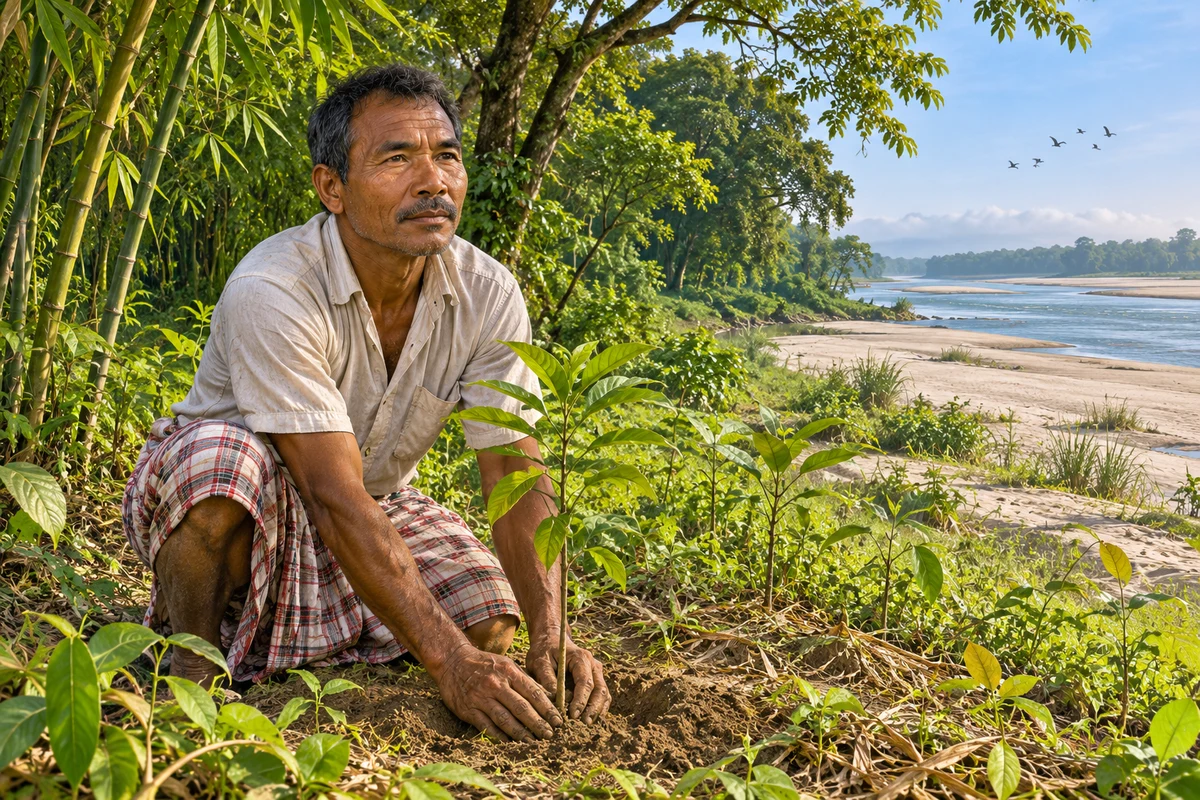
In the late 1970s, a young man in northeastern India began planting trees on a sandy stretch of land beside the Brahmaputra River. There was no grand environmental organisation behind him and no guarantee that anything would survive. Decades later, the landscape had become a forest covering hundreds of hectares, supporting wildlife and demonstrating what extraordinary patience can achieve.
The forest that should not have existed
Imagine standing on a barren sandbar beside one of the largest rivers in Asia.
There are few trees.
The ground is exposed to the sun.
During the monsoon, floodwater can sweep across the landscape, carrying away soil and vegetation.
It does not seem like a promising place to grow a forest.
Yet in Assam, northeastern India, a remarkable transformation took place.
A young man began planting trees.
He returned to tend them.
He planted more.
And he continued doing so for decades.
His name was Jadav Payeng.
Today, he is widely known as the Forest Man of India.
The woodland associated with his work, called Molai Forest, covers an area commonly reported at approximately 550 hectares.
That is substantially larger than New York's Central Park.
What makes the story extraordinary is not simply the size of the forest.
It is the persistence behind it.
Payeng continued working on a landscape that many people had regarded as too difficult to restore.
And over time, nature began doing much of the work alongside him.
A childhood beside the Brahmaputra
Jadav Payeng grew up in Assam, a region of extraordinary rivers, wetlands and forests.
He belongs to the Mising community, whose traditions and livelihoods have long been connected with the Brahmaputra River.
The Brahmaputra is both life-giving and destructive.
Its annual floods deposit fertile sediments, sustain ecosystems and support agriculture.
But the river also erodes land, changes course and destroys settlements.
Sandbars and river islands can appear, expand or disappear as the water moves.
For communities living along its banks, the landscape is constantly changing.
Payeng grew up understanding that relationship.
He knew the value of trees, shade and vegetation in a place where water and weather could transform the land.
But an experience in the late 1970s gave his interest in nature a new urgency.
The dead snakes that changed his life
According to Payeng's own account, severe flooding left numerous snakes stranded on a barren sandbar.
When the floodwater receded, the animals were exposed to intense heat.
Without sufficient shade or shelter, many died.
The sight deeply disturbed him.
Why, he wondered, should living creatures die simply because there were no trees to protect them?
He approached forestry officials about planting vegetation.
In accounts of the encounter, officials suggested that the sandy ground was unsuitable for many trees but that bamboo might survive.
Payeng decided to try.
He began planting bamboo and other vegetation.
The episode has become central to the story of his life.
It is frequently retold as the moment when a teenager decided to create an entire forest.
That version is memorable, but it simplifies the chronology.
Payeng also participated in a government-supported social forestry project launched around 1980.
The project aimed to establish trees on vulnerable riverine land.
When the initial programme ended, Payeng continued planting and tending vegetation.
His long-term commitment became the defining feature of the project.
One tree, then another
Planting a tree is simple.
Keeping it alive can be considerably harder.
Young saplings are vulnerable to drought, flooding, grazing animals and competition from other plants.
On a sandbar beside a powerful river, the challenges are particularly severe.
Payeng planted seeds and saplings, watered vulnerable young plants and protected growing vegetation.
He encouraged bamboo and other species suited to the local environment.
Over time, the first patches of greenery began changing the conditions around them.
Roots helped stabilise soil.
Fallen leaves contributed organic material.
Shade reduced the temperature of exposed ground.
Vegetation provided shelter for insects, birds and other animals.
These changes created conditions in which additional plants could establish themselves.
The landscape was beginning to change.
And as the vegetation grew, the process became increasingly self-sustaining.
When nature joined the work
One of the most interesting aspects of the Molai Forest story is that it was not created solely through the physical act of planting individual trees.
Forests are living systems.
Once vegetation becomes established, birds and mammals can carry seeds into an area.
Wind distributes seeds.
Floodwater transports plant material.
Fallen leaves and decaying vegetation improve soil conditions.
Young trees create shade that allows other species to survive.
This process, known as ecological succession, can gradually transform a landscape.
Payeng's planting and protection helped establish the conditions in which natural regeneration could take place.
That distinction is important.
The popular description of a man who single-handedly planted every tree in a vast forest is an oversimplification.
His achievement was not simply the number of trees he placed in the ground.
It was his long-term commitment to helping a damaged ecosystem recover.
He continued tending the landscape while natural processes helped expand and diversify the vegetation.
In effect, he gave nature an opportunity to rebuild.
The return of the animals
As Molai Forest developed, it began providing habitat for wildlife.
Reports have documented deer, birds, reptiles and other animals using the woodland.
Larger animals, including elephants and rhinoceroses, have also been reported in the area.
The return of wildlife is one of the clearest signs that the landscape had become more than a plantation.
It was developing into a functioning ecosystem.
Trees provided shelter and food.
Vegetation created nesting places.
A more varied landscape supported a wider range of living creatures.
The same region where Payeng had once encountered dead snakes was becoming a refuge for wildlife.
That is an extraordinary reversal.
However, the precise number of animals using the forest varies between reports.
Claims about permanent populations of particular large species should be treated carefully.
Animals may move through the forest seasonally or use it as part of a much larger habitat.
The broader conclusion remains well supported.
The restored woodland provides valuable habitat in a riverine landscape threatened by erosion and environmental change.
How large is Molai Forest?
The area associated with Payeng's work is commonly reported as approximately 550 hectares, or 1,360 acres.
For comparison, New York's Central Park covers about 341 hectares.
The reported area of Molai Forest is therefore roughly one and a half times as large.
But this comparison needs context.
Forest boundaries are not always as clearly defined as those of an urban park.
River islands change shape through erosion, flooding and sediment deposition.
Different reports may use different boundaries when estimating the area.
The figure of 550 hectares is widely cited, including in forestry-related publications, but it should be understood as an approximate measure rather than an exact permanent boundary.
The scale is nevertheless remarkable.
Hundreds of hectares of woodland developed in a landscape where establishing vegetation was exceptionally difficult.
The man who stayed when others left
One of the most revealing parts of Payeng's story concerns the early forestry programme.
Around 1980, a government-supported project began planting trees on riverine land in Assam.
Payeng worked on the project.
But after the organised work ended, he continued.
For years, he returned to the forest, planting and caring for trees without the public recognition that would eventually follow.
His persistence was unusual because ecological restoration rarely produces dramatic results quickly.
A sapling may take years to provide meaningful shade.
A woodland may take decades to develop complex habitats.
There are setbacks.
Floods destroy young trees.
Drought damages vegetation.
Animals eat saplings.
The results are not always immediately visible.
Payeng continued anyway.
His story is therefore less about a single heroic act than about thousands of ordinary acts repeated over time.
That is what makes it so inspirational.
He did not need to know exactly what the forest would eventually become.
He simply kept working towards it.
The forest that attracted the world's attention
For many years, Payeng's work remained little known outside his region.
That changed as journalists and environmental campaigners began documenting the forest.
Photographs revealed the extraordinary contrast between the surrounding riverine landscape and the dense vegetation that had developed.
News reports introduced international audiences to the Forest Man of India.
Documentary filmmakers followed.
The story spread because it offered something rare in environmental reporting.
A visible example of recovery.
At a time when headlines frequently described deforestation, habitat destruction and environmental decline, Payeng's forest demonstrated that landscapes could also improve.
The story did not suggest that one person could solve every environmental problem.
But it showed that determined local action could produce substantial ecological change.
Recognition after decades of work
In 2015, Jadav Payeng received the Padma Shri, one of India's highest civilian honours.
The award recognised his contribution to environmental conservation.
By then, his work had become internationally known.
He had been invited to speak about reforestation and environmental responsibility.
His life inspired books, documentaries and educational projects.
Yet the recognition came only after decades of patient work.
He had not begun planting trees to receive an award.
His original motivation, according to his own accounts, was the suffering of animals and the destruction of their habitat.
The award acknowledged what had grown from that concern.
A forest.
An ecological restoration project.
And an example of environmental commitment that people around the world could understand.
Did one man really plant an entire forest?
The popular version of Payeng's story sometimes suggests that he personally planted every tree in Molai Forest.
That is not a scientifically precise description of what happened.
His work began within a landscape where organised forestry efforts also took place.
Other people contributed to planting and conservation.
Natural regeneration played an essential role as vegetation became established.
Seeds were dispersed by animals, wind and water.
The growing forest helped create conditions for further growth.
Payeng's achievement is therefore best understood as long-term environmental stewardship.
He helped initiate, maintain and protect a process of ecological recovery.
The forest did not emerge overnight.
Nor was it simply a collection of individual trees.
It became a complex living system through decades of human effort and natural processes working together.
That makes the story more interesting, not less.
What Molai Forest teaches us about restoration
Modern environmental restoration is often discussed in terms of large budgets, specialist equipment and government programmes.
Those resources can be essential, particularly when dealing with severe ecological damage.
But Payeng's story demonstrates the importance of persistence and local knowledge.
He understood the landscape in which he lived.
He recognised that vegetation could protect soil and provide habitat.
He experimented with planting.
And he continued caring for the land long enough for ecological processes to take hold.
The result illustrates several principles of restoration.
Native vegetation can help stabilise vulnerable ground.
Long-term protection is often as important as initial planting.
Wildlife can contribute to the regeneration of plant communities.
And environmental recovery may take decades rather than years.
There is also an important warning.
Planting trees is not automatically beneficial everywhere.
Some naturally open habitats, such as grasslands and wetlands, should not be converted into forests.
Successful restoration depends on choosing appropriate species and understanding local ecology.
Payeng's work is inspiring because it was rooted in the needs of a particular landscape.
A forest that began with compassion
Perhaps the most remarkable aspect of Jadav Payeng's life is the simplicity of the original impulse.
He saw animals suffering.
He wanted to prevent the same thing happening again.
So he planted trees.
There was no guarantee that his efforts would succeed.
He could not have known that the small patches of vegetation would eventually become a substantial forest.
But he continued.
Over the years, the trees grew taller.
Their roots spread through the soil.
Birds arrived.
Animals found shelter.
Seeds germinated.
And the landscape gradually became something entirely different.
Today, Molai Forest stands as a reminder that environmental recovery is possible when human determination works with natural processes.
Payeng's story is not proof that one person can repair every damaged ecosystem.
It is evidence that one person's commitment can become the beginning of something much larger.
He did not set out to become famous. He set out to make a barren place habitable again. And by continuing to plant and protect trees, he helped create a forest that would outgrow his original ambitions.
Sometimes changing the world begins with planting a single tree.
The extraordinary part is returning to care for it.
And then planting another.
What the evidence tells us
WELL SUPPORTED: Jadav Payeng has spent decades planting and protecting trees along the Brahmaputra River in Assam, helping establish the woodland known as Molai Forest.
WELL SUPPORTED: Payeng received India's Padma Shri award in 2015 for his contribution to environmental conservation.
WIDELY REPORTED: Molai Forest covers approximately 550 hectares. The figure should be treated as an estimate because riverine landscapes and forest boundaries change.
BASED ON PAYENG'S OWN ACCOUNT: His decision to begin planting was inspired by seeing snakes die on an exposed sandbar after flooding.
IMPORTANT QUALIFICATION: Payeng did not necessarily plant every tree individually. Earlier forestry projects, other contributors and natural ecological regeneration also played roles in the forest's development.
COMMON OVERSIMPLIFICATION: The forest appeared entirely through one man's work without assistance from nature or other people. The more accurate story is one of sustained stewardship, ecological succession and long-term conservation.
Historical sources and further reading
1. Mongabay — One Man Plants Forest Larger Than Central Park, 2014.
2. Mongabay — Man Plants Forest, Becomes Film Star, 2014.
3. Al Jazeera — India's Forest Man, 23 January 2014.
4. Indian Council of Forestry Research and Education — Van Sangyan, profile of Jadav Payeng.
5. Government of India — Mann Ki Baat, Jadav Payeng profile and Padma Shri recognition.
6. NDTV — Meet the Man Who Planted an Entire Forest to Curb Pollution, 2015.
7. World Bank — publication discussing Payeng's forest restoration work and the Brahmaputra landscape.