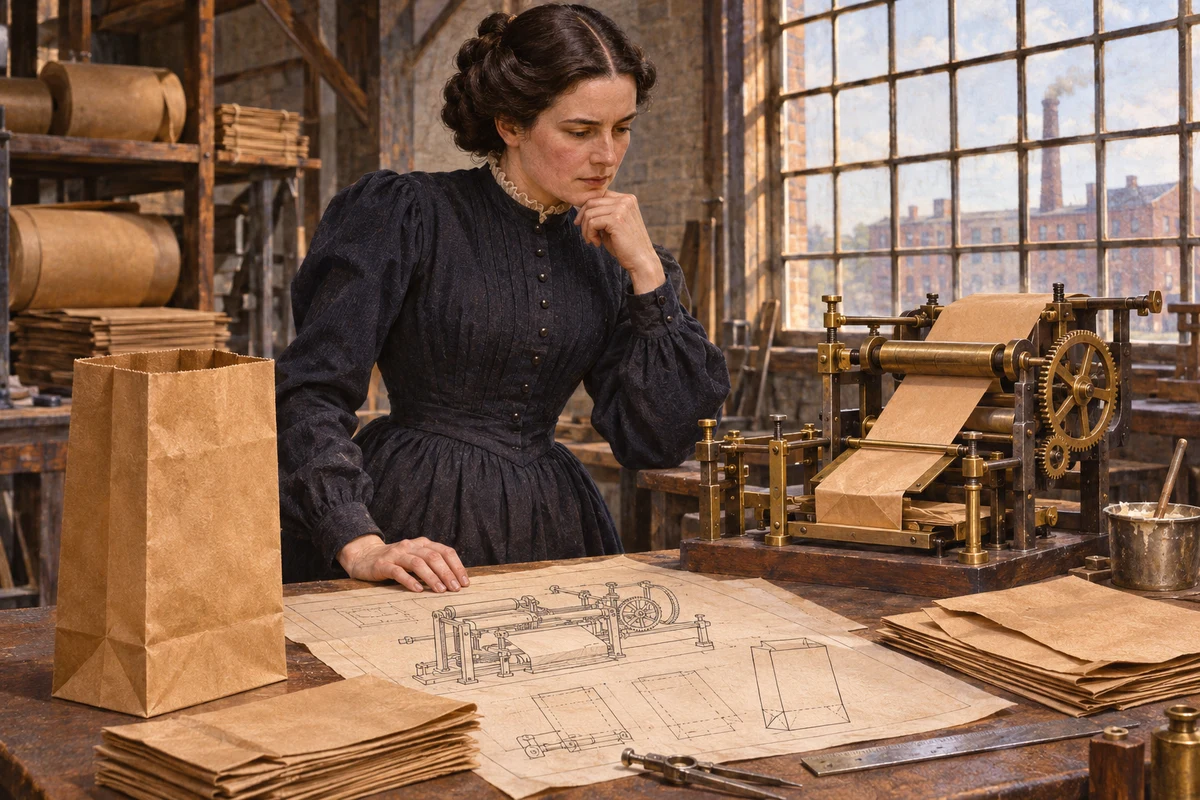
Before the familiar flat-bottomed paper bag became an everyday object, a young factory worker had to invent a machine capable of making it. Then another inventor attempted to claim her design. Margaret Knight fought back with drawings, models and evidence — and won.
The extraordinary story behind an ordinary paper bag
Pick up an ordinary brown paper bag and there is probably nothing about it that seems particularly remarkable.
It stands upright. Its flat bottom allows groceries to sit securely inside. When empty, it folds almost flat.
We take these features for granted.
But in nineteenth-century America, manufacturing such bags quickly and cheaply presented a surprisingly difficult engineering problem.
And one of the people who solved it was a woman who had spent much of her life working in factories.
Her name was Margaret E. Knight.
In 1871, she secured a patent for a machine that could manufacture flat-bottomed paper bags automatically.
But the patent came only after a dispute with another inventor who had attempted to claim a remarkably similar design.
According to later accounts, her rival argued that a woman could not possibly have devised such complicated machinery.
Knight's answer was not an angry speech.
It was evidence.
She produced the drawings, models and technical knowledge needed to establish that the invention was hers.
A girl who preferred machinery to dolls
Margaret Eloise Knight was born in York, Maine, on 14 February 1838.
Her childhood was shaped by the rapidly industrialising towns of New England.
She enjoyed making things, particularly practical objects that required mechanical ingenuity.
Accounts of her early life describe homemade sleds, kites and other inventions.
But there was little opportunity for a working-class girl to pursue formal engineering education.
After her father's death, her family moved to New Hampshire, and Knight entered factory employment while still young.
Textile mills were dangerous places.
Workers operated powerful machines fitted with rapidly moving belts, gears and shuttles. Industrial safety regulations were limited, and serious injuries were common.
Knight reportedly witnessed an accident involving a loom shuttle.
She devised a mechanism intended to prevent such accidents, although the details of this youthful invention survive chiefly in later biographical accounts rather than in a patent issued to her.
The story is revealing because it illustrates a pattern that would recur throughout her life.
Knight looked at an existing machine, identified a problem and imagined a mechanical solution.
She did not regard invention as something reserved for university-trained engineers.
To her, it was a practical response to an everyday difficulty.
The problem with nineteenth-century paper bags
By the 1860s, paper bags were already being manufactured.
But many were little more than folded paper envelopes.
They could carry lightweight objects, yet they were poorly suited to groceries or other goods that needed a stable base.
Flat-bottomed bags existed, but producing them efficiently was difficult.
Creating a square bottom required several precisely coordinated actions.
Paper had to be fed into a machine, measured, cut, folded and glued.
The bottom needed to be formed accurately enough to remain secure when the bag was filled.
Doing all this automatically was a considerable engineering challenge.
In 1867, Knight began working at the Columbia Paper Bag Company in Springfield, Massachusetts.
She recognised that a machine capable of forming square-bottomed bags could transform the business.
Over the following period, she developed a mechanism to perform the necessary operations.
By 1868, she had produced a working design.
The result was a machine capable of making the familiar flat-bottomed bags that would eventually become commonplace in shops and homes.
But developing the invention was only the beginning of her difficulties.
The man who tried to claim her machine
To obtain a patent, Knight needed a working model and technical documentation.
She arranged for machinery to be fabricated.
During this process, another inventor, Charles Annan, gained access to her design.
Annan subsequently pursued patent rights for a similar paper-bag-making mechanism.
Knight discovered that someone else was attempting to claim the invention she had developed.
For a woman working in nineteenth-century industry, this was a particularly formidable challenge.
Patent disputes required technical evidence, legal representation and the determination to confront another claimant.
Knight could have abandoned the matter.
Instead, she challenged Annan's claim.
In April 1870, her patent attorney requested an official interference proceeding to establish who had invented the mechanism first.
That request survives in the records of the United States Patent Office.
It provides unusually direct evidence of the dispute.
This was not simply a legend about an inventor robbed of recognition.
It was a documented contest over priority.
Could a woman really understand machinery?
One of the most frequently repeated details of the Knight story concerns Annan's response to her claim.
According to accounts preserved by major American museums and invention-history institutions, Annan challenged the idea that a woman could understand the mechanical complexities of the machine.
Whether every word of the familiar quotation can be established from the surviving legal record is less certain.
But the dispute itself is beyond doubt.
Knight assembled an impressive body of evidence.
She produced technical drawings, working models, notes and testimony from people familiar with her development work.
Her evidence demonstrated not merely that she had seen the machine, but that she understood its operation and had developed its underlying mechanism.
The case was decided in her favour.
On 11 July 1871, Margaret Knight received US Patent No. 116,842 for an improvement in paper-bag machines.
The patent drawings remain available today.
They reveal an elaborate mechanical arrangement designed to coordinate the movements required to create a square-bottomed bag.
The woman whose technical ability had been questioned had proved her case through engineering.
A patent was not the end of her ambitions
Knight did not regard her victory as the end of her career.
She helped establish the Eastern Paper Bag Company in Hartford, Connecticut.
Her invention made it possible to manufacture useful paper bags at industrial scale.
The importance of this achievement is easy to underestimate.
A flat-bottomed bag can stand on a counter while goods are placed inside.
It makes packaging, carrying and storing products more convenient.
It can also be manufactured from inexpensive material and transported efficiently before use.
These advantages helped establish the flat-bottomed paper bag as an important commercial object.
Knight's contribution was not the invention of paper packaging itself.
Nor was she the first person ever to produce a flat-bottomed bag.
Her achievement was developing a practical automated method of manufacturing such bags.
That distinction is essential to understanding why her invention mattered.
The inventor who never stopped inventing
Knight continued experimenting with mechanical devices throughout her life.
Her later patents covered a surprisingly wide range of technologies.
They included improvements associated with footwear manufacturing, window mechanisms and engines.
By the time she died in 1914, she had received more than two dozen patents.
Her career challenges the familiar image of nineteenth-century women inventors as occasional amateurs who happened upon one useful idea.
Knight was a sustained and technically capable inventor.
She worked across different mechanical problems and repeatedly translated her ideas into patentable designs.
Yet she never enjoyed the public recognition given to many male inventors of her generation.
The objects produced by her machines became familiar.
The woman behind them largely disappeared from popular memory.
What really happened in the patent dispute?
The most dramatic version of Margaret Knight's story is often presented as a simple confrontation.
A man stole a woman's invention, declared that women could not invent complicated machinery and was defeated in court.
The underlying story is substantially supported.
There was a genuine dispute over a paper-bag machine.
Knight supplied evidence establishing her priority.
She obtained the patent.
But some popular retellings compress the legal process into a theatrical courtroom scene, sometimes supplying dialogue that is difficult to verify word for word.
The surviving Patent Office documents are more valuable than any dramatic quotation.
They show how Knight used the legal mechanisms available to her to defend her work.
They also reveal that nineteenth-century women could be active participants in sophisticated industrial invention, even when their opportunities were restricted.
The story does not need embellishment.
A factory worker developed an important machine, challenged a competing patent claim and established her rights through technical evidence.
That is remarkable enough.
The woman behind the paper bag
Margaret Knight died on 12 October 1914.
Today, her name appears in museums, histories of invention and accounts of pioneering women engineers.
She was inducted into the National Inventors Hall of Fame in 2006.
But her greatest legacy remains something most people encounter without thinking about it.
The ordinary flat-bottomed paper bag.
Its familiar shape is the result of engineering, experimentation and industrial ingenuity.
And its history includes a woman who refused to surrender credit for her work.
The next time you see a paper bag standing upright on a shop counter, remember that one of the most ordinary objects in modern life carries an extraordinary story of invention, determination and a battle for recognition.
What the evidence tells us
WELL SUPPORTED: Margaret Knight developed a machine for manufacturing flat-bottomed paper bags, challenged Charles Annan's competing claim and received US Patent No. 116,842 in 1871.
WELL SUPPORTED: She continued inventing and received numerous additional patents during her lifetime.
REQUIRES QUALIFICATION: The precise wording of Annan's alleged statement that women could not understand machinery. The discriminatory argument is reported by reputable institutions, but popular dialogue should not be presented as a verified verbatim transcript without reference to the original proceedings.
COMMON MISCONCEPTION: Knight invented the paper bag itself. Her major achievement was the automated production of flat-bottomed bags.
Historical sources and further reading
1. United States Patent No. 116,842, Improvement in Paper-Bag Machines, 11 July 1871.
2. US National Archives, Margaret Knight patent interference records, including the April 1870 request challenging Annan's claim.
3. Smithsonian American Women's History Museum, Margaret Knight Invented a Machine that Shapes the Way We Shop.
4. Smithsonian National Museum of American History, Putting a Face to the Invention.
5. National Inventors Hall of Fame, Margaret E. Knight.
6. MIT Lemelson, Margaret Knight.