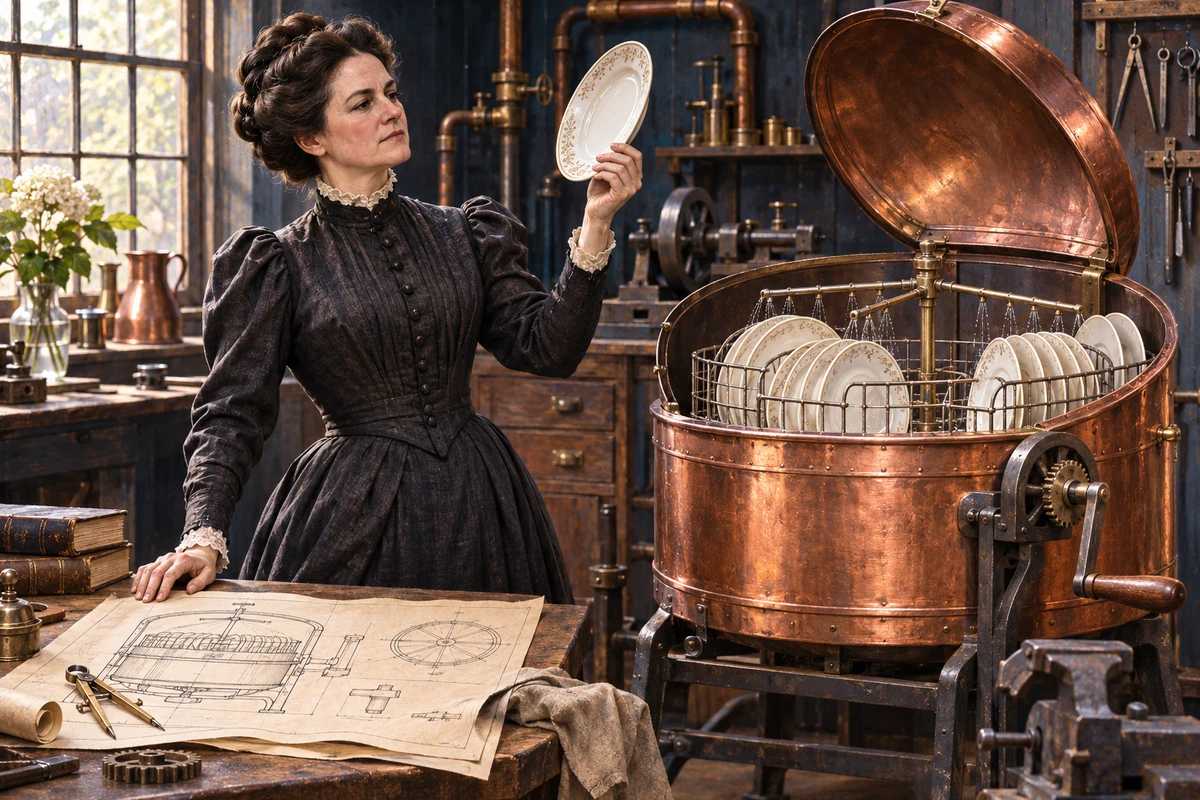
Josephine Cochrane did not simply invent a household convenience. In the 1880s, she designed a machine that manufacturers doubted, customers barely understood and most homes could not accommodate. Yet her invention helped change the modern kitchen forever.
A broken plate and a remarkable idea
Some inventions begin with scientific breakthroughs. Others begin with an irritation at the dinner table.
According to the familiar story, Josephine Cochrane was tired of discovering that her expensive china had been chipped while being washed by household servants.
She had a simple question: why couldn't a machine do the job more carefully?
It sounds like a small domestic complaint. But the answer would eventually change kitchens across the world.
There is, however, an intriguing complication.
The story of the careless servants was one Cochrane herself helped popularise. Modern historians have questioned how accurately it reflected her actual household circumstances.
What is beyond doubt is that she developed a commercially successful mechanical dishwasher when almost nobody believed such a machine had a future.
And she did it in an industry dominated by men.
An inventor without an engineering degree
Josephine Garis was born in Ohio in 1839 and later settled in Shelbyville, Illinois, after marrying William Cochran.
Her family had connections to engineering and invention, but Josephine had no formal mechanical engineering training.
She lived in a period when respectable middle-class women were expected to supervise domestic affairs rather than manufacture machinery.
Nevertheless, she began imagining a device capable of washing dishes without the repeated handling and scrubbing involved in ordinary washing-up.
The challenge was more complicated than it appeared.
A machine would need to hold fragile cups, saucers and plates securely, expose them to sufficient water pressure and clean them without breaking them.
Earlier inventors had already attempted mechanical dishwashing. Josephine was not the first person to imagine the idea.
Her achievement was developing a practical design that could become a viable commercial product.
The machine that washed dishes with water
Cochrane's central insight was to use directed water pressure rather than mechanical scrubbing.
She designed specially shaped wire compartments to hold different kinds of tableware.
These were arranged inside a rotating mechanism enclosed within a washing chamber. Water was directed over the dishes to remove food and grease.
She worked with a mechanic named George Butters to construct and refine the machine.
The collaboration was important: Cochrane provided the concept, design direction and entrepreneurial drive, while Butters contributed practical mechanical expertise.
In 1883, her husband died, leaving financial difficulties that made the success of her invention increasingly urgent.
The machine was no longer merely a clever household project.
It was an opportunity to support herself and her family.
On 28 December 1886, US Patent No. 355,139 was granted for her dish-washing machine.
The patent drawings survive.
They show that the familiar principle of placing dishes securely inside a chamber and cleaning them with directed water was already recognisable more than a century before modern dishwashers became commonplace.
A woman who refused to let manufacturers take control
Inventing the dishwasher was only part of Cochrane's challenge.
Getting it manufactured proved almost as difficult.
She encountered engineers and businessmen who doubted her technical judgement.
In a 1912 newspaper interview, she recalled the frustration of dealing with men who insisted on changing her designs before eventually accepting that her solutions worked.
Her experience reveals an important distinction between inventing something and persuading the world to use it.
A patent did not guarantee commercial success.
She needed skilled workers, reliable manufacturing, customers willing to pay and a machine that could withstand repeated operation.
Rather than surrender control, she established her own manufacturing operation.
She became not just an inventor but a businesswoman overseeing production, marketing and sales.
The dishwasher goes to the World's Fair
In 1893, Chicago hosted the World's Columbian Exposition.
The enormous fair celebrated technological innovation, industrial progress and the possibilities of a rapidly changing world.
Among the exhibits was Josephine Cochrane's dishwasher.
Her machine received an award recognising its mechanical construction, durability and suitability for its purpose.
For an inventor who had struggled to convince manufacturers to take her seriously, this was an extraordinary achievement.
But the award did not mean that American households immediately rushed to purchase dishwashers.
Quite the opposite.
Why nobody wanted a dishwasher at home
Cochrane had invented a machine ahead of the infrastructure needed to make it convenient.
Many nineteenth-century homes lacked the reliable hot-water supply required for effective mechanical dishwashing.
The machines were expensive, relatively large and unfamiliar.
Domestic washing-up was also embedded in established household routines.
A mechanical dishwasher could appear extravagant rather than essential.
Hotels, restaurants and institutions, however, faced a different problem.
They handled enormous quantities of crockery every day.
For them, a machine that could wash dishes efficiently and consistently offered an obvious commercial advantage.
These businesses became an important market for Cochrane's invention.
The device that would eventually become a familiar domestic appliance initially found much of its success outside the home.
Did servants really inspire the invention?
The broken-china story remains one of the most repeated anecdotes in the history of household technology.
According to Cochrane's own accounts, careless washing damaged valuable tableware and encouraged her to devise a better method.
The explanation is plausible.
But historical research has raised questions about the scale of the household staff she described.
Census evidence does not clearly support the image of a grand household employing numerous servants.
Cochrane was also a capable publicist who understood how to tell a memorable story about her invention.
That does not establish that the anecdote was invented.
It does mean that it should be treated as her account rather than an independently proven origin story.
The stronger evidence lies in her patents, manufacturing activity, exhibition records and surviving advertisements.
Those documents reveal a woman whose achievement was considerably more substantial than simply becoming annoyed by a broken plate.
The invention that outlived its inventor
Josephine Cochrane died in Chicago in 1913.
By then, she had spent decades developing and promoting her machines.
The company and technology associated with her work eventually became part of the history of KitchenAid.
But the dishwasher's great domestic breakthrough came long after her death.
During the twentieth century, improved plumbing, reliable hot-water systems, better detergents and changing expectations about household labour helped make dishwashers increasingly practical.
By the 1950s and 1960s, they were becoming established appliances in American homes.
Cochrane had not lived to see that transformation.
Nevertheless, the fundamental principle behind her machine survived.
The forgotten woman behind an everyday convenience
Today, loading a dishwasher is one of the most ordinary household activities imaginable.
Few people stop to consider the woman who helped make it possible.
Josephine Cochrane was not the first inventor to attempt mechanical dishwashing, nor did she single-handedly create every feature of the modern appliance.
Her accomplishment was something more specific and historically significant.
She developed an effective water-pressure design, obtained patents, organised manufacturing and built a market for a machine that most households were not yet equipped to use.
The popular story remembers a woman annoyed by broken china.
The historical record reveals an inventor who understood engineering, business and the importance of refusing to abandon an idea.
Sometimes the most remarkable part of an invention is not the machine itself, but the determination required to convince the world that it belongs there.
What the evidence tells us
WELL SUPPORTED: Cochrane's 1886 patent, collaboration with George Butters, commercial manufacturing and recognition at the 1893 Chicago exposition.
PLAUSIBLE BUT NOT INDEPENDENTLY ESTABLISHED: The familiar claim that repeated breakages by numerous household servants directly inspired the invention.
MISLEADING: The claim that Cochrane invented the first dishwasher of any kind. Earlier mechanical designs existed, but hers was a major commercially successful development.
Historical sources and further reading
- United States Patent No. 355,139, Dish-Washing Machine, granted 28 December 1886.
- National Inventors Hall of Fame — Josephine Garis Cochran.
- MIT Lemelson — Josephine Cochrane.
- Smithsonian Magazine — This Time-Saving Patent Paved the Way for the Modern Dishwasher.
- HISTORY — Who Invented the Dishwasher? (2024; updated 2025).