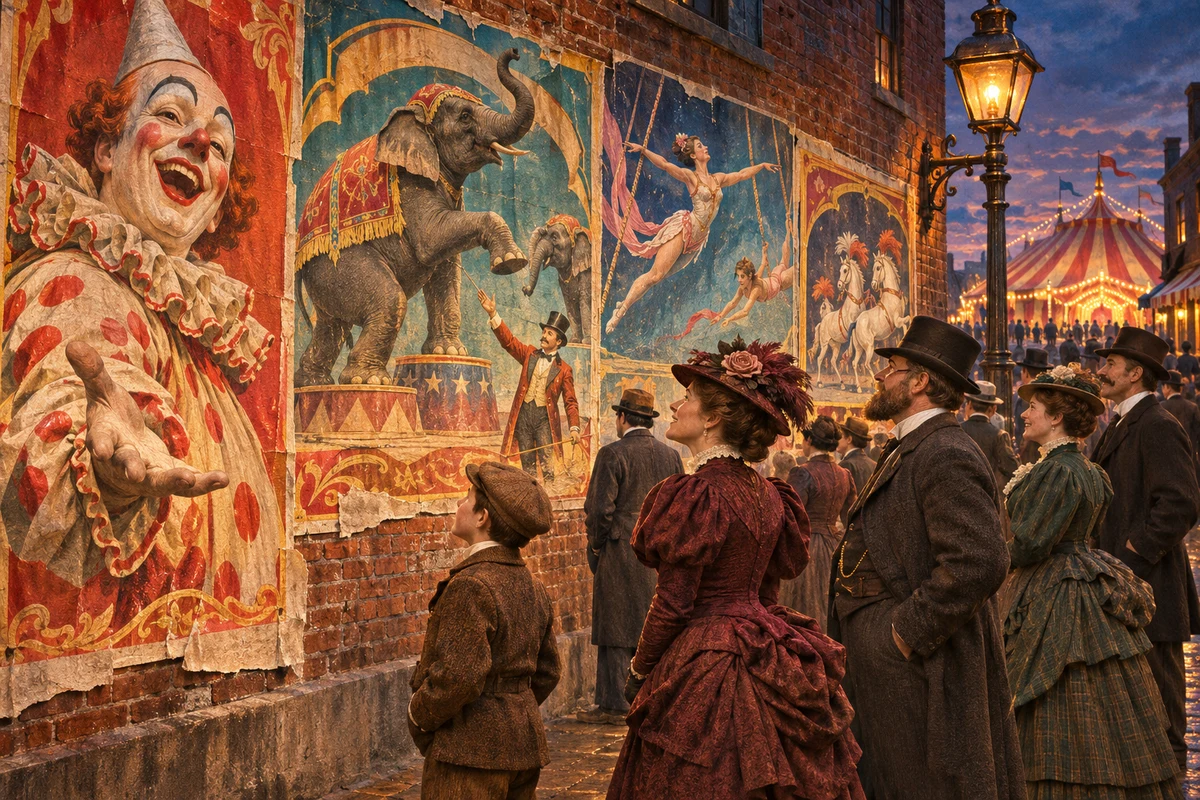
Before a Victorian circus arrived, its promises were already plastered across the town: impossible acrobats, extraordinary animals and people presented as wonders of nature. The posters were magnificent works of art. But what, exactly, were they selling?
The Circus Arrived Before the Circus
Imagine walking through an American town in the 1890s and discovering that an ordinary brick wall had disappeared beneath a riot of colour.
There were elephants standing on their hind legs. Acrobats apparently suspended in mid-air. Horses leaping through impossible formations. Performers dressed in glittering costumes, surrounded by declarations of astonishing feats.
And everywhere, words promising something greater, rarer or more extraordinary than anything the town had previously witnessed.
The circus might not arrive for another week. But its advertising had already transformed the street.
In an age before television, cinema advertising and social media, the travelling circus had developed an extraordinarily effective method of capturing attention: enormous, brilliantly coloured posters.
Some were so large that they covered the sides of buildings.
And some promised attractions that sounded almost beyond belief.
A Poster Nearly Twelve Feet Wide
One of the most remarkable surviving examples dates from 1856.
Its title was Five Celebrated Clowns Attached to Sands, Nathans & Company's Circus.
The original measured approximately 262 by 343 centimetres, or nearly twelve feet across.
Rather than being produced as a single sheet, it was assembled from ten sections of paper. Its vivid colours were printed using forty hand-carved wooden blocks.
The designer, Joseph W. Morse, helped develop methods for producing large theatrical advertisements.
The poster was intended to be seen from a distance, perhaps attached to a barn or the side of a building.
It was not subtle advertising.
Five enormous clowns, each nearly life-size, confronted passers-by in extravagant costumes and theatrical poses.
A contemporary newspaper advertisement identified the performers as Sam Welser, Ben Huntington, Toney Bliss, Bob Connor and Fred Denzor.
These were real entertainers, but the poster enlarged their presence to an almost monumental scale.
The remarkable object survives because a copy was deposited for copyright registration.
Most advertisements of this kind were temporary paper objects, designed to be pasted up, exposed to the weather and eventually destroyed.
The poster was not intended to last for generations. It was intended to stop people in their tracks.
When Printing Became Part of the Spectacle
By the late nineteenth century, colour lithography had transformed circus advertising.
Printing firms such as the Strobridge Lithograph Company of Cincinnati produced elaborate posters for major American circuses.
Instead of simply announcing performers and dates, these advertisements presented miniature theatrical worlds.
A single image could contain numerous acts, elaborate scenery, exotic animals and cheering audiences.
The composition was often crowded deliberately.
There was always another detail to discover.
The result was a kind of visual overload that made the circus appear inexhaustible.
One poster might show a sequence of elephant tricks. Another might advertise daring riders, extraordinary performers or animals performing seemingly impossible feats.
The images did not necessarily depict a single moment that an audience could witness.
They could combine separate attractions into one spectacular composition.
The poster was selling an experience larger than everyday life.
The Language of the Impossible
Circus promoters understood that ordinary descriptions would not suffice.
An elephant was not merely an elephant. It could become the greatest animal ever exhibited.
A performer was not simply unusually skilled. They might be presented as a marvel of physical nature.
A travelling show was not just entertainment. It was an event of unprecedented magnificence.
In 1899, Barnum & Bailey advertised a collection of performers as:
"The Peerless Prodigies of Physical Phenomena."
The surviving chromolithograph, preserved by the Library of Congress, depicts numerous performers presented on a stage before an audience.
The language borrowed the vocabulary of science and natural history while promising the excitement of theatrical spectacle.
The advertisement demonstrates how promoters packaged difference, rarity and novelty as something audiences could purchase the opportunity to see.
The effect was deliberate.
A spectator was not simply being invited to watch a performance.
They were being promised an encounter with the extraordinary.
The Darker Side of the Colourful Picture
Not everything advertised by Victorian circuses was harmless entertainment.
Many shows included exhibitions of people whose bodies, backgrounds or physical characteristics were presented as unusual.
Other attractions promoted people from distant countries using the language and stereotypes of colonial-era anthropology.
The advertisements reveal attitudes that can be deeply uncomfortable to modern readers.
Some performers found opportunities for income, professional recognition or a degree of independence.
Others faced exploitation, misrepresentation and restrictive working conditions.
The poster rarely reveals which experience lay behind the painted image.
It tells us what the promoter wanted the public to see.
That is not necessarily the same as what the performer wanted to communicate.
And this distinction is particularly important when examining the history of Victorian sideshows.
A spectacular poster might advertise a human being as a scientific curiosity, while revealing almost nothing about that person's actual life.
The Circus That Claimed to Educate
One of the most revealing developments in nineteenth-century entertainment was the way circus advertising sometimes borrowed the authority of science.
Promoters advertised collections of people, animals and unusual objects using terminology associated with natural history, geography and anthropology.
The implication was that spectators were doing something more respectable than simply satisfying their curiosity.
They were learning about the world.
Such claims could be genuinely educational in some circumstances, but they could also disguise exaggeration, racial stereotyping or outright invention.
A performer advertised as an extraordinary representative of a distant culture might be presented through a biography created largely for commercial purposes.
The audience had little means of verifying the story.
This was one of the great advantages of travelling entertainment.
The show arrived, made its claims, collected its admission money and moved on.
The advertisement might remain in local memory long after the circus had disappeared.
The Poster Was Part of the Performance
The most revealing aspect of Victorian circus advertising is that it did not simply describe a show.
It helped create the show.
Before anyone bought a ticket, the audience had already encountered a carefully constructed world of wonder.
The poster established expectations.
It made the circus appear enormous, mysterious, dangerous and unforgettable.
Its exaggerated language was not incidental. It was central to the commercial appeal.
Even when a performance was genuinely extraordinary, the advertisement encouraged spectators to imagine something more.
The circus existed first in the imagination.
Only later did it appear beneath the canvas.
And there was another clever element to this strategy.
A poster displayed in a public street could attract people who had no intention of attending the circus.
They might stop to admire the artwork, discuss the strange performers or repeat the remarkable claims to friends.
In this way, the advertisement became a public spectacle of its own.
The entire town could participate in the excitement before a single ticket had been sold.
What the Surviving Posters Really Tell Us
Today, these advertisements are often admired as beautiful examples of Victorian graphic design.
Their reds, golds, elaborate lettering and densely packed illustrations make them enormously appealing historical objects.
But they are also records of commercial persuasion.
They reveal what promoters believed would excite an audience, what society regarded as unusual and how spectacle could be transformed into profit.
They are evidence of promises rather than automatic proof of performances.
That distinction matters.
A surviving poster may establish that an attraction was advertised, but it does not necessarily prove that the advertised feat occurred exactly as described.
To discover what audiences actually witnessed, historians must compare the advertising with contemporary newspaper reports, programmes, eyewitness accounts and performers' own recollections.
The poster tells us what people were encouraged to expect.
The historical record may reveal something quite different.
And perhaps that is the most interesting quality of these extraordinary objects.
Long before modern advertising promised experiences beyond imagination, Victorian circus promoters had mastered the art of making the impossible seem only one ticket away.
The Strange Truth
Victorian circus posters were not simply selling entertainment.
They were selling the expectation of astonishment.
Their magnificent artwork and extravagant promises transformed ordinary streets into previews of extraordinary worlds.
Some of those worlds contained genuine feats of remarkable human skill.
Others depended on exaggeration, theatrical illusion or the exploitation of human difference.
But all relied on the same principle.
The greatest spectacle began before the audience ever entered the tent.
Historical Sources and Further Reading
Library of Congress — Five Celebrated Clowns, 1856
An extraordinary multi-sheet circus poster, produced using hand-carved wooden printing blocks.
https://blogs.loc.gov/loc/2017/10/pic-of-the-week-caring-for-the-librarys-oldest-poster/
Library of Congress — Barnum & Bailey Human Curiosities, 1899
A surviving chromolithograph advertising performers presented as extraordinary physical phenomena.
https://www.loc.gov/item/95501056/
Victoria and Albert Museum — Circus Collection
Historical material documenting British circus performance, advertising and entertainment culture.
https://www.vam.ac.uk/collections/circus
University of Sheffield — Circus Collections
Historical circus posters, programmes and printed ephemera.
https://archives.shef.ac.uk/repositories/2/archival_objects/13472