How a Victorian poet married in secret, went home to her father and left a week later with her maid and her dog.
By David Elford · 23 November 2026
On Saturday 12 September 1846, Elizabeth Barrett left 50 Wimpole Street with her maid, Elizabeth Wilson. At St Marylebone Parish Church she married Robert Browning. Then she went back to her father’s house.
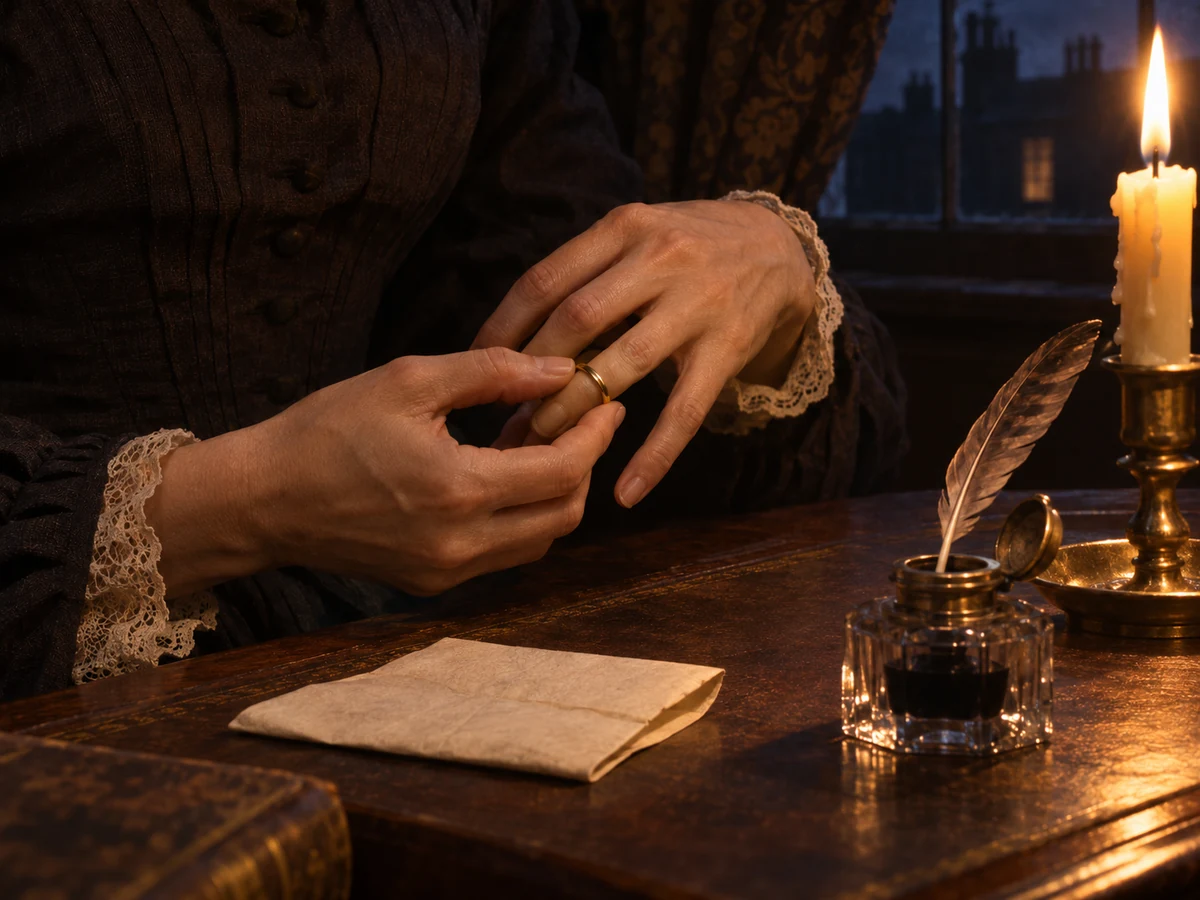
“I did hate so, to have to take off the ring!” she wrote to Robert in her first surviving letter after the ceremony. She told him he would have to put it on again one day. For a week, she lived at the same address as before, with a marriage to keep quiet and arrangements to make for a journey out of England.
A caption circulating online says that Barrett was bedridden and believed to be dying when she married, then “disappeared without a trace”. She had indeed spent long periods confined by illness, and the wedding really was a secret. We can follow her out of London almost stop by stop. By the time she reached Paris, London newspapers were announcing whom she had married.
The room at Wimpole Street
Elizabeth Barrett was born on 6 March 1806, the eldest of twelve children. Her family’s wealth came from Jamaican sugar estates that relied on enslaved labour. She had been writing since childhood, and her 1844 collection Poems made her one of Britain’s best-known poets.
Chronic illness kept her indoors for long stretches. The loss of her brother Edward, who drowned in 1840, deepened her retreat. She took opiates for her symptoms, and much of her writing and correspondence came from the room in Marylebone where she spent so much of her time. “Bedridden” gives a fair impression of some periods of her life. By September 1846 she was well enough to go out, and had been doing so before the wedding.
There was another constraint at Wimpole Street. Edward Barrett Moulton-Barrett opposed his children marrying. His opposition had consequences for those who married anyway, but his reasons are harder to establish. Elizabeth knew what it would cost to defy him. When she wanted to spend the winter in a warmer climate for her health, he refused to let her go. She did have investments of her own. Their income gave the couple a way to contemplate a life together even if her father cut her out of his will.
The man who wrote first
The first letter from Robert Browning bears a postmark of 10 January 1845. “I love your verses with all my heart, dear Miss Barrett,” he began. Further down he added, “and I love you too.” He was thirty-two and had never met her. He had read her poems, including one in which she had mentioned his work, and wanted her to know what they had done to him.
She answered the next day. They wrote for four months before she received him at Wimpole Street on 20 May. There were dozens more visits, alongside letters that went on almost daily. Wellesley College describes its holdings as 573 courtship letters. Baylor’s collaborative digital collection counts 574 in the exchange, which takes in the week after the wedding. Either archive puts the reader unusually close to the decisions the two of them had to make.
A cab into the East End
Early that September, someone snatched Elizabeth’s cocker spaniel, Flush, near her carriage while she was out shopping. Pet thieves in Victorian London could make money by demanding a ransom from an owner who wanted a dog back. Flush had been stolen before, and Elizabeth knew the business well enough to recognise what was happening.
She and Wilson went by cab into the East End to find the man who had promised to recover him. Elizabeth’s letter of 6 September records the cabman stopping at a public house to ask directions, and strangers gathering around the cab. When they urged her to get out and wait, Wilson tugged at her dress to keep her inside. The man they had come to see was away. Someone else carried the money on a later errand, and Flush came home. Another angle on private lives and Victorian keepsakes comes from the belongings Catherine Eddowes carried.
Elizabeth put the ransom at six guineas. Her letter records what happened next with a dog owner’s precision. Flush ran to her door and drank three cupfuls of water. Within a week, she would be out again with Wilson, this time with Browning waiting for her.
A wedding and two journeys home
Elizabeth’s sisters Arabella and Henrietta knew of the relationship and kept it quiet. At St Marylebone on 12 September, Wilson stood witness for Elizabeth, and Robert’s cousin James Silverthorne stood witness for him. Afterwards, Robert went back to his family and Elizabeth to Wimpole Street. She took off the ring.
The surviving letters from that week move between delight, anxiety and practical arrangements. Elizabeth had to go on living in her father’s house while preparing to leave it. In a letter postmarked 16 September she discussed the names and addresses for the marriage announcements. The arrangements for telling people were already under way while the household was still in the dark.
On 19 September, she went out with Wilson and Flush. They met Robert at Hodgson’s bookshop in Great Marylebone Street, travelled to Southampton and took the crossing to Le Havre. From there they travelled through France and made their first home in Italy at Pisa.
On Monday 21 September, The Times printed their names in its marriage notices. It gave the church, the officiating clergyman and Elizabeth’s father’s address. A story about a final family meal before the departure remains unverified. A bookshop rendezvous, a spaniel and an announcement in the newspaper are all on the record.
Letters returned unopened
Elizabeth’s father disinherited her and refused to resume contact. She kept writing to him. Her letters came back unopened. In 1850, when she republished Poems in an expanded edition, she kept the dedication to him from 1844. He died in 1857 without reconciling with her.
Elizabeth’s health improved after she moved to Italy, although illness continued to interrupt her life. She and Robert settled at Casa Guidi in Florence. On 9 March 1849, three days after her forty-third birthday, their son Robert Wiedeman Barrett Browning was born. The family called him Pen. She followed the struggle for Italian independence closely and made it part of the work she wrote there.
Among the poems she published in 1850 were the love sonnets she had written during the courtship. Robert encouraged her to publish them. Sonnets from the Portuguese gave a private sequence the appearance of a translation. Its most famous question, “How do I love thee? Let me count the ways”, travelled rather further than the original letters.
The step at Marylebone
Elizabeth died in Florence on 29 June 1861, aged fifty-five. Robert returned to England with Pen. A local tradition says he went back to St Marylebone on wedding anniversaries when he could and kissed a step. That story comes to us as a tradition. The ring has a better source.
In her own letter, Elizabeth says she took it off and hated doing it. She had already gone through with the wedding. What she wanted now was to be able to wear the ring. Compare this with the story of the ring finger’s vein of love and the rise of the white wedding dress.
What the evidence supports
- A long illness confined Elizabeth to her room for periods. Documented. Her outings in September show she could leave the house.
- Her family expected her to die imminently. Unverified as a claim about the whole household in September 1846.
- Her father opposed his children marrying. Documented. His motives remain uncertain.
- There were 573 courtship letters. Wellesley gives 573. Baylor lists 574 for the exchange through the week after the wedding.
- Flush was stolen, and Elizabeth went looking for him herself. Documented in her letter of 6 September. An intermediary made the successful ransom payment.
- She married on 12 September, took off the ring and left a week later. Documented. Where she put the ring is unknown.
- She disappeared without a trace. False. Her route is recorded and the marriage appeared in The Times on 21 September.
- She shared one last family meal before leaving. Unverified.
- Robert kissed the church step on visits after her death. Reported local tradition.
Sources and further reading
- Robert Browning’s first letter to Elizabeth Barrett, postmarked 10 January 1845
- Elizabeth Barrett’s letter about the search for Flush and his return, 6 September 1846
- Elizabeth’s letter about removing the ring, postmarked 14 September 1846
- The marriage announcement in The Times, transcribed by the editors of The Brownings’ Correspondence
- Wellesley College’s Browning Collection and Baylor University’s collaborative Browning Letters collection
- English Heritage, Elizabeth Barrett Barrett and 50 Wimpole Street
- Marjorie Stone, Elizabeth Barrett Browning, Oxford Dictionary of National Biography
- The Poems of Browning, chronology of the journey from London to France
- The Victorian Web, St Marylebone Parish Church and the tradition of Robert’s return visits