The Victorian woman the internet keeps giving the wrong face
An online portrait offers Catherine Eddowes a face the historical record cannot verify. An inquest offers something more intimate. It tells us what she did with half a crown, what she kept in a mustard tin and what she carried in her pockets.
The face in the photograph
The woman has a neat centre parting and a calm expression. In the sort of portrait that gets pinned to an online board of Victorian photographs, a caption supplies the rest. Catherine Eddowes.
The known photographs of Eddowes were taken after her death. Neal Shelden, who traced her descendants and published a short biography in 2003, looked for a photograph of her in life and came away with family photographs, including one of her granddaughter, Catherine Sarah Hall. That gives us a documented photograph of a relative. The sitter in the circulating portrait remains unidentified, and there is no verified lifetime photograph of Eddowes to compare it with. Other stories about private lives and Victorian keepsakes include the Victorian photograph recovered from a shipwreck and Victorian photographs of the dead.
There is another way to get acquainted with her. Start with a pair of boots.
Kate, before the inquest
Catherine Eddowes was born in Graiseley Green, Wolverhampton, on 14 April 1842, the sixth of twelve children. Her father worked in tinplate and her mother cooked at a hotel. Both parents were dead by the time Catherine was fifteen. She and three of her siblings entered a workhouse.
As a young woman she lived with Thomas Conway, a former soldier with a pension. They had three children, a daughter and two sons. On her left forearm were two letters tattooed in blue ink, TC. Later she lived with John Kelly, a labourer. He told the inquest they had been together for seven years and that she sold things in the streets.
Some accounts describe Kate as scholarly and remember a fierce temper. Those are reported impressions. Kelly’s testimony gives us a more particular glimpse of her. On the last afternoon he saw her, she said she was going to Bermondsey to look for her daughter Annie.
What half a crown bought
In September 1888, Kate and Kelly came back from hop-picking in Kent short of money. She took his boots to Jones’s pawnbroker in Spitalfields and got two shillings and sixpence for them. Kelly told the inquest he stood at the door in his bare feet.
He was hazy about the day. The boot ticket was dated Friday, 28 September. He was clearer about what the money bought. It went on food and drink, including the tea and sugar found among her belongings.
Half a crown was enough to get something to eat and still have a little tea and sugar to carry away. It cost him the boots he had been standing in.
“Nothing”
Around half past eight on Saturday evening, 29 September, Constable Lewis Robinson found Kate drunk on the pavement in Aldgate High Street. He and another officer took her to Bishopsgate Police Station. According to the reported testimony, when asked her name she said, “Nothing.”
Shortly before one in the morning, the gaoler found her sober. She gave the name Mary Ann Kelly and the address 6 Fashion Street, and the police let her go around one. The name happens to resemble Mary Jane Kelly’s, the woman killed in Miller’s Court in November. The resemblance has invited speculation. The inquest gives us no reason to think the two women knew each other.
At 1.44 am on Sunday, 30 September, Constable Edward Watkins found Catherine Eddowes dead in Mitre Square.
Everything she carried
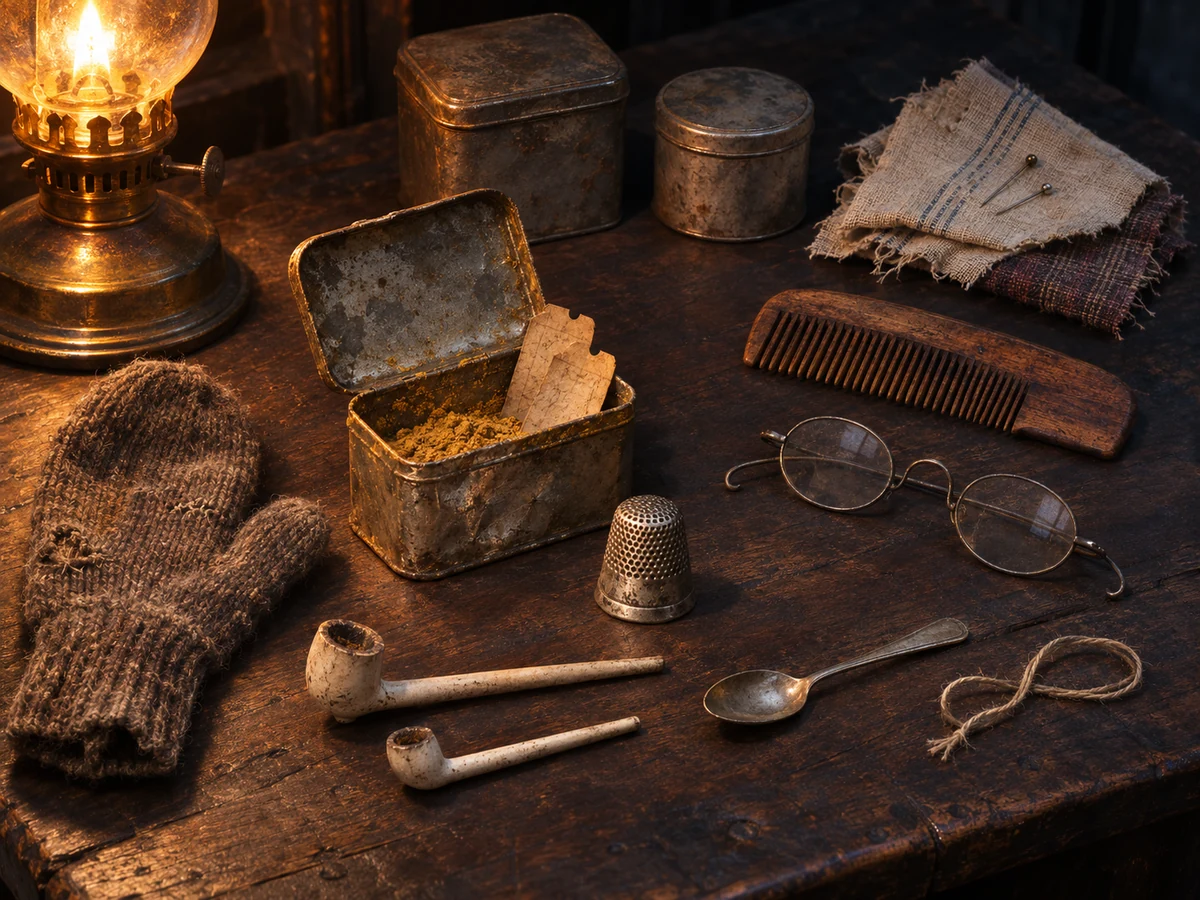
Eddowes’s original inquest papers survive, as does an inventory of her effects. Some things were recorded among her belongings. Inspector Edward Collard also testified that a sergeant picked up several small objects from the pavement beside her. The list below is a selection from those records and contemporary accounts. Related examples can be found in Elizabeth Barrett Browning’s secret wedding.
Among her belongings
Two clay pipes. Tea and sugar. Cloth scraps with pins and needles. Small pieces of soap. A comb and a teaspoon. String. Part of a pair of spectacles. A single mitten.
Recorded beside her
Several small buttons, a metal thimble and a little mustard tin containing two pawn tickets.
The tea and sugar can be traced back to the boots because Kelly told the coroner where the money went. The other objects yield smaller clues. Pins and needles could keep a garment going. Pieces of soap could still be used. A little tin could keep two slips of paper from getting lost among everything else.
The inventory was made to help identify a woman. Read with Kelly’s testimony, it also shows the small decisions involved in getting through a day when you had very little to spend.
### The two pawn tickets
One ticket was for a man’s shirt and was reported under the name Emily Birrell. The other was for the boots. The name on that one appears as Ann or Anne Kelly in early reports and as Jane Kelly in some later accounts. Kelly said a woman they had met during the hop-picking had given Kate a ticket for a shirt. The reports leave room for doubt about precisely how the shirt ticket came to be in the tin. The boots have the clearer trail.
The two slips were worth keeping. A pawn ticket was how you got something back if you managed to raise the money.
What a caption leaves out
A name attached to a photograph can travel from a pin to a history account and then to a colourised or AI-restored version. Each copy can look more convincing while taking the picture further from whatever information originally accompanied it. A convincing face is especially easy to remember. With Eddowes, it can eclipse the details we actually have.
For readers who want to follow the lives behind those details, Hallie Rubenhold’s The Five draws on the histories of all five women. In Kate’s case, even a few lines of the inventory give us something to hold on to.
We don’t know her face as she looked in life. We know she carried tea and sugar, and that she had kept one mitten.
Sources and further reading
- Catherine Eddowes’s inquest, transcribed by Casebook
- The Times, 5 October 1888, first inquest report
- The Times, 12 October 1888, police testimony and release from Bishopsgate
- Casebook, inventory testimony from Inspector Edward Collard
- Casebook, Catherine Eddowes biographical file and Emily Birrell and the pawn-ticket reports
- Neal Shelden’s discussion of his search for family photographs and his account of being unable to find a photograph of Kate
- Robert Clack’s survey of the known photographs, The Victims Photographs and some Wall Writing. Contains mortuary images.
- Hallie Rubenhold, The Ripper Revealed, on the surviving inquest and inventory, and The Five: The Untold Lives of the Women Killed by Jack the Ripper (2019)
- Stewart P. Evans and Keith Skinner, The Ultimate Jack the Ripper Sourcebook. Further reading for transcribed records. The National Archives’ Metropolitan Police files, MEPO 3/140, provide wider investigation context.