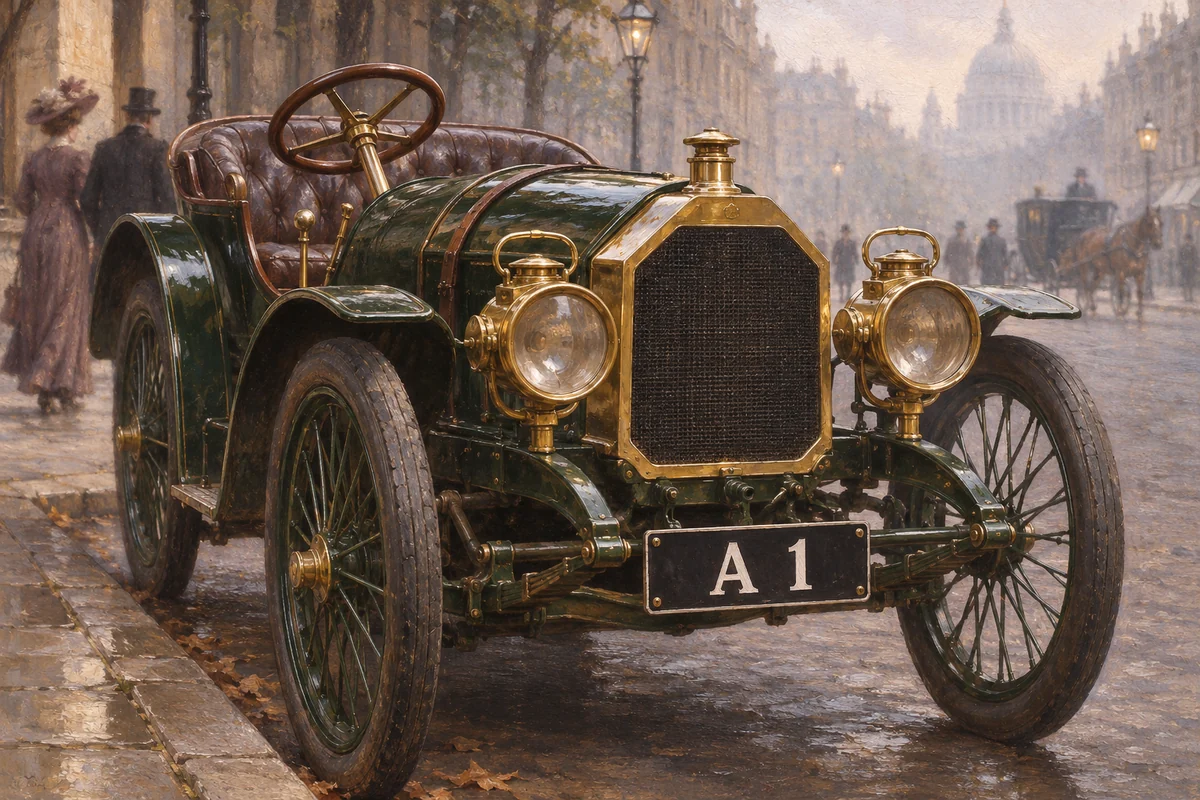
The plate looked like it had to be first. One letter, one number and an earl determined to get it. London’s A 1 became the most memorable registration of the early motoring years. The trouble is that a draper in Hastings appears to have beaten London to the starting line.
The short answer
A 1 was London County Council’s first registration and went to the second Earl Russell for his Napier. Surviving evidence points to an earlier issue in Hastings, where Jules Mastin received DY 1. Calling either plate Britain’s first with absolute certainty asks more of the surviving records than they can provide.
From the man with the flag to the number on the car
In 1896, a change in the law freed qualifying light motor vehicles from older road locomotive restrictions. The London-to-Brighton run celebrated that change. Within a few years, lawmakers had another problem to solve. If a motor car passed a witness or a police officer and continued out of sight, how could anyone identify it?
The Motor Car Act 1903 required motor cars to be registered with a county or county borough council. Each authority assigned separate numbers to the cars it registered, and an identifying mark showed both the registration and the council. The Act came into force on 1 January 1904. Councils were already organising and issuing registrations in 1903, which explains why the earliest dates precede the start of the legal requirement. Compare this with the number plate on Franz Ferdinand’s car and the red flag required for early motor vehicles.
The crucial word is local. London and Hastings kept separate registers. An A and a 1 look as though they ought to head a single national list, but there was no such list from which every council took its turn.
The earl and the overnight queue
The second Earl Russell secured A 1 for his Napier. A December 1903 report in The Car Illustrated, reproduced in a later history of the plate, records both the competition for it and the successful applicant. A person named L. H. Oliver also claimed to have handed Russell the certificate.
The overnight queue is harder to pin down. In 2007, an MP told the Commons that Russell had queued all night and beaten another applicant by five seconds. Other versions put a servant in the queue. Hansard records what was said in Parliament more than a century later. The contemporary magazine excerpt supports the competition for A 1, while the overnight wait and the five-second finish still need firmer contemporary evidence.
The draper who appears to have got there first
In Hastings, the early series began with DY. Local histories name Jules Mastin, a partner in a drapery business, as the recipient of DY 1. Registration histories commonly date its issue to 23 November 1903 and date Russell’s A 1 to December.
The East Sussex Record Office catalogue identifies the surviving Hastings registers and dates the series from 1903. Its public description points researchers towards the original volumes. The exact November date comes from published registration histories, since the catalogue entry itself does not reproduce Mastin’s individual record. Another angle on early motoring and transport comes from the Spanish roots of cowboy culture.
Even with that qualification, the comparison explains the confusion. A 1 was first in London. The evidence for DY 1 makes it a stronger candidate for an earlier issue. Surviving local records can place the two in order more readily than they can prove the first issue in all of Britain.
When identification became a status symbol
The law gave councils a way to distinguish one motor car from another. London’s first registration also showed that motorists could care about which mark they received. Two plain characters could suggest that the driver had been among the first to take to the road, or at least had been first in the right queue.
That is what makes A 1 worth remembering even if it loses the national contest. The earliest competition over the plate was already turning an official identifier into something its owner might want for its own sake.
Related curiosities
Why Did Someone Have to Walk in Front of Britain’s Early Motor Vehicles With a Red Flag?
Why Did Victorian Railway Passengers Carry Their Own Carriage Keys?
Why Is There a Lost River Beneath Oxford Street?
Sources & further reading
- UK Parliament — Motor Car Act 1903, especially sections 2 and 20
- East Sussex Record Office at The Keep — Motor Taxation registers, including Hastings series VEH/2
- Hastings Chronicle — 1900–1949, including the account of Jules Mastin and DY 1
- Simply Registrations — Registration Fun Facts, including the published issue dates for DY 1 and A 1
- Regtransfers — The Legendary Number A 1, quoting The Car Illustrated, December 1903
- House of Commons Hansard — Debate of 23 March 2007, columns 1102–03
Last checked: 25 November 2026.