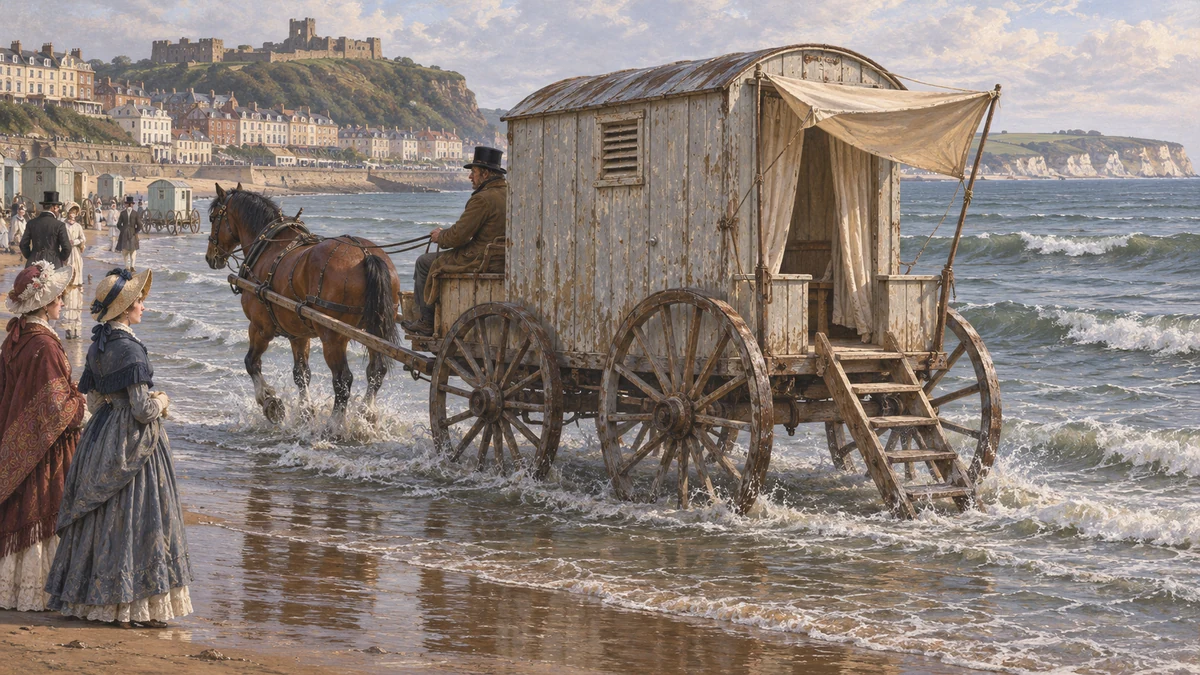
For nearly two centuries, a dip at a British seaside resort could start inside a wooden hut on wheels. A horse hauled it into the shallows, an attendant helped you into the water and, if you happened to be George III, a band might play.
A cure before it was a holiday
Taking a dip was already an amusement for some people when eighteenth-century doctors began promoting cold seawater as a treatment. One of its best-known advocates, the Sussex physician Richard Russell, recommended drinking seawater as well as bathing in it. His regime could involve half a pint before the dip and another half-pint afterwards. Mixing it with milk was an option.
Scarborough had attracted visitors to its mineral spring since the seventeenth century. By the 1730s, visitors were taking to the sea as well. A panoramic print made for John Setterington and dated 28 July 1735 includes a small wheeled bathing hut, one of the earliest known images of the machine. By 1745, an engraving by Samuel and Nathaniel Buck showed five.
Your changing room comes with you
A customer went into the wooden cabin on shore and undressed or changed into bathing clothes. A horse commonly hauled the machine into the shallows, though attendants sometimes moved it themselves. Once it was in position, the customer went down steps on the seaward side, with the cabin screening them from the beach. On some machines a flag summoned the driver for the return journey.
Benjamin Beale of Margate is credited with adding a folding canvas hood, often called a tilt. Historic England dates the improvement to 1753, while Margate’s town history puts it in use around 1750 or possibly earlier. Lowered over the steps, it formed a tent over a patch of water. The sea could still come in. People on the beach could see much less.
Horsepower eventually acquired a rival. From 1888, Folkestone had bathing carriages that ran on tracks, hauled in and out by a cable connected to a stationary steam engine. They could take several people at a time and even had washbasins.
The dippers
A dipper helped bathers down the steps, steadied them in the waves and sometimes plunged them under as part of the treatment. The service could be hired with the machine. An 1808 guide quoted by Sir John Soane’s Museum gives the price of a machine with a guide for one woman at Margate as one shilling and threepence.
Brighton’s best-known dipper was Martha Gunn, born in 1726. Remembered as the “Venerable Priestess of the Bath”, she spent decades in the trade. Brighton also had male attendants, known locally as bathers. One was John “Smoaker” Miles, whose customers included the Prince of Wales.
The king and the band
In 1789, George III went to Weymouth while recovering from a serious illness. Frances Burney, who accompanied the royal household, described the town’s enthusiasm. “God Save the King” appeared on hats, on bathing machines and even around the waists of the attendants’ bathing dresses. Other stories about leisure and enterprise in the Victorian age include the pointed hats of the Castle Rising almshouse and the Victorian craze for ferns.
Burney recorded that on his first dip, just as the king put his head under the water, a band concealed in a neighbouring bathing machine struck up the anthem. George went back to Weymouth repeatedly. The band belongs to the story of that first visit.
The queen and the chicken coop
On 30 July 1847, Queen Victoria took her first sea bath at Osborne on the Isle of Wight. An attendant helped her. Victoria recorded in her journal that she found it delightful until she put her head under and thought she would be stifled. Related examples can be found in the Arctic tourism plans for Polaris.
Her private machine ran on rails down the beach. It had a changing room, a sheltered veranda and a lavatory. After her death, it served for a time as a chicken coop. It was restored in the 1950s and returned to Osborne beach in 2012, when the beach opened to the public.
How the wheels came off
Separate bathing areas and the need for privacy helped keep the machines in business. Men sometimes bathed naked, and many resorts set aside different stretches of beach for men and women. The rules loosened town by town. Bexhill permitted mixed bathing in 1901, while Aberystwyth’s council was still considering the question in 1905.
As bathing costumes and mixed swimming became more usual, a changing room that stayed on shore was enough for many visitors. Scarborough had replaced its machines with bathing tents by 1904. Some lingered much longer. Country Life dates the last use at Margate to 1927.
In some places the old huts stayed on the beach after their wheels came off. The modern beach hut owes part of its history to those stationary changing rooms. You can still hire a little cabin by the sea. Getting it into the water is your own affair.
Sources & further reading
- Science Museum, “Chemistry and the birth of the seaside”
- English Heritage, sources for the 1735 Scarborough engraving
- Historic England, Margate’s Seaside Heritage
- Margate Charter Trustees, the bathing machine
- Sir John Soane’s Museum, sea bathing at Margate
- My Brighton and Hove, bathers and dippers
- Frances Burney’s diary, the royal visit to Weymouth
- Victorian Web, Queen Victoria’s machine at Osborne
- Queen Victoria’s journal, 30 July 1847, transcribed in University of Michigan research
- English Heritage, history of Osborne
- Aberystwyth University, local bathing byelaws
- Country Life, the rise and decline of the bathing machine