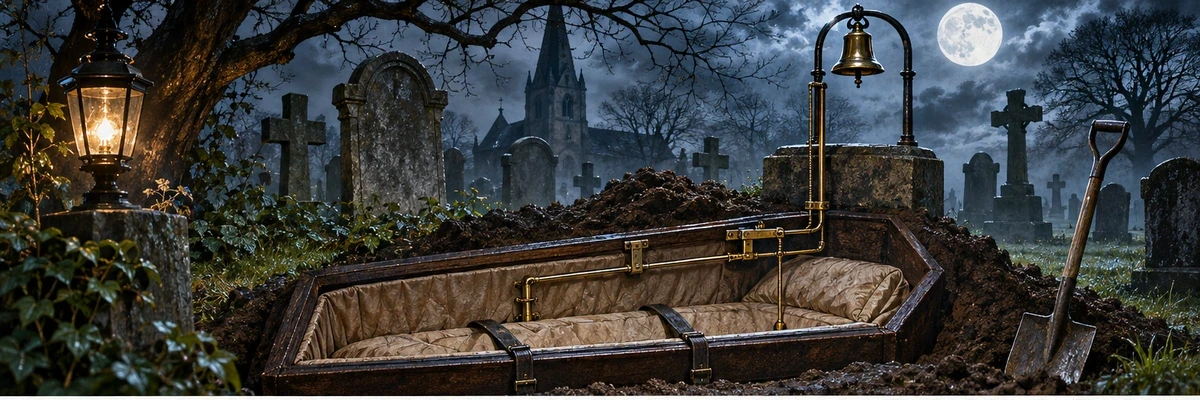
The terrifying history of safety coffins, graveyard bells and the nineteenth-century obsession with premature burial.
There are few thoughts more horrifying than waking up in a coffin.
Imagine opening your eyes in absolute darkness. You cannot sit up. You cannot see your hands. Somewhere above you lies six feet of earth, and everyone you have ever known believes you are dead.
For nineteenth-century readers, this was more than the premise of a Gothic novel. It was a fear that appeared in newspapers, medical journals, popular fiction and the extraordinary inventions of people determined to ensure that death really meant death.
The Victorians were fascinated by the possibility of premature burial. And some of their proposed solutions were almost as extraordinary as the nightmare itself.
When Death Was Difficult to Diagnose
Today, medical professionals have established procedures for confirming death. But in earlier centuries, determining whether someone had truly died could be surprisingly uncertain.
Before modern monitoring equipment, doctors relied heavily on physical observations: breathing, heartbeat, body temperature and other signs.
A person in a deep coma, suffering severe hypothermia or experiencing certain neurological conditions might appear lifeless to an inexperienced observer.
The problem was not unique to the Victorian period. Anxiety about premature burial had been growing in Europe since the eighteenth century.
But the nineteenth century brought a particularly potent combination of medical debate, sensational journalism and an expanding market for ingenious mechanical inventions.
The fear had a name: taphophobia, from the Greek words associated with burial and fear.
And for some people, it became an obsession.
The Coffin That Could Ring for Help
If someone might awaken underground, inventors reasoned, surely there should be a way for them to summon assistance.
Enter the safety coffin.
During the eighteenth and nineteenth centuries, inventors proposed and sometimes patented coffins equipped with elaborate emergency mechanisms.
Some designs featured cords attached to the occupant's hands or feet. If the supposedly deceased person moved, the cords could activate a bell above ground.
Other designs incorporated ventilation tubes, signalling devices or mechanisms intended to allow the occupant to communicate with the living.
One particularly remarkable American design was patented by Franz Vester in 1868. His invention provided a means of escape from a burial chamber, including a ladder and a route to the surface.
In 1897, Count Michel de Karnice-Karnicki promoted a safety apparatus designed to respond to movement within a coffin.
The underlying principle was simple: if the dead were not quite dead, they needed a way to tell somebody.
Whether these devices would have worked reliably in an actual emergency was another question entirely.
Did Graveyard Bells Really Give Us the Phrase "Saved by the Bell"?
It is a wonderful story.
According to a frequently repeated explanation, Victorian coffins were fitted with bells so that accidentally buried people could ring for help. Anyone rescued this way was supposedly "saved by the bell".
Unfortunately, the explanation is not supported by the history of the expression.
"Saved by the bell" is associated with boxing, where the bell ending a round could spare a struggling fighter from further punishment.
The existence of safety coffins is real. Their supposed connection to the expression is a popular folk etymology.
The same caution applies to claims that "dead ringer" and "graveyard shift" originated with people watching for signals from buried coffins.
These colourful stories are frequently repeated online, but the linguistic evidence does not establish those connections.
Sometimes the true history is strange enough without adding another legend.
The Waiting Mortuaries
Not every proposed solution involved fitting a bell to a coffin.
In parts of continental Europe, authorities established waiting mortuaries where bodies could be kept under observation before burial.
These institutions were sometimes known as Leichenhäuser in German-speaking regions.
The idea was straightforward: delay burial long enough for unmistakable signs of death to appear.
Some facilities employed attendants to watch for movement or other indications that a person might still be alive.
In certain arrangements, cords attached to the bodies could activate bells if movement occurred.
These institutions reveal how seriously some communities took the uncertainty surrounding death.
They also demonstrate an important distinction: the fear was widespread, but documented cases of people actually reviving in these facilities were exceptionally rare.
Edgar Allan Poe and the Nightmare Beneath the Earth
Few writers captured the terror of premature burial more effectively than Edgar Allan Poe.
His 1844 story The Premature Burial explored the psychological horror of being mistakenly declared dead and interred.
Poe drew upon contemporary anxieties and sensational accounts of apparent death.
His writing helped make premature burial one of the defining nightmares of nineteenth-century Gothic literature.
The subject also appeared in newspaper stories, medical discussions and accounts of supposed narrow escapes.
Some were based on genuine misunderstandings or unusual medical circumstances. Others were embellished, unverified or entirely fictional.
The difficulty was that once a terrifying story entered popular circulation, it could be repeated for decades as established fact.
Were People Actually Buried Alive?
This is where the history becomes more complicated.
There are documented historical concerns about mistaken declarations of death, and unusual cases of apparent death certainly occurred.
But dramatic tales of people awakening beneath the earth are much harder to verify.
Accounts of coffins discovered with scratch marks, bodies found in unnatural positions or mysterious sounds coming from graves often lack reliable contemporary evidence.
Changes to a body after death can also be misinterpreted when graves are reopened.
The existence of safety-coffin patents does not prove that accidental live burial was common.
Indeed, the remarkable number of proposed precautions may tell us more about the intensity of public anxiety than the frequency of the event itself.
When Medicine Finally Overtook the Nightmare
As medical knowledge advanced, methods of determining death became more systematic.
Improved clinical assessment, greater understanding of disease and eventually modern diagnostic technologies helped reduce uncertainty.
The elaborate safety coffin gradually became a historical curiosity rather than a serious medical proposal.
Yet the underlying fear never completely disappeared.
Premature burial remains a powerful subject in horror fiction, films and urban legends because it combines several deeply human anxieties: helplessness, isolation, darkness and the terrifying possibility of being forgotten.
The Victorians did not invent that fear.
They simply gave it bells, ropes, breathing tubes and patents.
The Strange Truth
The most extraordinary thing about Victorian safety coffins is not that people were routinely being buried alive.
There is no convincing evidence that they were.
It is that the fear of such a fate became powerful enough to inspire an entire category of inventions.
Engineers designed escape mechanisms. Doctors debated the signs of death. Writers filled their pages with underground nightmares.
And somewhere in the imagination of nineteenth-century society, a little bell waited above a grave.
Just in case.