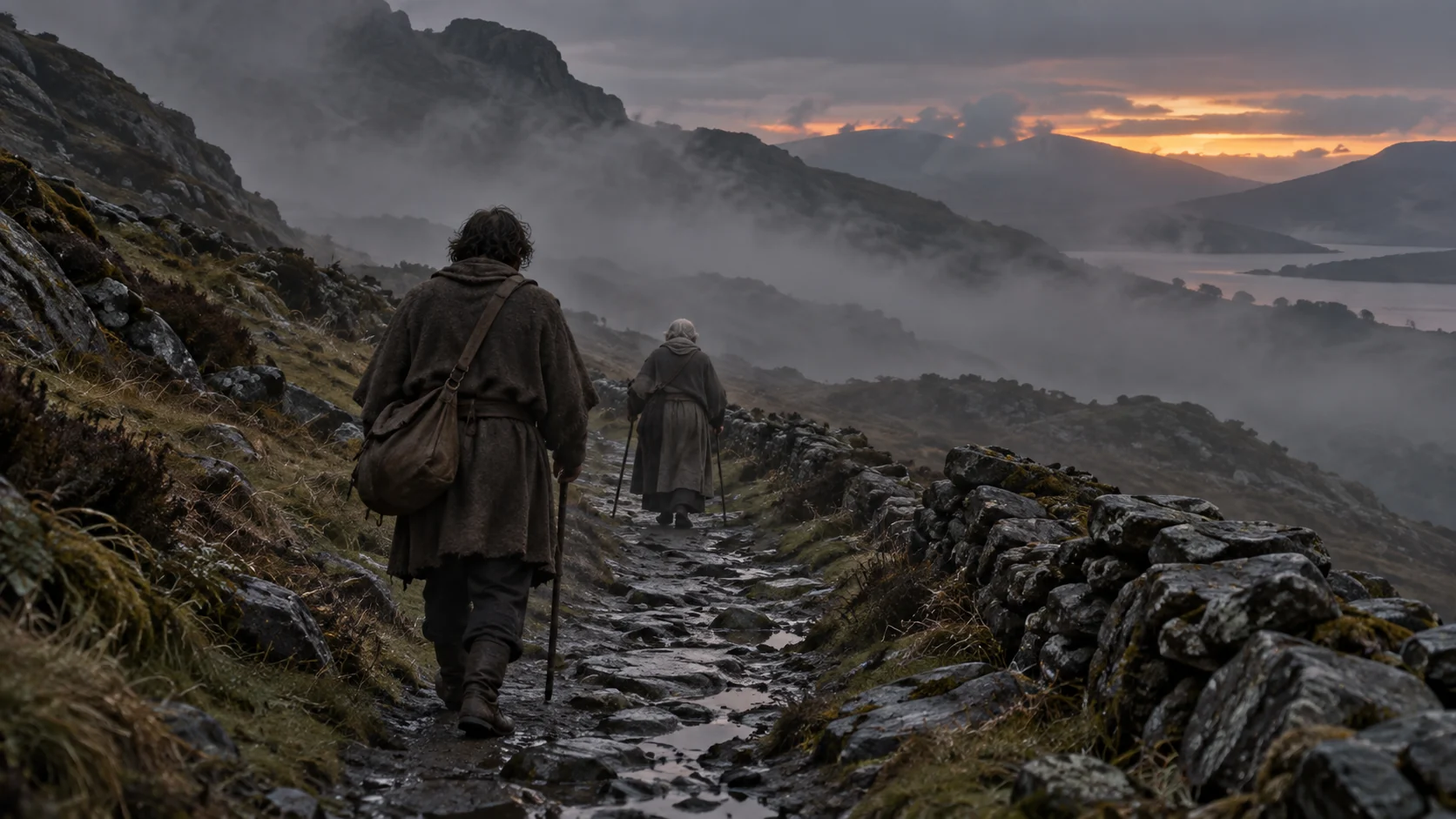
Imagine crossing a Welsh mountain road after dark.
It is a road you know.
Then the mist comes down.
Ahead of you, an old woman appears. She seems ordinary enough: poorly dressed, walking alone through the mountains. Perhaps she knows the way.
So you follow her.
But however quickly you walk, you never seem to catch her.
And eventually you realise something worse.
You no longer know where you are.
In accounts collected from Welsh folklore, mysterious beings associated with encounters like these became known as the Gwyllion — supernatural figures particularly associated with lonely mountain country, darkness and travellers losing their way.
But beneath the wonderfully unsettling image of strange women wandering through the Welsh mountains lies a more complicated question.
Who — or what — were the Gwyllion?
THE SPIRITS OF THE MOUNTAIN ROAD
One of the most important nineteenth-century accounts appears in American writer and folklorist Wirt Sikes's 1880 book British Goblins: Welsh Folk-Lore, Fairy Mythology, Legends and Traditions.
Sikes devoted an entire chapter to what he called the Gwyllion and the mountain fairies of Wales.
In his classification, the Gwyllion were frightening female supernatural beings associated particularly with lonely mountain roads.
Their most characteristic trick was not attacking travellers.
It was making them lose their way.
That distinction matters.
The Gwyllion of these accounts are not simply witches lurking in the mountains or monsters waiting to pounce.
Their danger is uncertainty.
A familiar path becomes unfamiliar.
A traveller becomes disorientated.
Someone — or something — appears to offer a direction through the darkness.
And following it may make matters worse.
In a landscape of steep slopes, bogs, sudden weather and thick mountain mist, becoming lost was not merely frightening.
It could be deadly.
THE OLD WOMAN OF THE MOUNTAIN
Among the most memorable traditions preserved by Sikes is that of an apparition sometimes described as the Old Woman of the Mountain.
Sikes drew upon earlier Welsh supernatural traditions recorded by the eighteenth-century Welsh minister and writer Edmund Jones, remembered for collecting accounts of apparitions, fairies and other supernatural phenomena.
The mysterious woman was associated with mountain country in Monmouthshire.
What makes the description particularly effective is how ordinary she initially appears.
She was described as resembling a poor elderly woman dressed in ash-coloured clothing.
She reportedly wore an unusual four-cornered hat and carried something resembling a vessel used for fetching milk.
There are no horns.
No glowing eyes.
No elaborate supernatural costume.
She looks like someone you might genuinely encounter walking home through the countryside.
Except that travellers could not catch her.
The woman might remain ahead of them as they walked through the darkness, apparently close enough to follow but somehow never close enough to reach.
And encounters with her were associated with travellers becoming lost.
FOLLOWING SOMEONE WHO ISN'T THERE
This recurring idea gives the Gwyllion tradition much of its power.
A lone traveller sees another person ahead.
Following that person feels safer than remaining alone.
But the supposed guide leads deeper into uncertainty.
Sikes records another tradition involving a man named Robert Williams on the Black Mountain.
Williams reportedly encountered a mysterious woman and followed her before finding himself lost and moving into dangerous marshy ground.
According to the story, he eventually drew a knife.
The apparition vanished.
The detail fits a much wider body of British and European folklore in which iron objects were believed to provide protection against fairies or supernatural beings.
That does not prove that such a belief originally belonged to every Gwyllion tradition.
But it shows how stories about the Gwyllion became entangled with broader supernatural ideas circulating through British folklore.
WHY THE MOUNTAINS?
There is a practical reality behind these stories that should not be overlooked.
Before modern roads, electric lighting, reliable maps and weather forecasts, crossing remote upland country could be genuinely dangerous.
Mist can erase landmarks astonishingly quickly.
Paths disappear.
Distances become difficult to judge.
Sound behaves strangely.
A traveller convinced that he is walking towards home can gradually move farther away from it.
Folklore frequently gives personalities to dangers that cannot easily be seen.
The sea acquires spirits.
Marshes acquire lights.
Forests acquire creatures.
And mountains acquire beings that make travellers lose their way.
Whether people literally believed that a Gwyllion had misled them, used the supernatural explanation to make sense of frightening experiences, or simply repeated stories already embedded in local tradition is impossible to determine for every account.
But the landscape itself helps explain why such stories endured.
THE STRANGE CONNECTION WITH GOATS
The Gwyllion also became associated with another peculiar feature of Welsh fairy tradition:
goats.
Sikes recorded Welsh beliefs connecting goats with supernatural knowledge and with the fairy world.
One particularly curious tradition claimed that fairies gathered around goats and combed their beards on Friday nights so that the animals would appear respectable for Sunday.
It is exactly the sort of wonderfully specific detail that survives in folklore long after its original meaning has become obscure.
Goats were sometimes treated as animals possessing an unusual awareness of supernatural activity.
Their behaviour could therefore become evidence that unseen beings were nearby.
The connection does not mean that every historical account of the Gwyllion involved goats.
Instead, it demonstrates how individual supernatural traditions overlapped with the much larger network of Welsh beliefs concerning fairies, animals, mountains and dangerous places.
WERE THE GWYLLION REALLY FAIRIES?
This is where the story becomes less tidy.
Modern descriptions sometimes present the Gwyllion as though they were a clearly defined species of ancient Celtic female mountain fairy.
The historical evidence does not justify that degree of certainty.
The Welsh words gwyll and gwyllion have carried broader supernatural associations, and earlier usages do not necessarily correspond neatly with the category created by nineteenth-century folklorists.
Historical dictionaries and later scholarship show associations with spirits, apparitions, goblins and other supernatural beings.
Wirt Sikes helped popularise a particularly organised classification of Welsh supernatural creatures for Victorian readers.
That raises an important possibility.
The Gwyllion tradition may be old while the tidy category called “the Gwyllion” is considerably newer.
Folklore rarely behaves like modern fantasy.
People telling stories in isolated communities did not necessarily maintain an agreed catalogue of supernatural species with fixed powers, appearances and rules.
Stories changed from valley to valley and generation to generation.
Names overlapped.
One supernatural being could acquire characteristics belonging elsewhere to another.
Victorian folklorists then attempted to organise these messy traditions into categories readers could understand.
The result can make folklore appear much more systematic than it originally was.
AN ANCIENT BELIEF — OR A VICTORIAN CATEGORY?
There is therefore good reason to be cautious when describing the Gwyllion as an unchanged survival from ancient Celtic religion.
Welsh supernatural tradition is unquestionably old.
But demonstrating an uninterrupted historical line from ancient Celtic belief to a particular nineteenth-century description of female mountain spirits is much more difficult.
What we can document is fascinating enough.
Welsh tradition contained stories of supernatural beings associated with remote landscapes.
Collectors recorded stories of mysterious female figures appearing to travellers.
These figures became particularly associated with mountain roads and becoming lost.
And by the nineteenth century, writers such as Wirt Sikes were presenting these traditions under the name Gwyllion.
Beyond that, certainty becomes harder.
WHEN THE MIST COMES DOWN
Perhaps that uncertainty is appropriate.
The Gwyllion belong to a landscape where certainty disappears.
A path that looked obvious in daylight becomes unfamiliar after sunset.
Mist removes the horizon.
A shape in the distance becomes a person.
A person becomes something else.
And the traveller who thinks he knows the mountain suddenly discovers that the mountain knows him better.
Somewhere ahead walks an old woman.
You quicken your pace.
She remains exactly the same distance away.
You follow.
And when you finally look around, the road home has disappeared.
That is where the Gwyllion still live best:
not as neatly catalogued monsters from a fantasy mythology, but in that uncomfortable moment when a familiar landscape stops behaving as it should.
WHAT WE KNOW
Documented: Nineteenth-century folklorists recorded Welsh traditions concerning supernatural beings called Gwyllion and associated them particularly with mountainous areas and travellers being led astray.
Documented: Wirt Sikes discussed the Gwyllion extensively in his 1880 book British Goblins: Welsh Folk-Lore, Fairy Mythology, Legends and Traditions.
Documented folklore: Stories preserved by Sikes and earlier collectors include mysterious female figures encountered on mountain roads, including traditions surrounding an Old Woman of the Mountain.
Traditional belief: Iron or a knife appears as protection in at least one recorded Gwyllion story and corresponds with broader British traditions concerning iron and supernatural beings.
Traditional belief: Welsh fairy lore recorded by nineteenth-century collectors also connected goats with supernatural activity.
Uncertain: The precise age and original meaning of the Gwyllion tradition.
Uncertain: Whether the Gwyllion were historically understood throughout Wales as one clearly defined class of exclusively female mountain fairies.
Not established: Claims that the detailed modern description of the Gwyllion can be traced unchanged back to ancient Celtic religion.
SOURCES AND FURTHER READING
Wirt Sikes, British Goblins: Welsh Folk-Lore, Fairy Mythology, Legends and Traditions (1880). Use the Project Gutenberg edition as the principal accessible primary source:
https://www.gutenberg.org/ebooks/34704
Relevant section: Chapter IV, concerning the Gwyllion and mountain fairies.
Also consult the historical material attributed by Sikes to Edmund Jones and clearly distinguish Jones's reported supernatural accounts from independently verified historical events.
For linguistic and modern scholarly context, use academic research into Welsh fairy traditions and the historical meanings and usage of gwyll and gwyllion. Do not use modern mythology websites as evidence for ancient origins unless their claims can be traced to an identifiable historical or academic source.