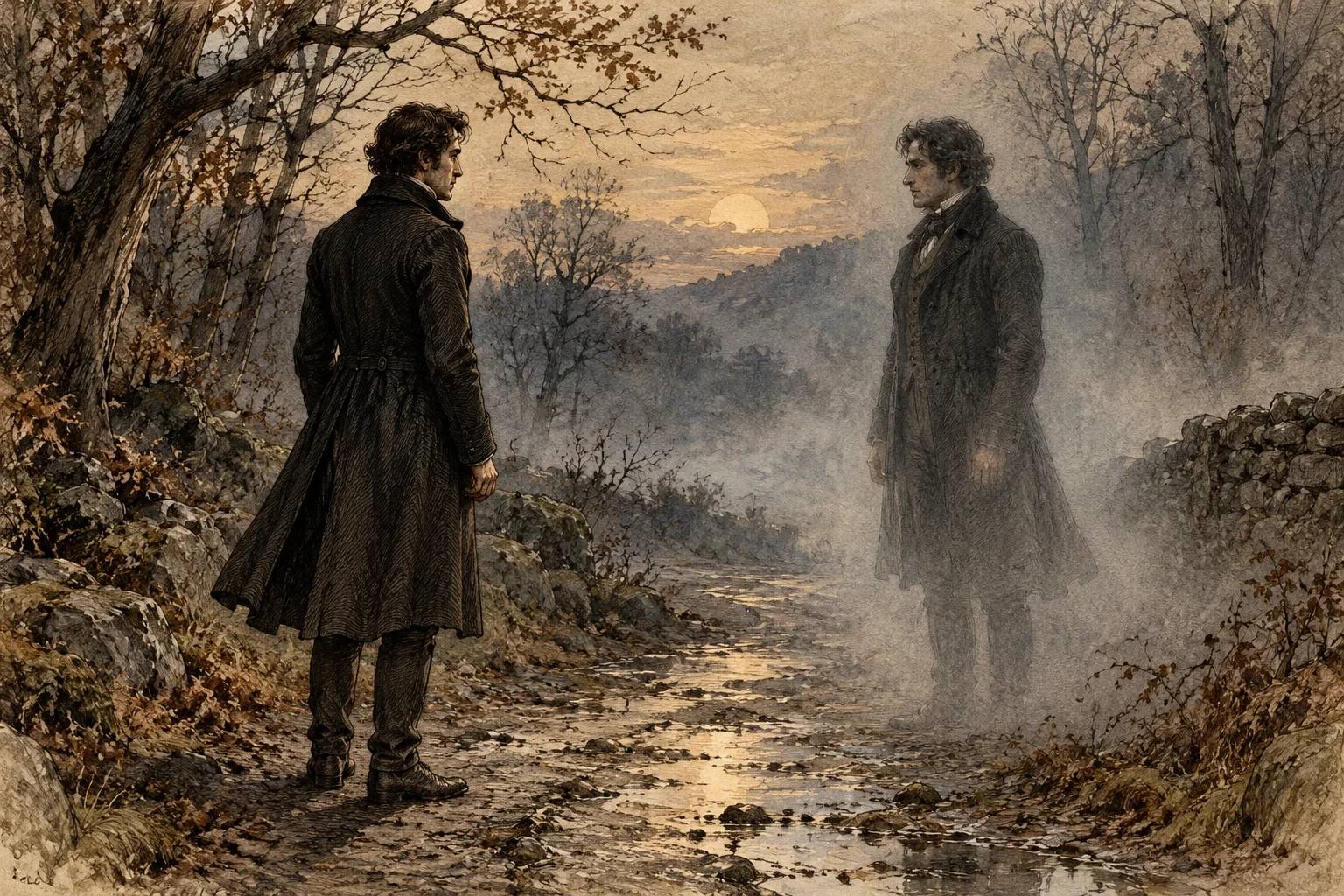
Imagine walking home along an empty road and seeing someone approaching in the twilight. As the figure draws closer, you recognise the face, the clothes and even the way it walks. It is you.
In some European traditions, such an encounter was not merely frightening. It could be interpreted as a warning that your life was approaching its end.
But where did this extraordinary belief come from, and why did people fear meeting themselves?
THE SHORT ANSWER
Seeing your own double was considered a death omen in certain European traditions because an apparition of a living person could be interpreted as a sign that something had gone terribly wrong with the boundary between body, spirit and life.
In Irish folklore, the mysterious fetch was a spectral counterpart whose appearance might foretell death. In German literature, the Doppelgänger developed into a disturbing symbol of divided identity, mortality and the possibility that a person might encounter another version of themselves.
These were related ideas, not one universal European belief.
The traditions are historically documented. There is no reliable evidence that seeing an apparent double predicts death, or that a supernatural duplicate of a living person exists.
WHAT WE KNOW
The word Doppelgänger comes from German, combining words associated with a double and a person who walks or goes. Its approximate meaning is a double-goer or double-walker.
Despite its ancient-sounding reputation, the term itself has a relatively recent literary history.
The German novelist Jean Paul, the pen name of Johann Paul Friedrich Richter, introduced the term in his 1796 novel Siebenkäs. His treatment of the double belonged to a sophisticated exploration of identity, selfhood and the unsettling possibility of another self.
It was not simply a warning that death was approaching.
The supernatural double became increasingly prominent in nineteenth-century literature, where it could represent a divided personality, a concealed identity, an unwelcome reflection or an apparently independent version of a living person.
But stories of spectral counterparts were not confined to German novels.
In Irish and British traditions, apparitions resembling living people could carry a much more immediate warning.
One especially revealing example was the fetch.
THE FETCH: A VISITOR WHO LOOKED EXACTLY LIKE YOU
In Irish folklore, a fetch was an apparition resembling someone who was still alive.
It might be seen by another person rather than by the individual whose likeness it bore. This distinction matters: the familiar modern image of someone meeting their own doppelgänger is only one version of a much broader tradition.
The fetch could appear unexpectedly, looking sufficiently like an ordinary person to be mistaken for them.
Only later might the witness discover that the real individual had been somewhere else entirely.
The apparition could then be interpreted as a warning of approaching death.
Yet the tradition was not entirely consistent. In some nineteenth-century accounts, the time of day mattered. An appearance in the evening might foretell death, while one in the morning could signify long life.
This variation is important. It shows that the supernatural meaning was supplied by the tradition, rather than by anything demonstrably inherent in the sighting.
The frightening part was not necessarily that the double threatened anyone.
It was that someone apparently alive had been seen in two places at once.
THE POET WHO SUPPOSEDLY SAW HIMSELF
One of the most famous stories of a death-foretelling double concerns the Romantic poet Percy Bysshe Shelley.
Shelley drowned in July 1822 when his boat was lost during a voyage off the Italian coast.
Accounts circulated afterwards describing strange experiences and apparitions in the period before his death.
Among them was the claim that Shelley had encountered an apparition resembling himself.
The story has often been retold as though a supernatural double appeared to warn the poet of his fate.
But the surviving material demands caution.
The apparition stories were transmitted through recollections and later accounts, and different versions became entangled with other strange incidents associated with Shelley's final weeks.
We do not possess independent contemporary evidence demonstrating that Shelley encountered an actual duplicate of himself.
What the story does demonstrate is how readily a mysterious experience could become a prophecy once the death it supposedly predicted had already occurred.
The ending gave the earlier incident its meaning.
Without Shelley's drowning, the same story might never have become famous.
THE SCHOOLTEACHER WHO WAS ALLEGEDLY SEEN TWICE
An even stranger nineteenth-century account concerns a teacher usually identified as Émilie Sagée.
According to a story published by Robert Dale Owen in Footfalls on the Boundary of Another World in 1860, pupils at a girls' school reportedly witnessed an extraordinary phenomenon.
Their teacher appeared to have a duplicate.
In one version of the account, the apparition stood beside her while she was teaching, apparently reproducing her movements.
In another, a figure resembling the teacher was reportedly seen in the classroom while the real woman was elsewhere.
The supposed double was not described simply as an approaching messenger of death. It was an unexplained counterpart appearing during ordinary daily activities.
Owen's book is a genuine nineteenth-century publication and an important source for understanding Victorian interest in apparitions.
That does not establish the truth of the incident.
The story reached readers through reported testimony rather than independently verified observations. Its extraordinary details cannot be confirmed merely because they appeared in print.
Nevertheless, it became one of the enduring examples of the phenomenon later described as bilocation: the apparent presence of a person in two places simultaneously.
It also demonstrates that not every spectral double was understood as a death omen.
Some were presented as mysteries of identity, perception or the supposed separation of a person's physical and spiritual selves.
HOW IT BECAME A HABIT
Why should the appearance of a double suggest death at all?
There is no demonstrated single origin for the belief, but its recurring themes offer a possible explanation.
A familiar face normally identifies a familiar person. We recognise someone because their appearance belongs to them.
An exact duplicate breaks that assumption.
If the person is standing elsewhere, who or what has appeared?
In cultures where apparitions were understood as manifestations of spirits, the sight of a living person's likeness could be interpreted as evidence that some part of them had become separated from their body.
Death provided one possible explanation for that imagined separation.
The double therefore became a warning that the boundary between the living and the dead had been disturbed.
This is an interpretation of the stories, not a proven account of how the belief originated.
Different communities supplied different explanations, and some doubles were not associated with death at all.
What united many accounts was the disturbing uncertainty created when appearance and identity no longer matched.
THE STORY EVERYONE TELLS
The familiar modern doppelgänger story usually follows a simple pattern.
Someone encounters an exact copy of themselves.
The duplicate may stand silently, imitate their movements or disappear without explanation.
Soon afterwards, disaster strikes.
The encounter is then remembered as a supernatural warning.
But this familiar sequence combines elements from different historical traditions.
The German literary double was not invariably a ghost or an omen. The Irish fetch was often seen by someone other than the person it resembled. Other European apparition traditions could involve warnings, mistaken identities or unexplained appearances without any subsequent death.
The popular idea that seeing your own doppelgänger always means you are about to die is therefore much too sweeping.
It turns a varied collection of beliefs and stories into a single supernatural rule.
There is another difficulty.
A frightening experience followed by a death is memorable. An equally frightening experience followed by nothing remarkable is less likely to survive as a famous cautionary tale.
This makes retrospective accounts particularly difficult to assess.
Once someone has died, earlier dreams, coincidences and unusual sightings may acquire an ominous significance they did not originally possess.
WHAT THE EVIDENCE ACTUALLY SAYS
The historical evidence supports the existence of stories about spectral doubles.
It does not support the supernatural explanation offered for them.
Three separate questions need to be distinguished.
First, did people tell stories about doubles and associate some of them with death? Yes. Literary works, folklore collections and nineteenth-century writings document such beliefs.
Second, did witnesses sometimes claim to have seen apparitions resembling living people? Yes. Published accounts record such claims, although their reliability varies considerably.
Third, were these apparitions independent supernatural beings capable of predicting death? There is no reliable evidence establishing that conclusion.
Ordinary explanations may include mistaken identity, unusual lighting, memory errors, dreams, suggestibility and perceptual disturbances.
None of these explanations can automatically be assigned to every historical report, especially when the original circumstances cannot be reconstructed.
But an unexplained experience is not evidence of a supernatural prediction.
The strongest conclusion is that people interpreted apparent doubles through beliefs already familiar to them.
A person who knew the tradition of the fetch might understand an unexpected likeness as an omen. Someone influenced by Romantic literature might instead regard it as a frightening encounter with another self.
The experience and its interpretation were not necessarily the same thing.
WHY IT STUCK
The doppelgänger remains unsettling because it turns something reassuring into something impossible.
Our own face is supposed to be uniquely ours.
We expect reflections to remain inside mirrors, portraits to remain on walls and other people to possess different identities.
A double violates those expectations.
It suggests that the familiar self might be copied, displaced or encountered as a stranger.
Death gives that disturbance an additional meaning.
If another version of you can appear without your knowledge, perhaps the boundary separating your living body from something beyond it is less secure than you imagined.
That is the fear the old stories exploit.
And it explains why the double has survived long after the particular beliefs surrounding it have changed.
Modern fiction often treats the doppelgänger as a sinister impostor, an alternative personality or an uncanny duplicate. Earlier traditions could make it a warning of mortality.
The details differ, but the central disturbance remains remarkably effective.
What would you do if you met someone who looked exactly like you?
And what if they recognised you first?
THE STRANGE PART
The most revealing detail is that the double did not always have to appear to the person whose death it supposedly foretold.
Someone else might see the apparition and only later learn that the real person had died.
In such stories, a familiar face could become a warning without its owner ever knowing that anything unusual had happened.
The supposed omen belonged as much to the witness as to the person it represented.
Perhaps that is why the tradition proved so enduring.
It allowed an ordinary encounter, a mistaken identity or a half-glimpsed figure to become something extraordinary after the event.
And it left behind one of folklore's most disturbing possibilities:
You might have a double walking somewhere in the world.
You might never meet it.
But someone else might.
SOURCES & FURTHER READING
1. Dimitris Vardoulakis, The Doppelgänger: Literature's Philosophy (Fordham University Press, 2010). Scholarly study of the double in literature, including Jean Paul's introduction of the term in 1796. https://academic.oup.com/fordham-scholarship-online/book/24269
2. Andrew J. Webber, The Doppelgänger: Double Visions in German Literature (Oxford University Press, 1996). Scholarly examination of German literary doubles and the development of the motif. https://academic.oup.com/book/6500/chapter-abstract/150383567
3. Robert Dale Owen, Footfalls on the Boundary of Another World (1860). Historical primary source documenting nineteenth-century accounts of apparitions, including alleged appearances of living people. The existence of the publication does not independently validate its supernatural claims. https://www.loc.gov/item/10032956/
4. Robert Dale Owen, Footfalls on the Boundary of Another World, Book IV, Chapter II, "Apparitions of the Living". Cambridge University Press edition and chapter listing. https://www.cambridge.org/core/books/footfalls-on-the-boundary-of-another-world/04FCFE8F8C224F3D87D37E1B8FFB576F/listing?pageNum=2
5. John Nolan, "Death Omens in Irish Folklore: Signs, Symbols, and Meanings", Irish Folklore (updated September 2026). Secondary overview of Irish death omens, including the fetch. https://www.irishfolklore.com/beliefs/death-omens-irish-folklore/
Editorial note: The Shelley anecdote and the Émilie Sagée story are presented as historical reports, not established supernatural events. The Shelley account particularly requires further primary-source verification before adding precise dialogue, dates or descriptions of an encounter.