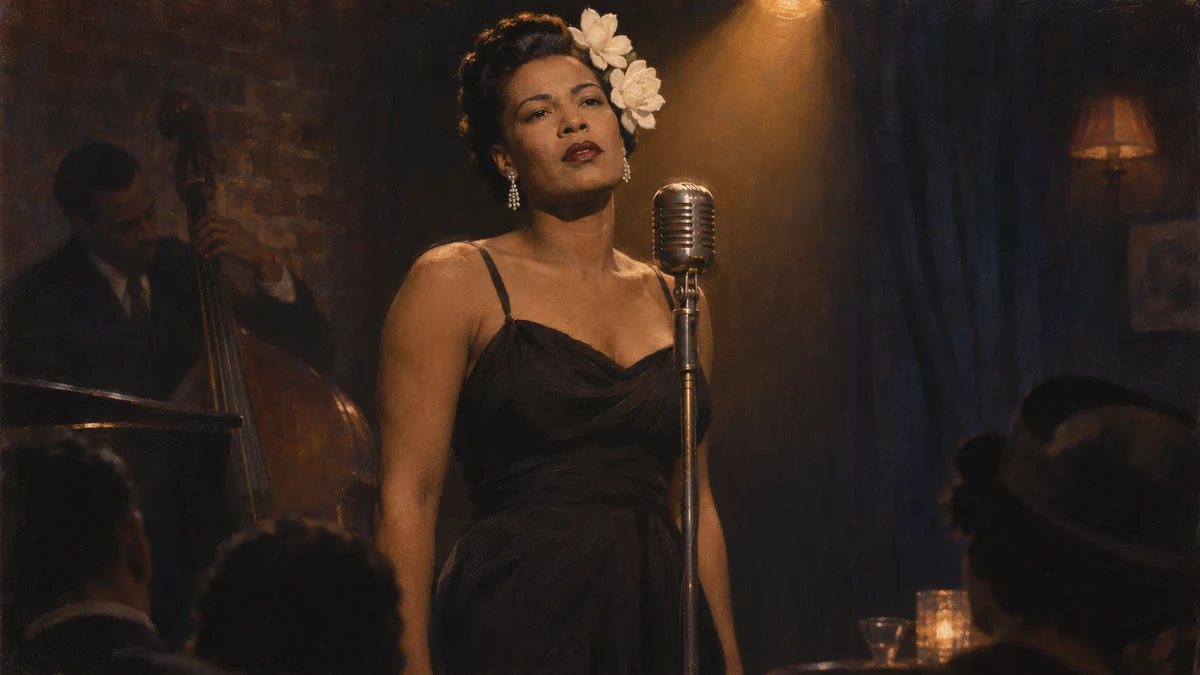
Billie Holiday made an anti-lynching song the last number of her set. When her regular label declined to record it, she took it to a small independent company that would.
At Café Society in Greenwich Village, the waiters stopped serving when Billie Holiday began her last number. The room went dark except for a light on the singer. The song was “Strange Fruit”, and its subject was the lynching of Black Americans. When it ended, Holiday left the stage. There was no encore.
The short answer
Holiday’s regular record company declined to record “Strange Fruit” in 1939. Accounts point to fears of a backlash from Southern record dealers and broadcasters, as well as doubts that a song about racist violence would sell. Holiday secured permission to record outside her contract for one session. On 20 April 1939, she made the record for Milt Gabler’s independent Commodore label.
A teacher’s poem
Abel Meeropol taught English at DeWitt Clinton High School in the Bronx. A Jewish schoolteacher active in the teachers’ union, he published an anti-lynching poem called “Bitter Fruit” in the January 1937 issue of The New York Teacher. He later set it to music and used his pen name, Lewis Allan.
Meeropol said a photograph of a lynching had stayed with him for days. His family identified it as a photograph taken in Marion, Indiana, in 1930, after a white mob murdered Thomas Shipp and Abram Smith. David Margolick, who wrote a history of the song, treats that identification as possible. The photograph’s influence is clearer than the precise identification. Compare this with David Bowie’s Christmas duet with Bing Crosby.
Before Holiday sang it, the song circulated at union gatherings and among progressive performers in New York. Meeropol’s wife, Anne, was one of its early singers. It reached Café Society through the people who organised its shows.
The last number at Café Society
Barney Josephson’s Café Society was a pioneering racially integrated nightclub. Black and white patrons could sit in the same room, and Black and white musicians appeared on the same stage. Holiday was already an accomplished recording artist when she began performing there.
Accounts differ on how readily she took to the song. What is clear is what she did with it. By early 1939 it was her closing number. The club stopped table service, dimmed the room and let the performance end in darkness. Holiday’s measured phrasing and the space she left between lines gave the audience time to take in the words.
Why her label declined
Columbia and its corporate affiliates had more to protect than a single record. Holiday’s contract was with Vocalion, part of the record business acquired by CBS. A contemporary Time report named Vocalion as the company that passed on the song. Later histories generally call it Columbia, and cite concern about dealers in the South and stations affiliated with CBS. Some accounts also say that John Hammond, an early champion of Holiday, declined to record it. The strongest evidence establishes the company’s refusal and the exception it granted her. Related examples can be found in the radio ban on an instrumental record and the deodorant joke behind Smells Like Teen Spirit.
For a Black singer to perform a song about lynching before a paying audience already took resolve. Putting it on a record meant the performance could travel far beyond the room, including to places where the company expected resistance.
Commodore says yes
Holiday brought the song to Milt Gabler, whose Commodore label grew out of his Manhattan record shop. The shop began on East 42nd Street and subsequently operated on West 52nd Street. Both addresses appear in accounts of Commodore. The recording itself was made at World Broadcasting Studio on Fifth Avenue.
On 20 April 1939, Holiday recorded four sides with trumpeter Frankie Newton’s Café Society band. Gabler had pianist Sonny White play an introduction that gave the recording more room and set the mood before Holiday entered. Commodore issued the performance as catalogue number 526, paired with Holiday’s “Fine and Mellow”. The original disc bears the Commodore name. Some histories describe a distribution arrangement with Vocalion, whose clearest documented role was clearing Holiday to make the record.
What the record made possible
The record found listeners despite limited airplay. The Library of Congress’s account describes resistance from broadcasters, and some stations declined to play it. The Library of Congress describes it as one of the biggest sellers of Holiday’s career. Precise sales totals are harder to establish.
In 1999, Time named it the song of the century. The Library of Congress selected it for the inaugural National Recording Registry in 2002. Those honours came decades after Holiday chose to end her set with the song. The 1939 recording preserves that choice. Her voice brought a protest against lynching out of a New York nightclub and into the lives of listeners who could hear it wherever a copy of the record reached them.
Sources & further reading
- Smithsonian Magazine, on the label’s refusal and the Commodore session
- Smithsonian National Museum of American History, Commodore 526
- Library of Congress, “The Power of a Poem”
- Library of Congress, National Recording Registry essay
- David Margolick on the song’s legacy, PBS
- Robert Meeropol on his father’s poem, Time
- Time, contemporary report on the release, June 1939
- Billie Holiday discography, 20 April 1939 session
- David Margolick, Strange Fruit: Billie Holiday, Café Society, and an Early Cry for Civil Rights (2000)
- Dorian Lynskey, 33 Revolutions per Minute: A History of Protest Songs (2011)