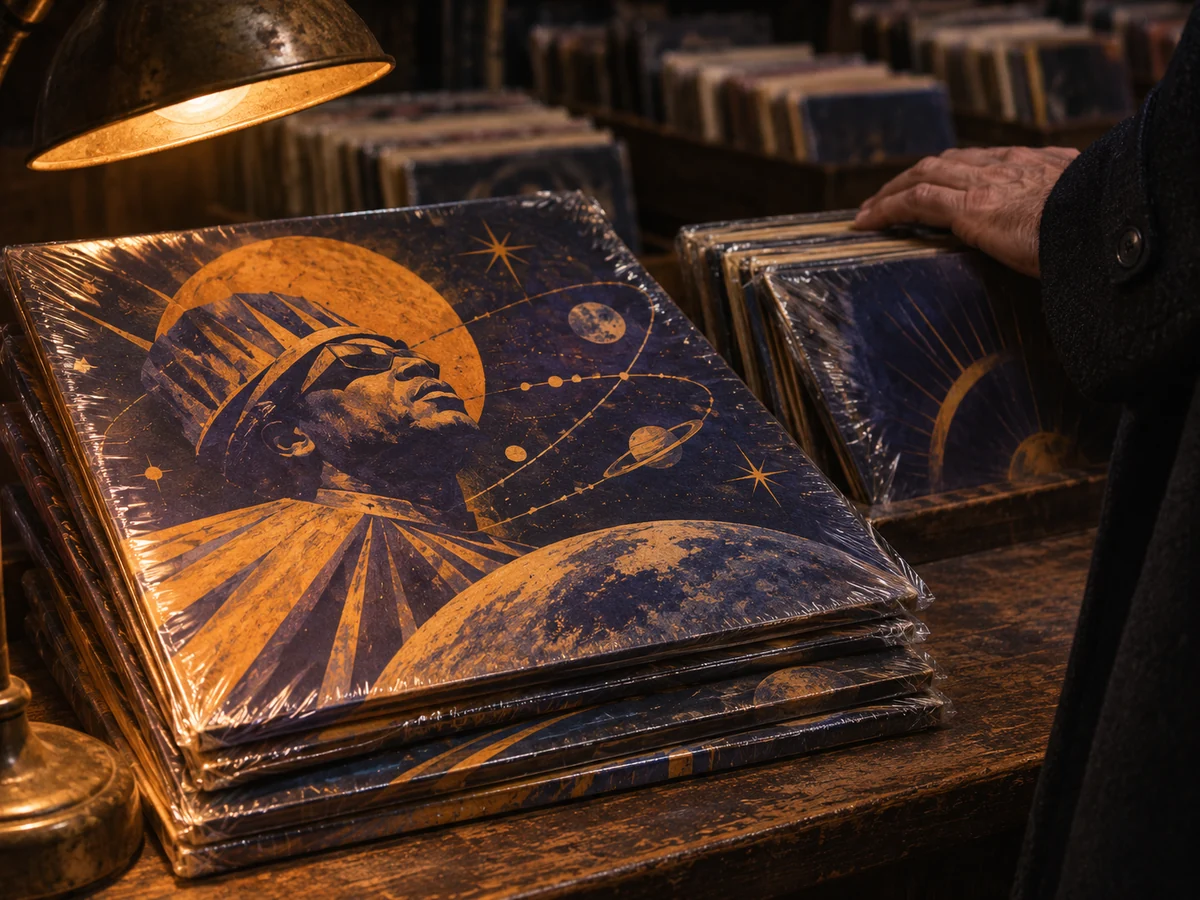
Pete Townshend had been looking for records he could scarcely find. Then, by his own account, a jazz shop produced 250 in one go. The curious part is how many he said were still sealed.
The jazz shop
“Give me everything,” Pete Townshend remembered saying.
He had walked into a jazz shop he placed in Chicago and asked whether they had any Sun Ra. For The Who’s guitarist, it was the sort of question that usually led nowhere. He had developed a taste for Sun Ra’s avant-garde jazz and found the records frustratingly hard to get. This time the man in the shop said he had the lot. According to Townshend, he came back with 250 albums.
Townshend told the story while recommending The Heliocentric Worlds of Sun Ra for an NME feature. His account appeared in the magazine in January 2011 and in its online cult-albums list in 2018. He gave no date for the visit and no name for the shop. The number comes from Townshend’s memory. It tells us the scale of the haul as he remembered it, with no inventory to establish how many different releases were in it.
Why Sun Ra was so hard to find
Townshend’s “I think” was about Sun Ra’s connection to Chicago. Sun Ra was born Herman Poole Blount in Birmingham, Alabama, in 1914. Chicago was where he worked as a pianist with Fletcher Henderson’s orchestra and where his own band and record label took shape.
In 1957, Sun Ra and the brothers Alton and Artis Abraham founded El Saturn Research in Chicago. The label gave Sun Ra a way to put out his Arkestra’s music himself. One of its early albums was Super Sonic Jazz. Alton Abraham kept running the Chicago side of Saturn after Sun Ra left the city. By the late 1970s, Sun Ra was also pressing records in Philadelphia with help from members of the Arkestra.
Some Saturn records were pressed in small numbers and sold by the musicians at gigs. Some came in plain sleeves. Others had printed designs or artwork drawn by hand by Sun Ra and members of the band. A record could be available at the front of the stage after a concert and almost impossible to track down from a shop back home. Compare this with the circus poster behind Being for the Benefit of Mr. Kite!.
Sun Ra also worked with other labels. The album Townshend recommended came out on ESP-Disk in 1965, and Impulse reissued Saturn albums including The Magic City and Atlantis in 1973. That wider distribution made parts of the catalogue easier to get. Other releases still travelled by the smaller routes the Arkestra had made for itself. The shop story gives us no way to tell which of those records Townshend took home.
The records he left sealed
The detail that makes the story is what Townshend said about the records afterwards. He recalled that he still had most of them in their shrink-wrap.
That tells us about those copies at the time he spoke. He could have heard the music from another pressing, on somebody else’s turntable or at a concert. He gave no reason for leaving the sleeves sealed. And yet it is easy to recognise the feeling behind his first request. A record you’ve been looking for has already taken up a little room in your life before you ever get it home.
Ordinarily, the pleasure of searching ends when you find what you wanted. Townshend’s story makes room for a second kind of waiting. The record is finally yours. You can take it down any evening, slit the wrapping with a thumbnail and hear what’s inside. And tonight, as on all the other nights, you can decide to leave it for tomorrow. Related examples can be found in the high tone hidden on Sgt. Pepper and Blind Willie Johnson’s recording on the Voyager Golden Record.
Sources & further reading
- NME, 1 January 2011, print archive with Townshend’s Sun Ra recommendation
- NME, 100 Cult Albums to Hear Before You Die, 2018 online feature, entry 96
- University of Chicago Library, Alton Abraham Collection of Sun Ra
- National Endowment for the Arts, Sun Ra profile
- Free Library of Philadelphia, Sun Ra: Art on Saturn catalogue entry
- Jazz Journal, Sun Ra: Art on Saturn, on gig sales and handmade sleeves