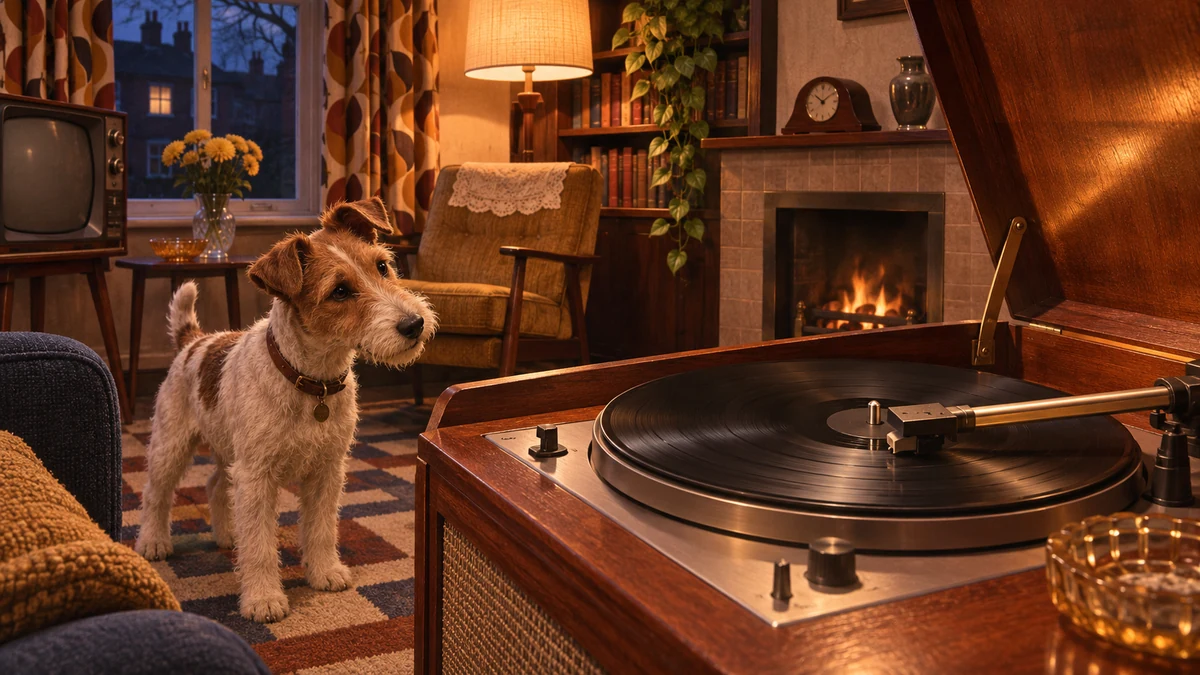
At the end of Sgt. Pepper, the Beatles left a little surprise for anyone listening with a dog. Depending on your ears and your copy of the album, you might hear it too.
The piano chord at the end of “A Day in the Life” takes its time disappearing. On an original British copy of Sgt. Pepper’s Lonely Hearts Club Band, the record has two more things to offer. There’s a thin, very high tone, and then a scrap of studio chatter that can keep going until someone gets up and lifts the needle.
The short answer
The Beatles put a tone of about 15 kilohertz on the 1967 British LP as a joke for dogs. It comes after the final piano chord and before the chatter in the locked groove. The tone is well supported. The claim that only dogs can hear it is half true. Dogs generally hear well above 15 kHz, and some human listeners, especially younger ones, can hear that pitch too.
The album ends twice
First comes the tone. It was added when the record was cut, in the spiral that carries the needle towards the centre. It lasts only a few seconds.
Then comes the chatter. On 21 April 1967, the Beatles gathered around microphones at EMI Studios and supplied a jumble of voices and noises. The studio team edited it down to roughly two seconds. That fragment went into the innermost groove, which closes into a circle. At 33⅓ revolutions per minute, the same piece of sound comes back roughly every 1.8 seconds. A manual turntable can keep playing it indefinitely. An automatic arm may lift before you hear a full loop. Another angle on record collectors, studios and experiments in sound comes from the supposed Mozart effect on babies.
Whose idea was it?
In The Complete Beatles Recording Sessions, Mark Lewisohn credits John Lennon with suggesting the high tone. Paul McCartney later remembered producer George Martin demonstrating high frequencies in the studio and the group deciding to put one on the record. Accounts of the chatter differ too. McCartney has talked about wanting a loop, while engineer Geoff Emerick remembered the group settling on the nonsense together. Compare this with Blind Willie Johnson’s recording on the Voyager Golden Record and the circus poster behind Being for the Benefit of Mr. Kite!.
The memories converge on the joke itself. The people in the room would think the music had stopped, and a dog might suddenly look up.
The awkward bit of cutting it
Putting sound into a groove that went round and round took more work than adding the tone. EMI cutting engineer Harry Moss needed several attempts to get the chatter into the right place. He recalled having to wait for unlabelled test pressings to hear whether it had worked, because the masters themselves couldn’t be played for checking. Lewisohn also records concern that putting sound in the inner groove could damage the metal parts used in pressing. The first British Parlophone issues, in mono and stereo, carried the result.
Listeners have since claimed to hear all sorts of words in the chatter, especially when it’s played backwards. What the session accounts document is a deliberately scrambled bit of studio nonsense.
What American listeners missed
The first US Capitol pressings omitted both the high tone and the chatter. In 1980, Capitol included the chatter on its US Rarities compilation under the title “Sgt. Pepper Inner Groove”. The 1987 CD of Sgt. Pepper brought back both sounds. On the CD the chatter repeats and fades, since a digital track has no physical groove to trap a needle.
So two people can put on Sgt. Pepper and get different endings. The edition matters, and on vinyl so does what the turntable does when the arm reaches the centre.
Can you hear it?
Fifteen kilohertz means 15,000 vibrations a second. That’s high for human ears, but it’s within the range some people can hear. Sensitivity at the top end generally declines with age, and it varies from person to person. Dogs can typically hear much higher frequencies, although an individual dog’s reaction is anyone’s guess.
If you’re curious, try the end of “A Day in the Life” on the 1987 CD at low volume. Keep the volume there if you hear nothing. The edition, the playback equipment and your own ears all affect what reaches you. The dog, of course, may choose to sleep through the whole thing.
Sources & further reading
- The Beatles Bible, the 21 April 1967 session and Harry Moss’s account
- The Paul McCartney Project, session accounts and recollections
- Paul McCartney on the dog tone, 2017 interview
- George Martin on the 1987 CD transfer, Reverb
- The Beatles Bible, US Rarities track listing
- Research on extended high-frequency hearing across age groups
- Louisiana State University, hearing ranges in dogs and other animals
- Mark Lewisohn, The Complete Beatles Recording Sessions (1988)