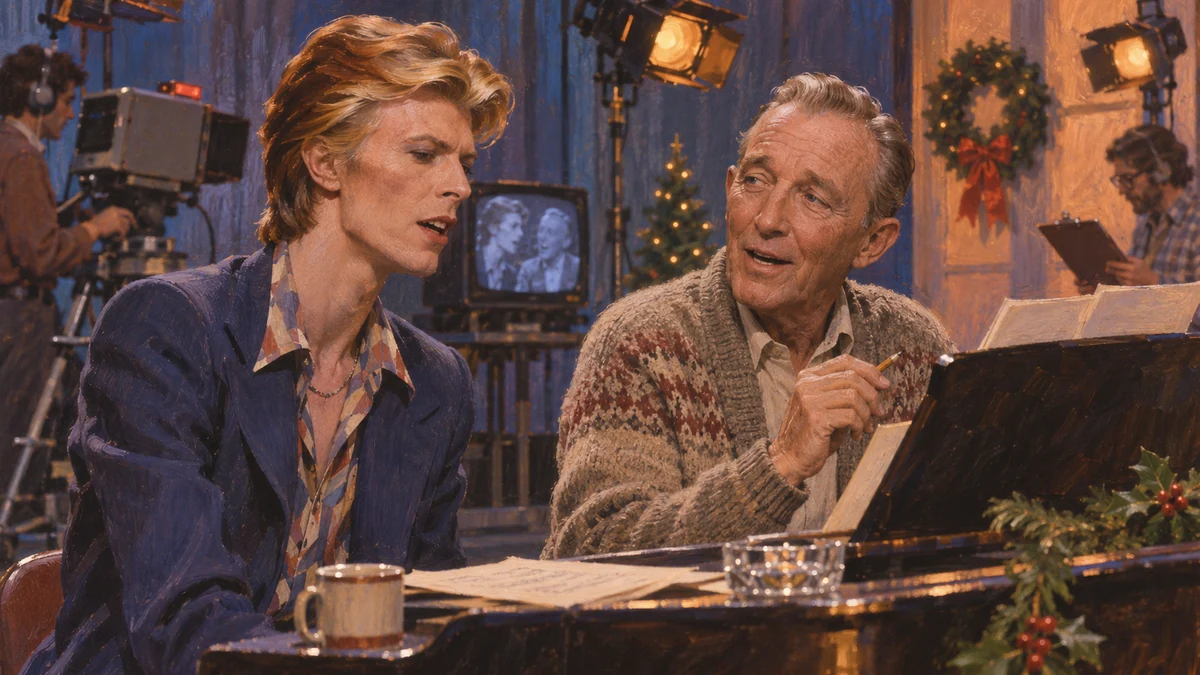
Bing Crosby’s Christmas special nearly lost its duet when David Bowie objected to the song. Three members of the production team wrote him a new part, and Crosby died before the performance aired.
When David Bowie arrived at Elstree Studios in September 1977, he was due to sing a Christmas carol with Bing Crosby. There was one problem, according to the people making the show. Bowie disliked “The Little Drummer Boy” and wanted something else to sing. The solution was to give him another song while Crosby kept the first one.
What Bowie objected to
The duet was recorded on 11 September 1977 for Bing Crosby’s Merrie Olde Christmas. Crosby was 74, and Bowie was 30. The pairing came from the producers, who were putting together a special set in England. The two men brought different audiences, and the show used that difference in a scripted conversation about music and Christmas traditions before they sang.
Musical director Ian Fraser later recalled Bowie saying he hated the carol. Composer Larry Grossman remembered the objection in similar terms. Their accounts establish that the song was a problem for Bowie. They give us little basis for a more elaborate theory about why he disliked it. The request was simple enough. He wanted a different part.
A song written to fit another song
Fraser, Grossman and scriptwriter Buz Kohan had little time to come up with something the singers could use. In about 75 minutes, according to the account in The Washington Post, they put together “Peace on Earth”. The new material had its own words and melody and was designed to fit against the existing carol. Related examples can be found in the copyright fight over Happy Birthday and the radio ban on an instrumental record.
Listen to how the two singers share the space. Crosby carries the familiar drummer’s song while Bowie brings in the new melody. The lines overlap and answer one another. The arrangement solved a production problem and gave the performance the very thing that makes it distinctive. You can hear two songs at once and follow either one.
The hour is best understood as a recollection, not a stopwatch reading. Accounts describe a hurried writing session and a short rehearsal. The writing credit itself is clear. Fraser, Grossman and Kohan are credited for “Peace on Earth”.
Did Bowie do it for his mother?
Grossman later recalled Bowie saying he had agreed to do the show because his mother loved Crosby. It is a detail from someone involved in the session, reported years later. It makes sense as a reason someone might say yes to an unlikely invitation. The surviving performance can establish what the singers did together. Bowie's full reasons for accepting the booking are harder to recover.
Crosby never saw the broadcast
Crosby died on 14 October 1977, after a round of golf near Madrid. That was 33 days after the recording. The special first aired in the United States on 30 November on CBS and in Britain on 24 December on ITV. Television viewers met the duet after Crosby’s death. Compare this with the deodorant joke behind Smells Like Teen Spirit.
It took another five years for the recording to become an official single. RCA issued it in 1982, and it reached No. 3 in the UK. The two dates sometimes get collapsed into one. In 1977 it was a television performance. In 1982 it became a chart hit.
What the evidence says
Well supported. Bowie objected to his proposed song, three contributors supplied a counter-melody, and Crosby died before the special’s first broadcast. The roughly one-hour turnaround and the story about Bowie’s mother come from participants’ later recollections.
The lasting surprise is audible. A television duet almost lost its second singer, and the part written to keep him there became the part people wait for.
Sources & further reading
- Paul Farhi, Bing and Bowie: An Odd Story of Holiday Harmony, The Washington Post.
- Randy Lewis, An odd couple carol is a hit, Los Angeles Times.
- Grossman and Kohan’s recollections, reported by People.
- PBS American Masters, Bing Crosby’s life and career.
- Recording and transmission dates and Official Charts’ Crosby chart history.