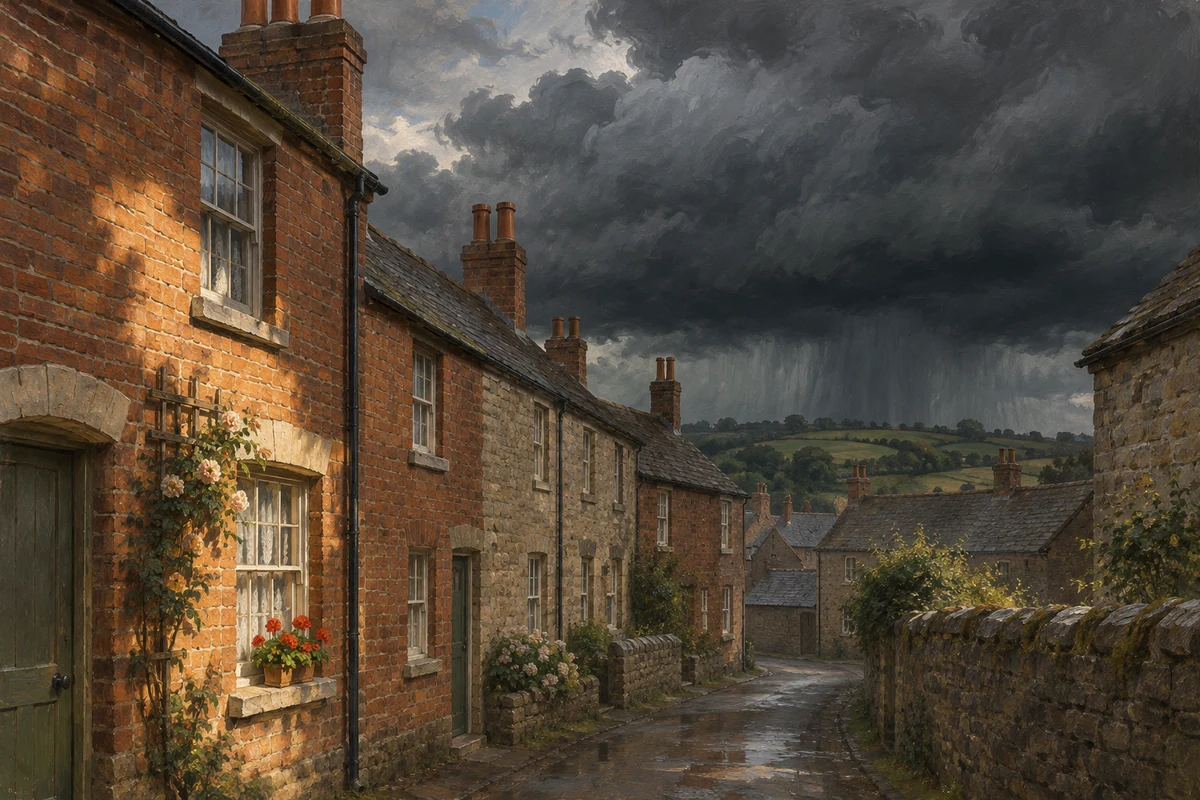
You look out of the window, see a bank of dark cloud and say it’s looking black over Bill’s mother’s. A person who grew up hearing it knows to expect rain. Everyone else has a second question. Who’s Bill?
The short answer
“It’s looking black over Bill’s mother’s” is an English weather saying. Dark clouds are gathering in the distance, and rain looks likely. Some speakers say Will instead of Bill, and some say “dark” instead of “black”. An early Suffolk account gives the phrase a direction. In the village of Lakenheath, “over Will’s mother’s” meant west. The surviving evidence gives us several places where the expression was used and very little to go on about the woman herself. Other stories about weather lore and the language of rain include the history of raining cats and dogs and the weather lore behind red sky at night.
A direction before a downpour
One early printed example is a small joke in the Bucks Examiner of 26 August 1927. The writer was describing an evening of remarkable light over Chesham after heavy rain. The spectacle was to the east, over the fields of a man called Gee. The writer set this against the familiar expression “over Will’s mother’s”, trusting local readers to understand the joke. The contrast suggests west, although the writer leaves that for the reader to infer.
In June 1930, a correspondent in Notes and Queries described a fuller weather version with Will as an old Sussex saying. That description tells us it was already familiar to the correspondent. It gives us no date for when people first said it.
The directional meaning is explicit in the Bury Free Press of 23 May 1931. In a report on Suffolk speech, Lakenheath villagers were said to call the west “over Will’s mother’s” and to use the phrase when cloud was gathering there. The writer already wondered who Will was and where his mother had lived. The mystery, in other words, is nearly as well documented as the saying.
How the saying travelled
The expression appears in accounts of speech across several English counties. A Portsmouth newspaper in 1952 gave a Hampshire version with Will. In 1977, Tony Geraghty put a Midlands version with Bill to work in The Spectator. His subject was British defence policy. The threatening clouds were figurative, but he expected readers to recognise the warning.
These examples show the saying doing slightly different jobs. In one place it can point towards the west. In another it can warn of rain, whichever way the cloud is building. It can even announce bad news with no reference to the weather. The printed examples give us glimpses of that range. They leave the route by which the saying spread between places uncertain. Related examples can be found in the nautical roots of under the weather.
The search for a real address
In 1978, a letter to the Daily Mirror asking about the phrase drew rival explanations. One reader associated it with a real family in north London. Another passed on a story about a woman whose husband Will came from Brize Norton in Oxfordshire. These are records of what readers remembered or had been told. Each gives the saying a plausible local setting, and each would need earlier evidence to establish an origin.
There is a reason such stories are easy to believe. The phrase sounds like the remains of a conversation between neighbours. Anyone who hears it for the first time might assume there is a house just beyond the next hill.
What the evidence actually says
The origin is unknown. The early Buckinghamshire, Sussex and Suffolk examples establish that the expression was circulating in several places by the early 1930s. The Suffolk account gives direct evidence for “west” in that village. It cannot tell us whether west was the original meaning everywhere, and none of the records identifies Bill, Will or his mother.
Why it stuck
“Rain’s coming” is a forecast. “It’s looking black over Bill’s mother’s” gives the weather a place in the neighbourhood. The line can pass from one family to another even after everyone has forgotten where it was supposed to point. You can still say it, and someone who knows it will look up.
Related curiosities
Why Do We Say “Raining Cats and Dogs”?
Why Does “Under the Weather” Mean Feeling Ill?
Why Do Sailors Say “Red Sky at Night”?