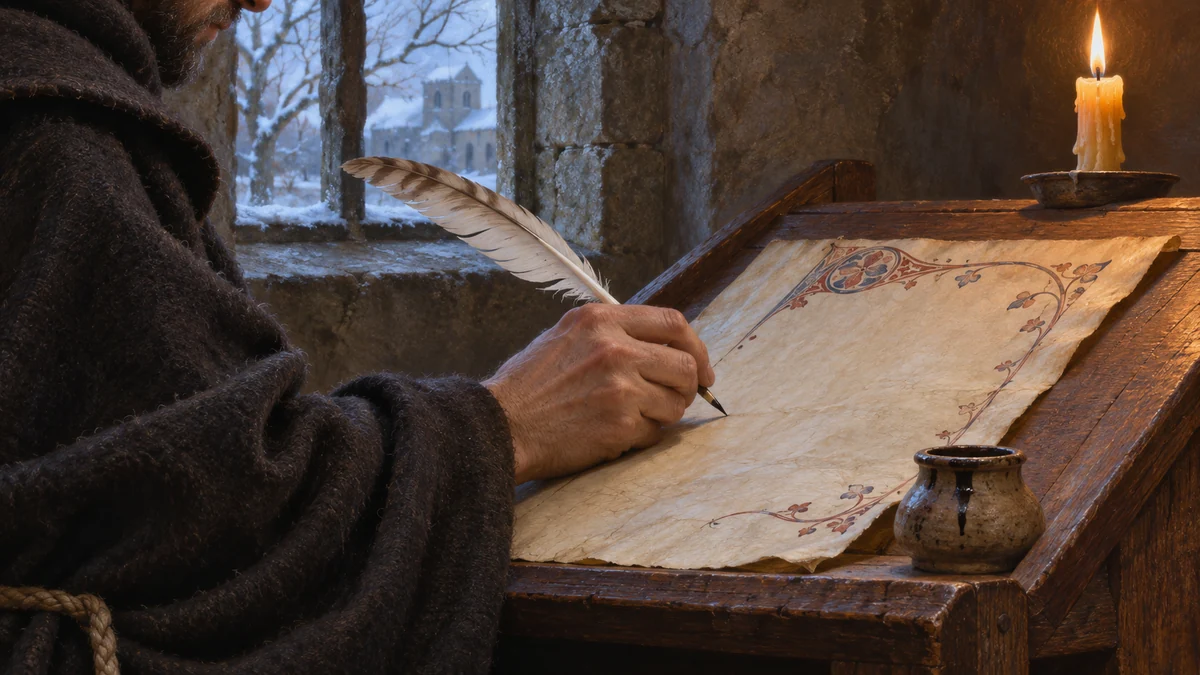
The X in Xmas has been mistaken for a stroke that crosses Christ out. It comes from the Greek letter chi, and Christian scribes were using the same shorthand nearly nine centuries ago.
On a page of the Peterborough Chronicle, a scribe tells us where King Henry held his Christmas court in 1101. The place was Westminster. The detail easy to miss is how the scribe wrote Christmas. The word for Mass is there, but Christ’s name begins with two characters that, to a modern English reader, look like X and P.
The short answer
No. Xmas has Christian roots. The X comes from chi (Χ), the first letter of Χριστός (Christos), the Greek word for Christ. Scribes used Greek letters to abbreviate the name long before Xmas appeared in its present spelling. The Oxford English Dictionary records that spelling in a letter dated 1721.
What the X stands for
In Greek, uppercase chi has the same shape as our X. The next letter of Christos is rho, which looks like a capital P. Put those two shapes together and you have the Chi-Rho (☧), a monogram for Christ. The loop at the top belongs to the rho. The diagonals belong to the chi.
The sign was associated with the Roman emperor Constantine in the fourth century. A silver medallion from that period shows it on his helmet. The image gives us a dated example of the two Greek letters doing the work of a whole name, centuries before an English scribe applied the same idea to Christmas.
What the scribe actually wrote
The Peterborough Chronicle is one version of the Anglo-Saxon Chronicle. The manuscript survives in Oxford’s Bodleian Library as MS. Laud Misc. 636. On folio 74r, the entry for 1101 uses a form transcribed as xpes mæssan, meaning “Christ’s mass”. The scribe copied that entry in the early twelfth century. The year in the text dates the event it describes.
Medieval scribes routinely shortened familiar words. Abbreviations could save pen strokes and space on a page. In this case, the scribe retained the Old English ending that marks possession, so the phrase still reads as Christ’s Mass. The short form belonged to a system readers already knew how to expand.
From X’temmas to Xmas
The spellings changed over the centuries. The Oxford English Dictionary’s citations include a form commonly transcribed as X’temmas in 1551, Xtmasse in 1660 and Xmas in 1721. That last example comes from a letter discussing school holidays. The word turns up in ordinary correspondence long before it became a familiar sight in shop windows.
On 31 December 1801, Samuel Taylor Coleridge wrote to Robert Southey about having breakfast with Davy on “Xmas day”. A decade later, Lord Byron used the same abbreviation in a letter about Hodgson spending Christmas at Newstead. Neither letter pauses to explain the spelling. The writers could expect their readers to know it. Other stories about Christmas gifts and winter folktales include the Christmas boxes behind Boxing Day and the Twelfth Night bean king.
The X had other uses too. Xian for Christian and Xianity for Christianity follow the same pattern. The Greek initial stands in for the first part of an English word.
When a spelling became a quarrel
By the mid-twentieth century, American church campaigns were urging people to give the religious side of Christmas more attention. A 1951 issue of the Episcopal periodical The Witness reported an appeal to stop using Xmas. A newspaper editorial in 1953 was already answering the claim that the abbreviation took Christ out of the holiday. Related examples can be found in children’s shoes left out for St Nicholas.
The spelling lends itself to signs, headlines and adverts because it is short. Merriam-Webster now labels it informal and notes such uses. That modern association helps explain why it may look commercial to some readers. The surviving manuscript and letters give the abbreviation a much longer history.
What the evidence actually says
Well supported. The X represents the Greek opening letter of Christos. The Bodleian manuscript shows an early English use of related Christian shorthand, and Xmas itself is recorded by 1721.
The next time you see Xmas on a card, look at that first letter again. A medieval scribe would have recognised what it was doing.
Do you write Xmas, or does it bother you?
Sources & further reading
- Peterborough Chronicle, Bodleian Library, MS. Laud Misc. 636, fol. 74r. Digital Bodleian manuscript page.
- Dave Wilton, Wordorigins.org. Christmas / Xmas, with a transcription of the chronicle passage and OED dates.
- Oxford English Dictionary, Xmas, and Merriam-Webster, Xmas.
- Michael Squire, Journal of Roman Archaeology. How to read a Roman portrait, including the Constantine medallion.
- Samuel Taylor Coleridge to Robert Southey, 31 December 1801, printed in The Atlantic Monthly, vol. 73, p. 66.
- Lord Byron, Correspondence, vol. 1, p. 67.
- The Witness, 20 December 1951, and a 1953 newspaper editorial.