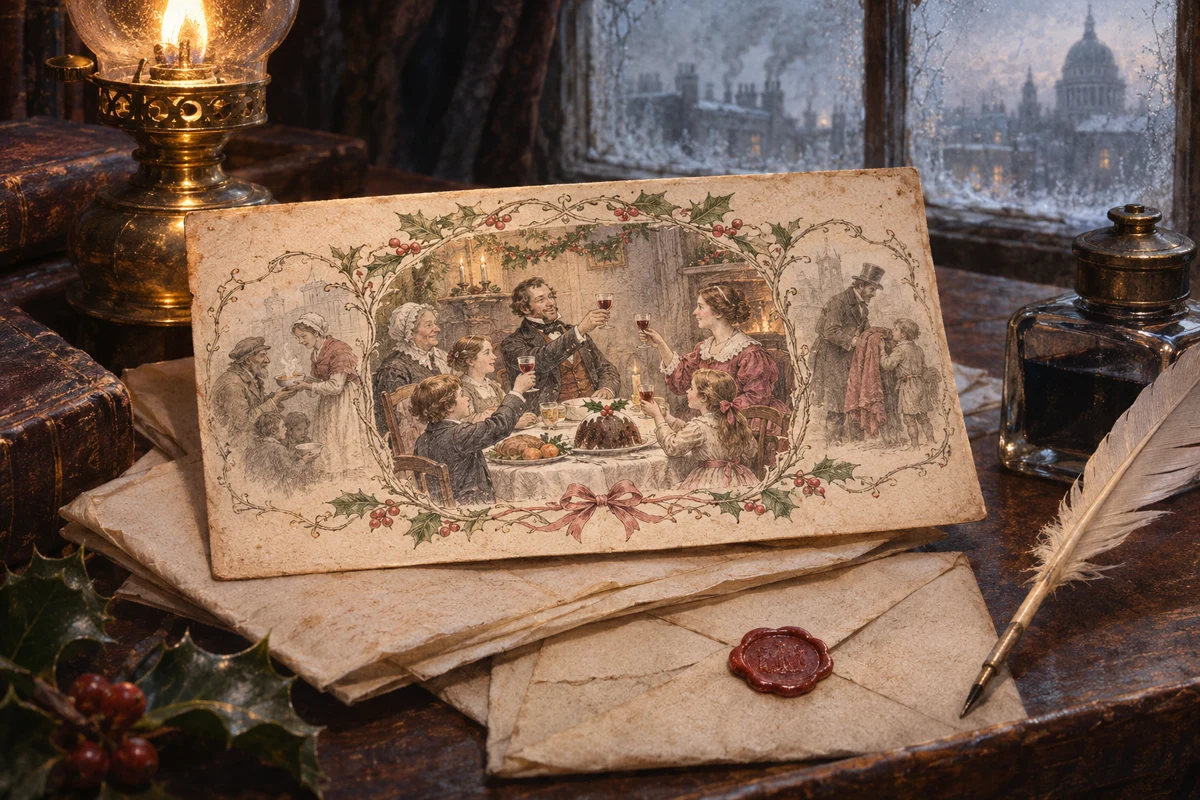
In 1754, a London essayist wished his readers a merry Christmas and a happy New Year. He borrowed the words, he said, from their barbers, tailors and shoemakers. Nearly ninety years later, a Victorian Christmas card put the same greeting in print again.
The short answer
“Merry Christmas” is an old seasonal wish that kept a word closely associated with celebration. “Happy New Year” uses the ordinary English adjective for wishing someone well, as in “Happy Birthday”. By the eighteenth century, the two had become familiar enough to be offered in one breath. Christmas cards and Dickens gave them memorable settings. The surviving records show when the expressions were in circulation. They leave the original choice of adjectives open.
A Christmas wish from the Tower
On 22 December 1534, John Fisher, Bishop of Rochester, wrote to Thomas Cromwell from the Tower of London. He was cold and asked for clothes and bedding. He also asked for books and the chance to see a priest. At the end of the letter he wished Cromwell “a mery Christmas”. The British Library holds the manuscript.
It is a striking place to find a phrase we now associate with cheerful cards and crowded shops. Fisher’s letter shows how naturally the greeting could sit alongside a sober appeal. The word merry had a wider range of meanings in older English, taking in pleasure and contentment as well as festivity. The letter gives us a dated use of the expression, with no way of knowing how long people had already been saying it.
A greeting from the tradesmen
The adjectives were still flexible. In December 1688, George Wheler, a canon at Durham Cathedral, wished his correspondent a “Happy Christmass and New-Year”. That one happy did duty for both occasions. The example comes from a letter cited by language writers Patricia T. O’Conner and Stewart Kellerman, who trace several early uses of “Happy Christmas”.
The familiar pairing turns up clearly in the London periodical The Connoisseur on 26 December 1754. Its writer wished his readers “a merry Christmas and a happy new year”, borrowing the expression from the tradespeople who called on them. He put it alongside other seasonal greetings, such as lamp-lighters and news-carriers addressing customers in verse. The Christmas boxes behind the name Boxing Day belonged to that same world of customers and tradespeople.
The essay is satirical, so it gives us the habits its readers were expected to recognise. That aside about the barber and the shoemaker tells us something particularly valuable. The pairing could already pass for everyday speech.
The year the Victorians put it on a card
In 1843, Henry Cole commissioned the artist John Callcott Horsley to design a Christmas card. A family raises glasses in its central panel. The smaller panels show acts of charity. Across the card runs the wish “A Merry Christmas and a Happy New Year to You”. The V&A has an example in its collection.
That same year, Charles Dickens published A Christmas Carol. Scrooge’s nephew Fred opens their conversation with a merry Christmas and gets a “Bah!” for his trouble. Later, as his guests raise a glass, Fred wishes his absent uncle a merry Christmas and a happy New Year. The greeting is part of the story’s argument about who deserves goodwill. Fred offers it even after Scrooge has refused it.
A card and a ghost story appearing in the same year make an appealing origin story. The Georgian essay moves the pairing back nearly ninety years. What the Victorians supplied were two enduring places to encounter it, one on the mantelpiece and one in a story people still return to each December. Another familiar sight on cards, the X in Xmas, has an even older history.
Why the words stuck
Merry fits a season of company, food and rejoicing. Happy is a broad good wish that works equally well for a birthday, a holiday or the coming year. A greeting expresses a hope, while a New Year’s resolution turns that hope into a personal undertaking. It is easy to hear the distinction as a wish for good cheer at Christmas and good things in the months ahead. That is a reasonable reading of the wording. No surviving letter, essay or card in this account tells us that people deliberately divided the greetings on those grounds.
“Happy Christmas” still sounds entirely natural in Britain, just as it did in Wheler’s letter. The two greetings we usually pair are a convention learned through repetition. The strongest clue to their staying power may be the Georgian essayist’s passing remark. He could wish his readers well in the words their shoemaker had probably used already.
Related curiosities
- Xmas: The Abbreviation That’s Older Than You Think
- Why Was the Day After Christmas Called Boxing Day?
- Why Do We Kiss Under Mistletoe?
Sources & further reading
- British Library — Cotton MS Cleopatra E VI/1, John Fisher’s letter to Thomas Cromwell, 22 December 1534
- The Anne Boleyn Files — transcription of Fisher’s letter to Cromwell
- Patricia T. O’Conner and Stewart Kellerman — “Merry or happy Christmas?”, including the 1688 Wheler letter and historical dictionary evidence
- The Connoisseur, no. 48, 26 December 1754 — digitised reprint in The British Essayists
- Victoria and Albert Museum — The first Christmas card
- Charles Dickens, A Christmas Carol (1843) — University of Virginia Library digital edition
Last Checked: 25 November 2026