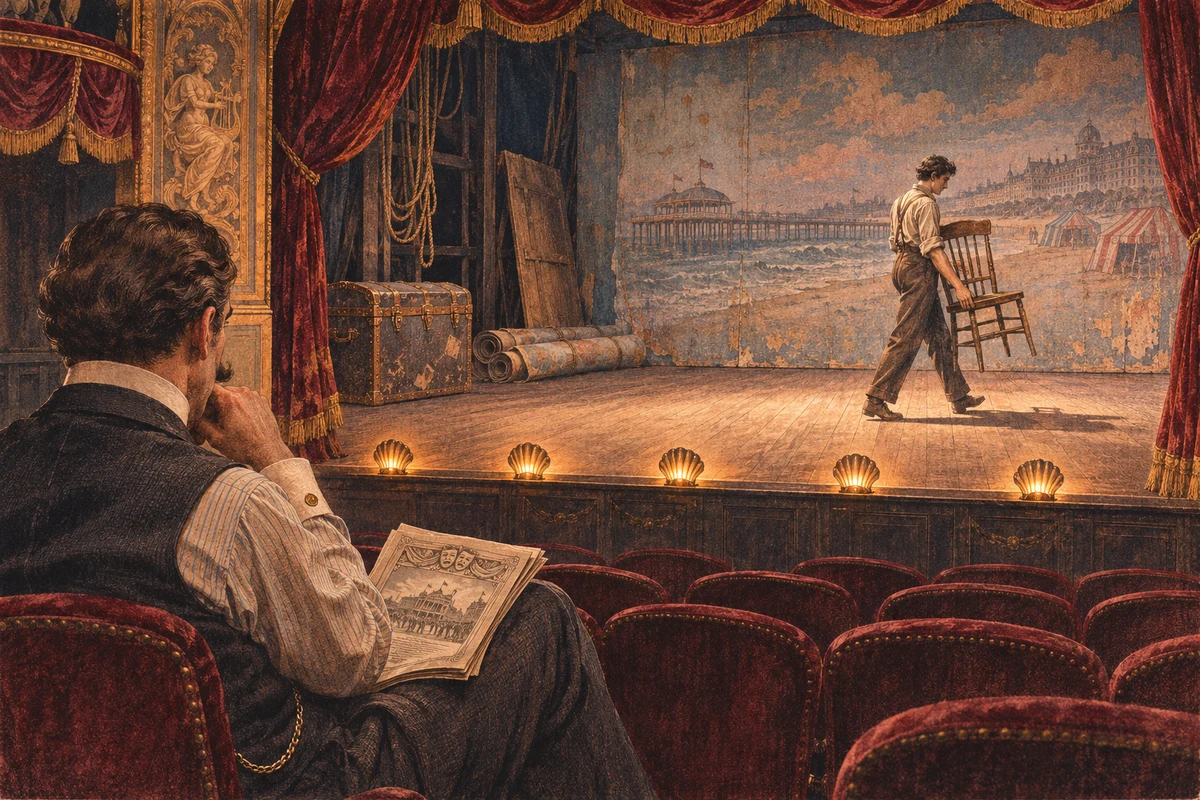
In November 1900, the Academy of Music in Atlantic City wanted an act for Thanksgiving. There were two performances on offer, a matinée and an evening show. The advert ended with three words in capitals: “NO TURKEY SHOW.”
It sounds like a manager with a seasonal sense of humour. To anyone in the business of booking acts, it was also a fairly precise instruction.
The short answer
American theatre people were calling makeshift productions turkey shows by 1900. By the 1920s, a reviewer could call an opening-night disappointment a turkey and expect readers to know exactly what their ticket money had bought them.
Thanksgiving is the best-attested contemporary explanation for the choice of bird. Some companies formed expressly to earn a share of the holiday takings. There is also a case for the name having belonged to travelling players first. The old newspapers tell us a great deal about how a turkey show worked. Finding out who named one is another matter.
What the manager was trying to avoid
A theatre company could have a very short life. A booking came up, a group of actors got together and, in some cases, the proceeds of a single performance were divided among them. A December 1907 report in the Duluth Evening Herald described just such engagements in small towns. For an actor between jobs, an evening’s share of the takings had an obvious attraction. The manager who had promised Atlantic City a first-class holiday entertainment had rather different interests.
An earlier item in the same Minnesota paper lets us hear the expression from the other side of the arrangement. In April 1903, a showman described fitting a turkey into a gap in his bookings. Asked what a turkey show was, he explained that the season was nearly over and there was still money to be made. Nobody concerned was trying to establish a reputation for the production. The object was to get it on the road while the dates were there.
Two details matter. The speaker used turkey on its own, nearly a quarter of a century before the famous Broadway definition. And by his own account, a turkey could do exactly what its organisers wanted. A few profitable nights would suit them very well.
The Thanksgiving explanation
In 1906, the Evening Telegram of New York printed a story told by the theatre man George M. Cohan. He said he had been at a printer’s when a customer came in wanting printed material for a turkey show. Cohan asked him what that meant. The customer explained that the company was going out for the Thanksgiving takings.
The paper supplied the reasoning its readers might lack. Thanksgiving drew such good houses, it said, that a show with little else to recommend it might still find an audience. Seen from the box office, the name makes sense. The holiday that put a turkey on the table could also put paying customers in the seats.
This is unusually good evidence for an origin story. People in the trade were offering the explanation while these companies were still taking bookings. There is a limit, though, to what Cohan’s story settles. Even in his telling, the printer’s customer was explaining a term already in circulation.
Did the actors bring the name with them?
Slang scholar Gerald Cohen drew attention to a second expression in American burlesque: turkey troupe. That leaves a small but consequential question. Did turkey troupes get their name from the shows they put on, or did the shows get theirs from the people who performed them?
Cohen suggested looking among the possessions of a travelling worker. A turkey was an old name for the bundle or holdall a lumberman might carry from job to job. A company of players forever moving on to the next town might have acquired the same nickname. Cohen called this part of his account a conjecture. A travelling bundle and a travelling troupe make a plausible pair. What is missing is a contemporary speaker making that connection as explicitly as Cohan’s printer-shop acquaintance made the Thanksgiving one.
Another familiar explanation appeals to the bird’s reputation for stupidity. That would account for turkey making a serviceable insult. It does less to explain why early theatrical examples keep turning up in discussions of holiday bookings, spare dates and dividing the money.
When the critic got hold of it
In September 1927, Variety reported on the opening of the road season at the Wieting theatre in Syracuse, New York. Local papers had encouraged people to support touring theatre. The attraction was Mamie Smith and Her Gang. What particularly aggrieved the writer was the price. For this, the audience had been asked to pay $2.20.
Here turkey tells us something quite different from the showman’s account in Duluth. The Syracuse writer had no need to establish how the company was formed or what the season’s accounts might show. All the reader needed to understand was that, in the writer’s opinion, the evening had been dreadful value.
That November, Walter Winchell included the word in his Vanity Fair primer of Broadway slang. His definition was “a third rate production”. Quality was the point. A poor show might sell tickets, just as a fine one might close early. Call either a box-office flop and you are talking about receipts. Call it a turkey and the audience is entitled to ask what was so awful.
By 1939 the word was perfectly at home in Hollywood. Groucho Marx used it in a letter that October. He had seen the studio’s current offering and had a low opinion of it. As for what the studio had lined up next, Groucho’s verdict was already in: “another turkey”.
Related curiosities
- Why Do Actors Say “Break a Leg”?
- Why Do We Say “Steal Someone’s Thunder”?
- Why Do We Say “Go Cold Turkey”?
Sources & further reading
- Barry Popik, “Turkey (a flop production); Turkey Show”. Dated transcriptions of the 1900 Atlantic City advert in the New York Dramatic Mirror, the Duluth reports, the Cohan anecdote and the Syracuse review. Also reproduces the Oxford English Dictionary citation for Groucho Marx’s letter of 27 October 1939.
- Walter Winchell, “A Primer of Broadway Slang”, Vanity Fair, November 1927. Winchell’s contemporary account of the vocabulary of the theatre.
- Gerald Cohen, summary of “Material for the Study of Slang Turkey”. The author sets out his burlesque-troupe and travelling-bundle theory and identifies the conjectural step.
- “How the turkey got its name (and then lent it to film flops)”, Big Think. A broader word history presenting the bird’s reputation as an explanation.
Last Checked: 25 November 2026