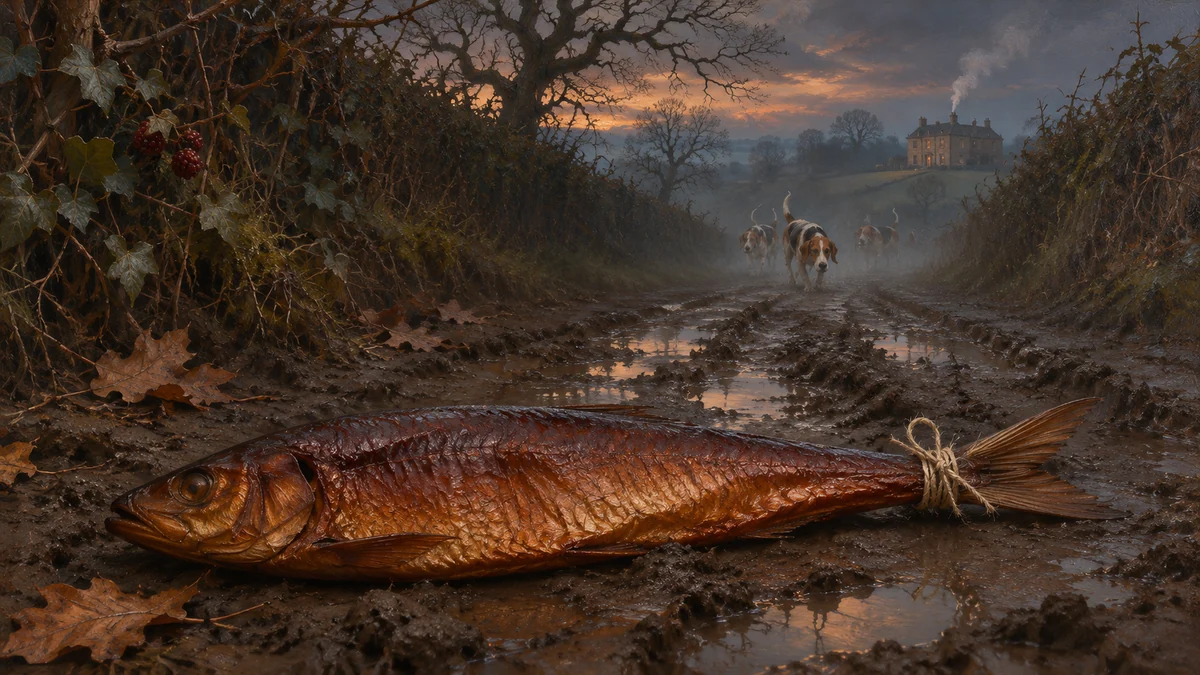
A smoked fish really could lay a trail for hounds. William Cobbett turned it into a story about misleading the press in 1807, but the political metaphor was already decades old.
In February 1807, William Cobbett took aim at the London newspapers. They had been carried away by reports of a defeat for Napoleon. To explain how easily they had lost sight of affairs at home, Cobbett told a story about a boy, a pack of hounds and a smoked fish.
The short answer
A red herring is a clue or piece of information that leads you away from the real issue. The image comes from a heavily cured fish whose strong smell could provide a trail for hounds to follow. Cobbett’s famous 1807 story turned that idea into a vivid example of political misdirection. Earlier writers had already used the scent of a red herring as a metaphor for a false pursuit.
What a red herring actually is
A red herring is a herring that has been heavily salted and smoked until it turns reddish-brown. The cure preserved the fish and gave it the pungent smell on which the whole story depends. A medieval teaching text records the Middle English wording heryng red. The fish had been familiar for centuries by the time Cobbett tied a string to one.
By the 16th century the fish also appeared in the proverb “neither fish, nor flesh, nor good red herring”. That expression describes something that fits no recognised category. It takes a scent trail to get from the preserved fish to the false clue. Another angle on force, authority and disturbing legends comes from the chickpea story from the Sicilian revolt.
The scent before Cobbett
In 1599 the writer Thomas Nashe praised red-herring skin for drawing hounds to a scent. A late 17th-century horsemanship guide published with Nicholas Cox’s The Gentleman’s Recreation describes dragging a dead cat or fox for several miles, then setting the dogs on the scent. A red herring would do in a pinch. Following the dogs gave the horses exercise over a planned course.
By 1682, a political pamphlet was already imagining a red herring dragged through the kingdom to keep the hounds in full cry over an alleged association. A century later came an especially clear example. In a parliamentary speech from 1782, printed in The Beauties of the British Senate in 1786, John Courtenay mocked supporters of the American war for following the “red-herring scent of American taxation” before discovering there was no game to pursue.
Cobbett’s hounds
On 14 February 1807, Cobbett wrote in his Political Register that, as a boy, he and his companions wanted to keep a hare for themselves. He claimed they dragged a red herring on a string over hedges and ditches, across fields and through coppices, for four or five miles. They hoped to draw the harriers far enough from the hare’s scent that the hunters would give up on it.
His real quarry was the London press. Cobbett suggested that someone had fed the papers misleading news from the Continent and that editors had followed it with the enthusiasm of hounds on a fresh scent. By Saturday the excitement had died away. He called it a “political red-herring”. Compare this with the marquess linked to paint the town red and the history of Traitors’ Gate.
Cobbett told the story again in 1833. In 1853, his son reinforced the hunting explanation in an edition of Rural Rides. Repetition helped give Cobbett’s childhood anecdote the standing of a traditional account.
The fugitives who never were
Another version has fugitives dragging smoked fish behind them to shake off bloodhounds. Some accounts instead credit fox hunters with using red herrings to teach their dogs to ignore tempting scents. Early evidence for those explanations is lacking. The horsemanship guide gives the hounds a scent they are meant to follow. Cobbett’s boys, by his telling, wanted the hounds to abandon a trail they were already on.
What the evidence actually says
Well supported. Smoked herring could be used to lay a scent trail. The political metaphor was in print before 1807, and Cobbett’s article gives us a dated, explicit example of a red herring as a distraction.
Unverified. Cobbett presented the hare hunt as a childhood memory. It reads like a story shaped to make a political point, and the episode has no independent corroboration.
Unsupported. The familiar claim that the expression began with fugitives fooling bloodhounds rests on later retellings.
Why it lasted
A detective novelist can give a suspect a motive, a missing hour and a muddy pair of boots. Every detail may be true within the story. If those details make the reader overlook the person who actually committed the crime, they have done the work of a red herring.
That is what makes the fish such a good image. A scent can be perfectly real and still lead you miles from the thing you set out to find. Even the familiar tale about where the expression came from can send you down the wrong trail.
Sources & further reading
- William Cobbett, Cobbett’s Weekly Political Register, vol. XI, 14 February 1807, “Continental War”, col. 232.
- John Courtenay’s speech of 20 March 1782, reprinted in The Beauties of the British Senate (1786). Transcribed passage.
- Michael Quinion, World Wide Words. Red Herring.
- Gerald Cohen (ed.), Comments on Etymology, October 2008, including Robert Scott Ross’s research on “red herring”.
- Grammarphobia, February 2019. Why a ‘red herring’ is a false clue.
- Dave Wilton, Wordorigins.org. Red herring.