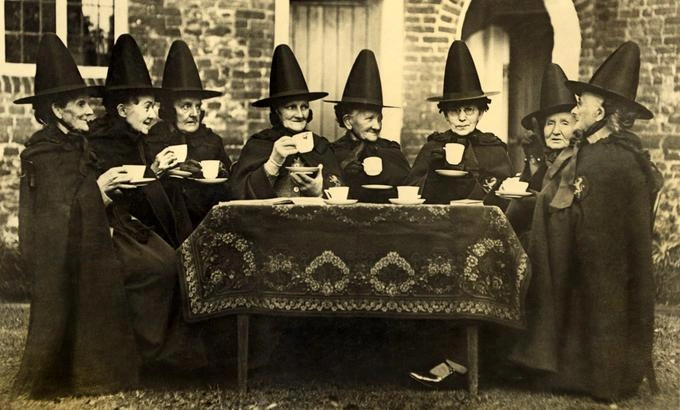
In an extraordinary photograph from early 20th-century England, a group of elderly women sit enjoying tea beneath towering black pointed hats. They look like witches gathered for an afternoon meeting. But their unusual clothing tells a remarkable story of charity, religion and a 400-year-old tradition that survives today.
The strangest afternoon tea in England
Imagine wandering into a quiet Norfolk village in the early 20th century and encountering a sight that seemed to belong in a fairy tale.
Seated around a table are elderly women drinking tea from delicate cups.
Nothing particularly unusual about that.
Except every woman is wearing a towering black pointed hat and a dark, sweeping cloak.
They look remarkably like the witches of children's storybooks.
Yet these women are neither performers nor members of some mysterious occult society.
They are residents of the Hospital of the Holy and Undivided Trinity, an almshouse in the village of Castle Rising, Norfolk.
And their extraordinary clothing is part of a tradition stretching back more than four centuries.
The story behind the photograph is stranger, and considerably more revealing, than its appearance suggests.
A hospital where nobody was ill
The word hospital might suggest a place for treating the sick, but in early modern England it could also describe a charitable institution providing accommodation and support.
The Hospital of the Holy and Undivided Trinity was established through the generosity of Henry Howard, Earl of Northampton, during the reign of King James I.
The almshouses were constructed between approximately 1609 and 1614, with the charitable foundation established in the years surrounding Howard's death in 1614.
Howard intended to provide shelter and financial security for impoverished older women.
The original institution accommodated twelve women, with an additional woman serving as governess.
The residents were often described as sisters or bedeswomen.
The latter term came from an old tradition in which recipients of charity offered prayers for their benefactors.
The women received accommodation, allowances and clothing, along with the relative security of belonging to an endowed charitable institution.
For an elderly woman without sufficient family support or independent means, such an arrangement could be invaluable.
But there was a catch.
Entry came with some remarkably strict conditions.
No drunkards, no scolds and absolutely no taverns
Henry Howard did not believe that charitable assistance should be offered without moral supervision.
The original admission rules reveal a world in which poverty, religion, gender and respectability were closely intertwined.
Residents were expected to be unmarried women of good character.
They had to be religious, discreet and respectable.
Marriage could mean losing their place.
The founder's regulations also excluded women considered troublesome, disreputable or excessively fond of drinking establishments.
Among those barred were women described as common beggars, scolds, drunkards and frequent visitors to taverns.
The term scold was particularly revealing.
In early modern England, it was commonly applied to women considered argumentative, quarrelsome or insufficiently submissive.
The rules therefore reflected not merely a concern with poverty, but the prevailing expectations about how women ought to behave.
Religious observance was equally important.
Residents were required to pray three times daily, including prayers for the founder and his family.
The charity offered genuine protection against hardship, but it also expected obedience, gratitude and a carefully regulated way of life.
For women who might otherwise face destitution, the arrangement was both a refuge and a form of social control.
Why the extraordinary pointed hats?
Now we come to the most striking part of the story.
The clothing.
The women of Castle Rising were provided with distinctive garments that made them immediately recognisable as residents of the almshouse.
Historical descriptions record blue gowns, scarlet cloaks and extraordinarily tall black hats.
The hats were sometimes described as steeple-crowned or sugar-loaf hats, referring to their unusual height and shape.
Their silhouette is instantly familiar to anyone who has seen an illustration of a storybook witch.
But the hats were not intended to suggest witchcraft.
They formed part of a traditional charitable uniform associated with the almshouse's foundation.
Norfolk heritage records describe an arrangement under which the women received clothing allowances and, at intervals, new ceremonial garments.
One 19th-century account records that the residents were entitled to a high-crowned black beaver hat every seven years.
The uniform helped identify the women as beneficiaries of the founder's charity.
It also preserved the visual identity of the institution.
And there was something particularly unusual about the cloaks.
Although they appear almost black in many early photographs, the traditional cloaks were actually scarlet red.
The contrast between the dark hats, bright cloaks and formal gowns must have been quite spectacular.
Did these women inspire the witch's hat?
It is tempting to look at the Castle Rising photographs and conclude that we have discovered the origin of the classic witch's hat.
But the history is more complicated.
Tall, pointed and high-crowned hats appeared in European clothing long before the familiar Halloween witch became a standard popular image.
Similar forms appeared in different periods, regions and social settings.
The Castle Rising residents wore one particularly striking example of this broader clothing tradition.
The Museum of Witchcraft and Magic in Cornwall holds an early postcard showing the women in their unusual attire.
The museum identifies the image as part of a series of photographs consciously evoking an earlier Jacobean appearance.
It also notes the resemblance between the women's clothing and popular depictions of witches.
That resemblance is fascinating.
But resemblance is not proof of origin.
There is no compelling evidence that the Castle Rising uniform directly created the modern witch's hat.
What the photographs do demonstrate is that clothing now associated with magic and Halloween once existed in entirely ordinary, respectable and religious settings.
Indeed, these women were expected to be models of Christian propriety.
The apparent witches of Castle Rising were among the last people their founder would have wished to associate with sorcery.
The photograph that made them famous
By the early 20th century, the residents of Trinity Hospital had become something of a photographic curiosity.
Their remarkable clothing, historic surroundings and dignified appearance made them irresistible subjects for postcards.
One surviving photograph, now preserved by the Library of Congress, shows eight women in tall hats gathered for tea.
The photograph is dated to the 1920s.
Another early postcard, held by the Museum of Witchcraft and Magic, dates from approximately 1901–1910.
Such images circulated at a time when photographers and postcard publishers were fascinated by supposedly picturesque survivals of Britain's past.
The women were presented as living reminders of an earlier age.
Their costumes were particularly appealing because they seemed to transport viewers back to the reign of James I.
The photographs also played upon the contrast between an ordinary domestic activity and an extraordinary appearance.
Tea drinking was familiar.
The hats were anything but.
The result was an image that seemed simultaneously comforting, comic and faintly supernatural.
More than a century later, that same visual contradiction continues to attract attention.
The women behind the costumes
There is another way to look at the photograph.
Rather than seeing a gathering of witches, we might see a group of women whose lives had been shaped by the limited economic opportunities available to their generation.
For centuries, older unmarried women and widows could be particularly vulnerable to poverty.
Employment opportunities were restricted, wages were often low and financial independence could be difficult to maintain.
Charitable almshouses provided one possible answer.
At Castle Rising, the women received a home within a small, established community.
The institution offered companionship, stability and practical support.
Yet the historical regulations remind us that assistance was not unconditional.
Residents were expected to conform to the founder's standards of behaviour.
Even the clothing reflected that relationship.
The women were protected by the charity, but they were also visibly identified with it.
Their remarkable hats were therefore more than quaint fashion accessories.
They represented an entire system of charity, religious duty, social expectations and public respectability.
A 400-year-old tradition that refuses to disappear
Perhaps the most extraordinary part of the story is that Trinity Hospital has not vanished.
The almshouses at Castle Rising still exist.
Their early 17th-century buildings remain an important part of the village's architectural heritage.
The institution has also adapted to modern life.
The original accommodation has been converted into self-contained cottages, and the severe moral restrictions of the founder's time have been substantially relaxed.
A report published in Norfolk Magazine in September 2024 described six women living in the historic almshouse complex.
And the remarkable clothing?
It survives too.
The residents no longer have to wear the traditional costume in everyday life.
But for special occasions, including Founder's Day, the scarlet cloaks and towering black hats still make an appearance.
According to the 2024 report, several of the surviving hats date from the Victorian period, while the newest was made in 1933.
That means some of the hats are themselves historic artefacts.
The tradition has survived the English Civil War, the Industrial Revolution, two world wars and the enormous social changes of the modern era.
What began as a compulsory uniform has become a ceremonial link with the past.
The real mystery was never witchcraft
Look again at the old photograph.
The pointed hats.
The dark cloaks.
The teacups balanced delicately in elderly hands.
It is easy to imagine some forgotten gathering of witches.
But the real story is one of charity, survival and the extraordinary persistence of tradition.
These women were not practising magic.
They were living within an institution founded more than 400 years ago, wearing clothing that preserved the memory of a long-dead aristocrat.
Their unusual appearance also reminds us how readily modern eyes can misunderstand the past.
A hat that once represented religious respectability and charitable identity can now look like the costume of a fairy-tale sorceress.
Perhaps that is the strangest part of all.
The women never needed to dress as witches. History simply changed what their hats meant to us.
---
Sources and further reading
1. Library of Congress — Not a Modern Witches' Council. Archival photograph of eight women in high hats taking tea, dated to the 1920s.
https://www.loc.gov/pictures/item/91795910/
2. Museum of Witchcraft and Magic — Postcard: Women in Pointed Hats. Early 20th-century postcard showing residents of Castle Rising and discussing their distinctive clothing.
3. Norfolk Heritage Explorer — Almshouses and Parish Almshouses. Historical foundation, allowances and uniform details.
https://nhe.esdm.co.uk/Theme/TNF2254
4. Historic England — Trinity Hospital, Castle Rising. Historical photographs and documentation of the almshouse uniform.
https://historicengland.org.uk/images-books/photos/item/LON01/01/NF/009B
5. The Almshouse Association — Trinity Hospital Castle Rising. Founder's admission regulations and modern continuation of the charity.
https://www.almshouses.org/news/trinity-hospital-castle-rising/
6. Norfolk Magazine — Cloaked in History, September 2024. Contemporary reporting on the residents, ceremonial garments and surviving historic hats.