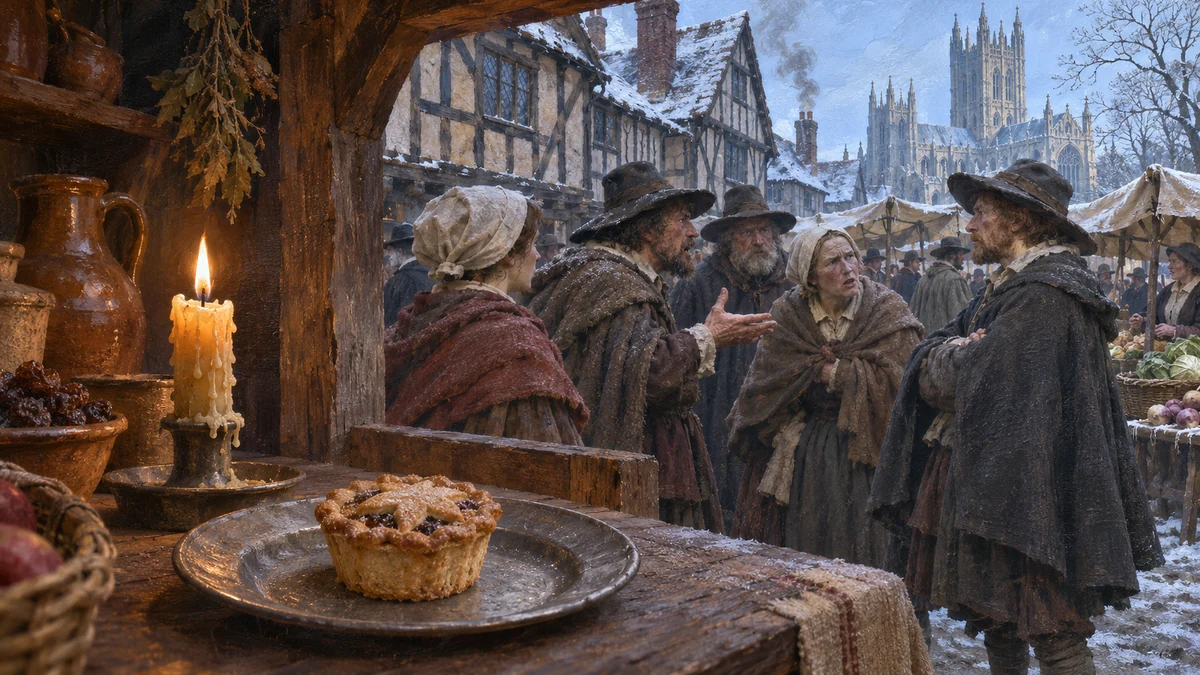
For more than a decade, England’s rulers tried to suppress Christmas. Parliament abolished the feast in 1647, six years before Cromwell became Lord Protector. The mince pies had a political life of their own.
On Christmas Day 1647, people gathered in Canterbury to demand a sermon. The mayor had forbidden it. The authorities’ response turned the gathering into a riot, and the protesters issued a declaration accusing Parliament of tyranny. A dispute over whether a minister could preach on 25 December had become an argument about who had the right to tell a city how to live.
The short answer
Partly. Parliament abolished the observance of Christmas, Easter and Whitsun in 1647. Oliver Cromwell was an MP and army commander at the time. He became Lord Protector in 1653, and the restrictions continued under his government. The Christmas measures contain no ban on mince pies by name, and the restrictions ceased to have force at the Restoration in 1660.
Why Christmas troubled reformers
For Puritan reformers, the question was whether the Bible authorised an annual feast for Christ’s birth. Scripture gives no date for the Nativity, and the reformers saw no warrant for making Christmas a holy day. They also objected to the drinking, feasting and disorder that could accompany it. The objections were both religious and practical. A day meant for devotion could turn into a very long dinner.
In 1645, the new Directory for Public Worship set out the principle that feast days without scriptural warrant should be discontinued. The dispute was over which traditions belonged in public worship and what people were expected to do with a day their parents and grandparents had kept holy.
1644: A feast falls on a fast
Parliament had set aside the last Wednesday of the month for a public fast. In December 1644 that Wednesday was Christmas Day. On 19 December, the Lords and Commons ordered that the fast be observed on 25 December in England and Wales. They called for repentance and religious reflection on a day they thought had become an occasion for excess.
A mince pie would have broken the fast, just as a slice of roast beef would. The instruction concerned how to spend the day.
1647: A Tuesday off instead
On 8 June 1647, Parliament ordered an end to the observance of Christmas, Easter, Whitsun and other feast days. The ordinance also addressed a practical problem. Traditional holy days gave people a break from work. The new arrangement allotted scholars, apprentices and other servants time for recreation on the second Tuesday of every month. Local magistrates could settle disputes over the arrangement.
A regular Tuesday break may have made sense on paper. It had little chance of taking the place of Christmas for people who wanted a service, a feast or the right to keep their shops shut on the day.
When Canterbury pushed back
The confrontation in Canterbury was one of several disturbances over Christmas in the 1640s. The mayor’s refusal to allow a Christmas sermon drew a crowd. The declaration that followed the riot turned a local dispute into a charge that Parliament was trampling on the liberty of its subjects. Canterbury would go on to play a part in the renewed civil war of 1648.
Where Cromwell fits
The case against Cromwell is stronger when it comes to enforcement. On Christmas Day 1657, during his Protectorate, the diarist John Evelyn and his wife Mary attended communion in a private chapel in London. Soldiers surrounded the worshippers, detained them and questioned Evelyn before letting him go. Other congregations continued to observe the feast, and enforcement varied. Evelyn’s account shows what could happen when the authorities intervened. Compare this with Queen Charlotte’s Christmas tree.
How the mince pie got blamed
Mince pies had a place at the Christmas table and in the printed quarrel over the feast. One satirical verse imagined Christmas killed at the Battle of Naseby, with roast beef and the “shred pie” among the casualties. For defenders of the traditional festivities, a pie could stand for a whole way of keeping Christmas. It was easier to picture than an argument about the religious calendar.
The ordinance of 1647 abolished feast days and did not list forbidden dishes. At the Restoration in 1660 the restrictions lost their force. Samuel Pepys’s diary even records sending for a mince pie on Christmas Day in 1662. Related examples can be found in the Christmas boxes behind Boxing Day and the secret-code theory about The Twelve Days of Christmas.
Scotland took a different course
Scotland had its own dispute over Yule. In 1640 the Scottish Parliament abolished the courts’ Yule vacation, and a later Parliament acted against it again in 1690. Parts of those measures were subsequently repealed, while the Kirk continued to discourage Christmas observance. Historic Environment Scotland dates Christmas Day’s recognition as a Scottish public holiday to 1958. That date tells us when the country formally took the day off. Families could mark the occasion long before then.
Which surprised you more, the riots or Scotland?
Sources & further reading
- Lords and Commons, December 1644 order on the monthly fast. The Huntington’s copy of the printed ordinances.
- Parliament, An Ordinance for Abolishing of Festivals, 8 June 1647. Institute of Advanced Legal Studies, with an extract and the Law Commission’s explanation of the mince-pie myth.
- Stephen Roberts, History of Parliament. Parliament and Christmas during the Civil War.
- Rosalind Johnson, Institute of Historical Research. Christmas Under Cromwell.
- National Army Museum. The war on Christmas.
- History of Parliament. Did the Puritans ban Christmas dinner?.
- National Records of Scotland on the Yule vacation and Historic Environment Scotland’s Christmas timeline.