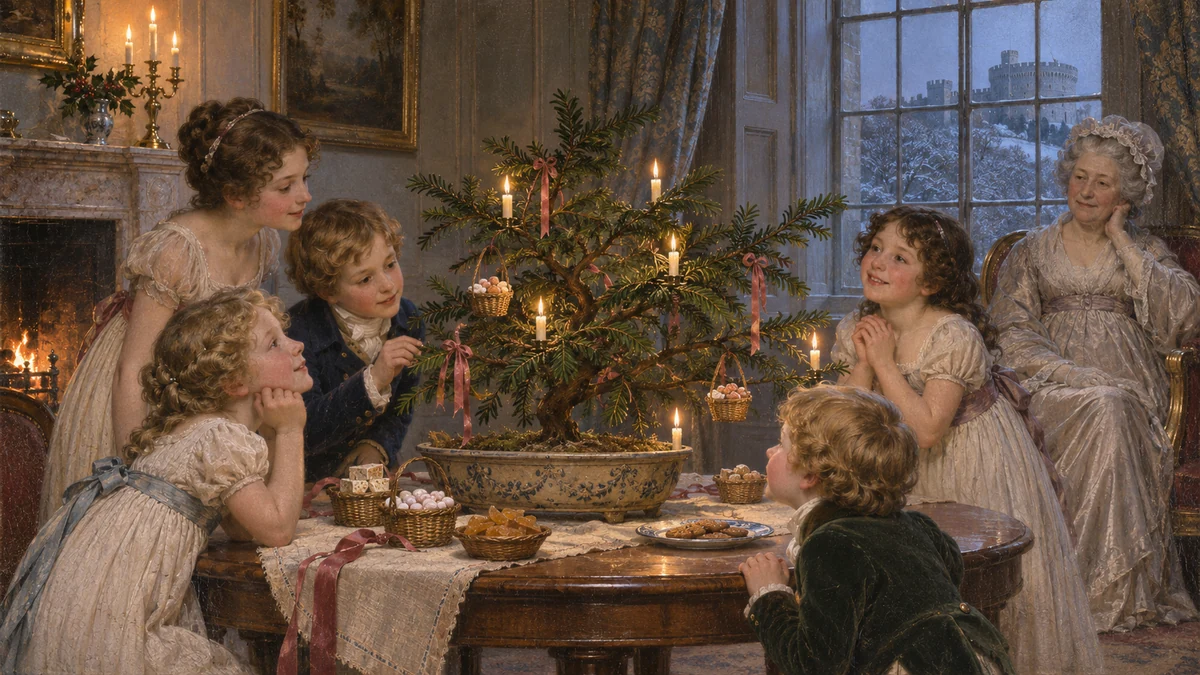
Queen Charlotte gave a Windsor Christmas party with a candlelit yew in 1800. Forty-eight years later, a newspaper engraving of Victoria and Albert’s family made a royal tradition visible to readers on both sides of the Atlantic.
On Christmas Eve 1800, the children of Windsor’s leading families came to a party at the Queen’s Lodge. There, in a large tub, stood a yew hung with sweets, fruit and toys. Little wax candles lit the branches. The queen who gave the party was Charlotte, the German-born wife of George III and grandmother of the future Queen Victoria.
The short answer
Prince Albert helped make the Christmas tree fashionable in Britain. The custom was already established in the royal household before he married Victoria in 1840. Charlotte’s Windsor tree of 1800 is an early, well-documented example. Victoria herself described two decorated trees in 1832. The picture most closely associated with Albert appeared in 1848, when the Illustrated London News showed his family gathered around a Christmas tree at Windsor.
Queen Charlotte’s candlelit yew
John Watkins described the Windsor party in his 1819 biography of Queen Charlotte. He lists sweetmeats, almonds, raisins, fruit and toys hanging from the branches. Small wax candles lit the display. The decorations were things children could eat, unwrap or play with.
Charlotte came from Mecklenburg-Strelitz. The Royal Collection Trust places the custom in royal Christmas celebrations by the late eighteenth century. The 1800 account gives us a date, a room and a tree we can describe. A private household could keep a Christmas tree without leaving a record, so the claim that Charlotte put up the first one anywhere in Britain is harder to establish.
What Victoria remembered
On 24 December 1832, Princess Victoria wrote in her journal that two round tables in the Kensington Palace dining room held trees “hung with lights and sugar ornaments”. She was thirteen. Her account describes a family occasion, complete with presents laid out on tables. This was eight years before her marriage.
After Victoria and Albert married, the custom became more elaborate. The Royal Collection Trust records trees brought from Albert’s native Coburg and displayed around Windsor Castle. Members of the royal family had individual trees with gifts beneath them, and a tree was decorated for household staff. In her diary for Christmas Eve 1841, Victoria associated the smell of the trees with happy memories. Related examples can be found in the secret-code theory about The Twelve Days of Christmas and the Christmas boxes behind Boxing Day.
The engraving that travelled
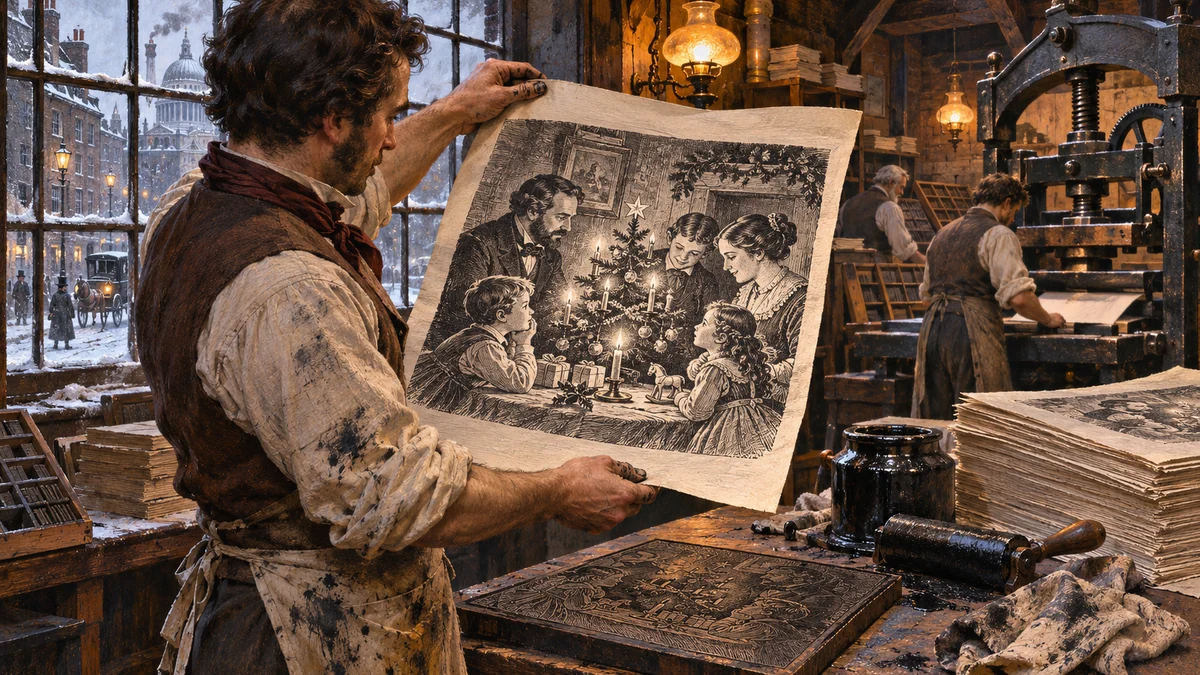
The Christmas supplement of the Illustrated London News in December 1848 carried a wood engraving titled Christmas Tree at Windsor Castle, drawn by J. L. Williams. The tree stands on a table, with lighted candles and gifts. Victoria, Albert and the children gather around it. The scene gave readers a clear idea of what a royal Christmas tree looked like and how a family might arrange one at home. Compare this with children’s shoes left out for St Nicholas.
The engraving became a widely recognised image of the custom. It is easy to see why it stuck: the reader’s eye goes straight to the tree, then to the children. A royal interior suddenly looked like a place where an ordinary family might recognise itself. The picture helped spread the fashion. The evidence gives us no count of how many households adopted a tree because of that issue.
An American family, by way of Windsor
Two years later, in December 1850, Philadelphia’s Godey’s Lady’s Book published an adapted version called The Christmas Tree. Albert’s moustache and signs of royal rank disappeared, and the caption no longer identified the castle or its occupants. The family and its tree could now pass for an American domestic scene.
The two prints make a good pair. The British version made the tree worth looking at because it was at Windsor. The American version made it easier to imagine in your own parlour.
How else did the custom travel?
There were routes through books and immigrant households as well as through the court. Samuel Taylor Coleridge saw a German family light its tree on Christmas Eve in 1798 and wrote about the custom. Historian Judith Flanders notes that his account was reprinted in the British and American press in the 1820s and 1830s, years before the Windsor engraving.
Manchester already had a substantial German merchant community around the turn of the nineteenth century. Later accounts say some German families near the city put up trees before 1840. The community itself is well documented. The evidence for the dates of individual household trees is thinner, so the Manchester tradition is best treated as a possible parallel route.
What the evidence actually says
Well supported. Charlotte’s candlelit yew predates Albert’s marriage by forty years. Victoria’s 1832 journal confirms that decorated trees were part of her childhood. The surviving engravings show how Victoria and Albert’s Christmas travelled into print and across the Atlantic.
Albert’s place in the story is still substantial. He and Victoria made the tree a conspicuous part of royal family life, and the 1848 image gave that custom a much wider audience.
Had you heard of Queen Charlotte’s tree?
Sources & further reading
- John Watkins, Memoirs of Her Most Excellent Majesty Sophia-Charlotte, Queen of Great Britain (1819), pp. 462–63. Digitised edition.
- Royal Collection Trust, Royal Christmas Trees, with the 1800 party and Victoria’s journal accounts.
- Royal Archives, Queen Victoria’s Journals, and the Royal Household’s transcription from Christmas Eve 1832.
- J. L. Williams, Christmas Tree at Windsor Castle, Illustrated London News, Christmas supplement, 1848. Library of Congress print.
- Godey’s Lady’s Book, December 1850. Scan of the adapted engraving.
- Judith Flanders, Gresham College, Christmas Myths and Christmas Traditions.
- Manchester City Council, local history of Manchester’s German community.
- British Philatelic Bulletin, vol. 37, no. 4, Christmas Decorations, for the later account of trees kept by German merchants near Manchester.