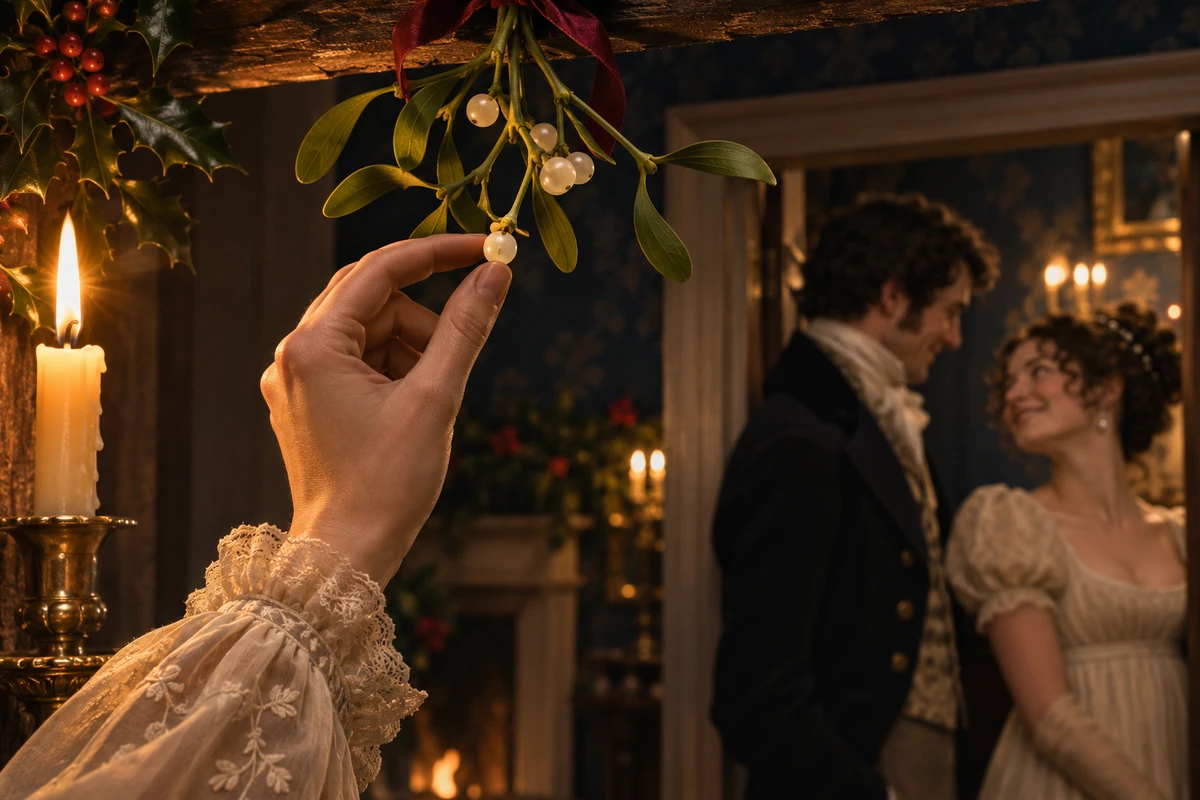
The white berries on a Christmas sprig once did a job. Each time somebody kissed beneath the mistletoe, one berry was taken off. When the sprig was bare, the game was over.
The short answer
Plucking a berry was a way of counting down the kisses. In his essay ‘Christmas Eve’, published around 1820, the American writer Washington Irving described mistletoe hanging in English farmhouses and kitchens. He explained that one berry was picked with each kiss and that the privilege ended when the berries were gone. That puts the rule on record before Victoria came to the throne. Who devised it, and where, remain open questions.
The rule in the footnote
Irving’s Christmas scene is full of things to do. There are parlour games, a Yule log and a Christmas candle, with mistletoe among the greenery. The detail that matters here is tucked into a note. Irving explains how the berries were plucked and ends with a wonderfully matter-of-fact sentence: ‘When the berries are all plucked, the privilege ceases.’
The note also tells us who was expected to do the kissing. Irving describes young men kissing young women under the sprig. That is the version of the custom he chose to record. His account gives us a glimpse of the expectations at one kind of Christmas gathering, and the limit it placed on the game. Other stories about Christmas gifts and winter folktales include Christmas kissing under mistletoe and the secret-code theory about The Twelve Days of Christmas.
There is earlier evidence for the kiss itself. Smithsonian Magazine traces an explicit English reference to 1784. The date establishes that the kissing custom was familiar enough to appear in verse by then. Irving is the source here for the countdown. A record of a kiss and a record of a berry being plucked answer different questions.
What the berries did
Imagine the sprig halfway through the evening. A guest could look up and see both what the greenery invited and how much longer the invitation would last. Picking a berry made each kiss change the decoration everyone could see. A small sprig would bring the game to an end sooner than a well-laden one.
The plant supplying the counters is European mistletoe, Viscum album. It makes its own sugars through photosynthesis while drawing water and minerals from its host tree. That makes it a hemiparasite. In winter, its green leaves and pale berries are easy to spot among bare branches. Indoors, those same berries were easy to count. Related examples can be found in Queen Charlotte’s Christmas tree.
Frigg’s tears belong to a different telling
In the Prose Edda, Frigg takes oaths to protect her son Baldr and spares the mistletoe because she thinks it too young to ask. Loki discovers the omission and guides the blind Höðr, who strikes Baldr with mistletoe. An attempt to bring Baldr back from the realm of the dead fails when one figure refuses to weep for him.
Some later retellings give the plant a gentler part. Frigg’s tears become the white berries, and mistletoe becomes a token of love. The white berries make that ending memorable. For the English party rule, the evidence leads back to Irving’s footnote.
The last berry
We can say how the game ended in Irving’s account. We can also say it was in print before the Victorian era. What we cannot tell from that footnote is how widely people kept count, whether households played by the same rules, or when the first berry was picked.
A sprig still signals Christmas even if nobody bothers to count its berries. But in the version Irving recorded, the smallest thing in the room could call time on the whole game.
Related curiosities
- Why Do We Kiss Under Mistletoe?
- Why Do We Hang Stockings at Christmas?
- Why Did a Horse’s Skull Sing for Its Supper in Wales?
Sources & further reading
- Washington Irving, ‘Christmas Eve’, The Sketch Book — the berry rule in Irving’s note.
- Smithsonian Magazine, ‘How Mistletoe Became a Christmas Kissing Tradition’ — the 1784 reference and chronology.
- Snorri Sturluson, Gylfaginning, Arthur Gilchrist Brodeur translation — Baldr’s death and the attempt to bring him back.
- Royal Botanic Gardens, Kew, ‘Surprising facts about mistletoe’ — mistletoe biology and Christmas traditions.
- The Mistletoe Pages, ‘Traditions’ — variations on the kissing custom.