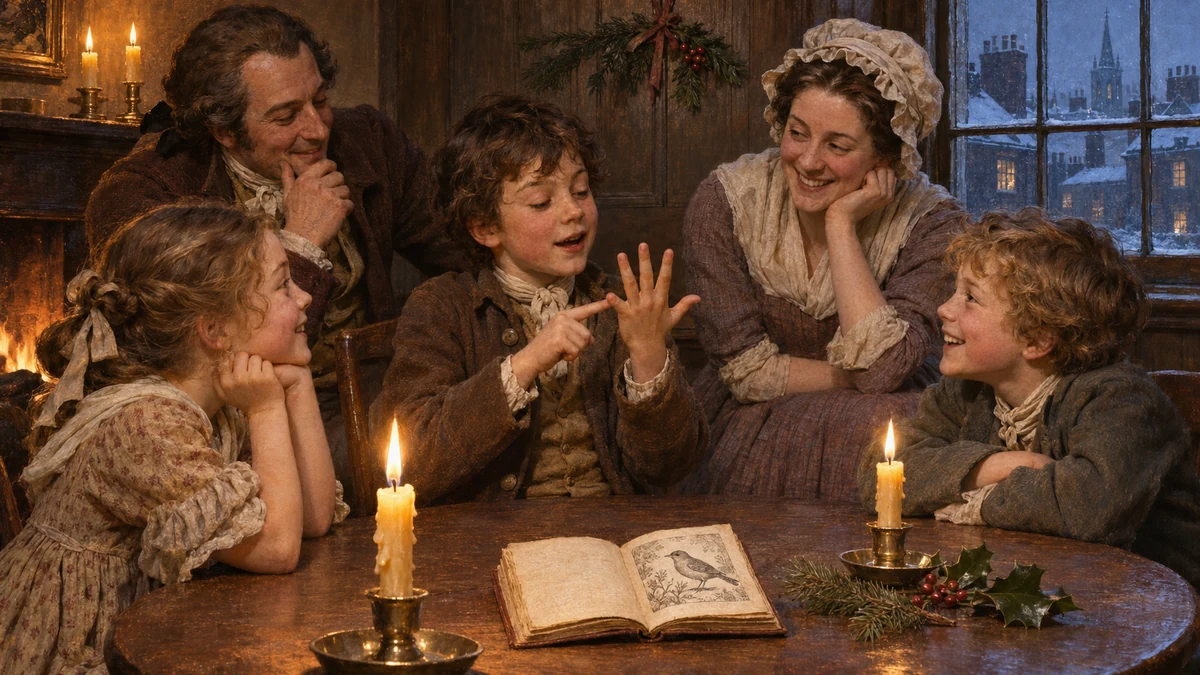
The turtle doves supposedly stand for the two Testaments, and the leaping lords for the Ten Commandments. The earliest printed evidence puts the song among children’s amusements. The secret-code story turns up nearly two centuries later.
Try getting through the twelfth verse without swapping two presents or leaving out a bird. Now imagine doing it with the whole room listening and a forfeit waiting if you stumble. That was one way to play The Twelve Days of Christmas. It also explains why a song about presents gives you the same presents over and over again.
The short answer
Almost certainly no. There is good historical evidence that The Twelve Days of Christmas was played as a memory-and-forfeits game. Its words were in print by about 1780. The story that the gifts formed a secret Catholic catechism can be traced to the late twentieth century, and its proponents have produced no contemporary evidence that the song was devised for that purpose. Its precise beginnings before publication remain uncertain.
A small book of games
One of the earliest surviving printings is in Mirth without Mischief, a London children’s book published by C. Sheppard and conventionally dated to around 1780. The Christmas verses share the booklet with other amusements, including a game about a wide-mouthed frog. The early text already has the partridge, the pear tree and the growing list of presents. Its fourth gift is “colly birds”, an older expression for dark or black birds.
The rules make sense of the repetition. Players take turns repeating the gifts. Each round adds another item, and everyone has to remember what came before. Get one wrong and you owe a forfeit. The folklorist Alice Bertha Gomme recorded a version in which a player handed over a small possession after a slip. By the end of the game, the group had a collection of forfeits to redeem.
The book tells us what people could read by the late eighteenth century. The game accounts tell us how people used the verses. The date when someone first put a partridge in the pear tree is still open.
Where the secret code came from
In the familiar story, Catholics in England taught children the faith through a song that could be recited without raising suspicion. The partridge stands for Christ. Two turtle doves stand for the Old and New Testaments. Three French hens represent faith, hope and charity. The ten leaping lords are the Ten Commandments, and the twelve drummers are the twelve articles of the Apostles’ Creed. Compare this with children’s shoes left out for St Nicholas and the children’s author who operated a radio in occupied Paris.
The historical setting gives the story much of its force. English Catholics really did face penalties and restrictions after the Reformation. The claim is sometimes told as a single ban running from 1558 to 1829, though the laws changed over time. Parliament’s chronology records relief in 1778, freedom of worship under the 1791 relief act and further political emancipation in 1829.
The paper trail for the interpretation is far more recent. Canadian hymnologist Hugh D. McKellar proposed a religious reading in a 1979 article, “How to Decode the Twelve Days of Christmas”, and returned to the subject in The Hymn in 1994. A similar account by Father Hal Stockert, reportedly written in 1982, appeared on the Catholic Information Network in 1995 and circulated online. These accounts supply a key to the gifts. The missing piece is a period source connecting that key to the song. Another angle on Christmas gifts and winter folktales comes from Parliament’s Christmas ban.
What would the code have hidden?
The proposed lessons give us another reason to be cautious. The two Testaments, the Trinity, the Ten Commandments and the Apostles’ Creed belonged to mainstream Protestant teaching as well as Catholic teaching. They make sense as subjects for religious instruction. They give little reason for a Catholic household to conceal those particular lessons in a list of birds and presents.
The wording also varies across versions. “Calling birds”, familiar to many singers today, came after the older “colly birds”, and James Orchard Halliwell’s 1843 collection gives the tenth day ten ships sailing, with the leaping lords on day nine. A group can still play the memory game with a different list. A claim about a fixed code needs evidence that its particular gift-to-lesson pairings were recognised at the time.
Why everyone stretches “five gold rings”
The words were circulating long before the familiar modern arrangement. In 1909, Novello published Frederic Austin’s setting. It gives the fifth gift the long, emphatic phrase that draws everyone in, even the people who have already lost track of the birds. Earlier versions used other tunes. The words have their own history, and the version most of us know has a separately dated score.
The real twelve days
Count Christmas Day as day one and the twelfth day falls on 5 January. On that reckoning, Twelfth Night is the evening before Epiphany on 6 January. Some traditions count the days differently. The title refers to the festive days following Christmas, a season that had room for both worship and games.
The song can still serve as a religious mnemonic for anyone who enjoys reading it that way. The strongest evidence for its early use is a roomful of people trying to remember what comes after the five gold rings.
Were you taught the secret-code version?
Sources & further reading
- Mirth without Mischief, London, c. 1780. Catalogue description of the early edition and transcription of the verses.
- Library of Congress, Is it “Four Calling Birds” or “Four Colly Birds”?.
- Alice Bertha Gomme, The Traditional Games of England, Scotland, and Ireland, vol. II, “Twelve Days”. Digitised volume.
- English Folk Carols’ notes on the game and McKellar and Hymns and Carols of Christmas’s notes on Stockert and other sources.
- UK Parliament, Religion and belief: key dates, 1689 to 1829.
- Frederic Austin, 12 Days of Christmas, Novello, 1909. Score catalogue and scan.
- English Heritage, Christmas traditions and the date of Twelfth Night.