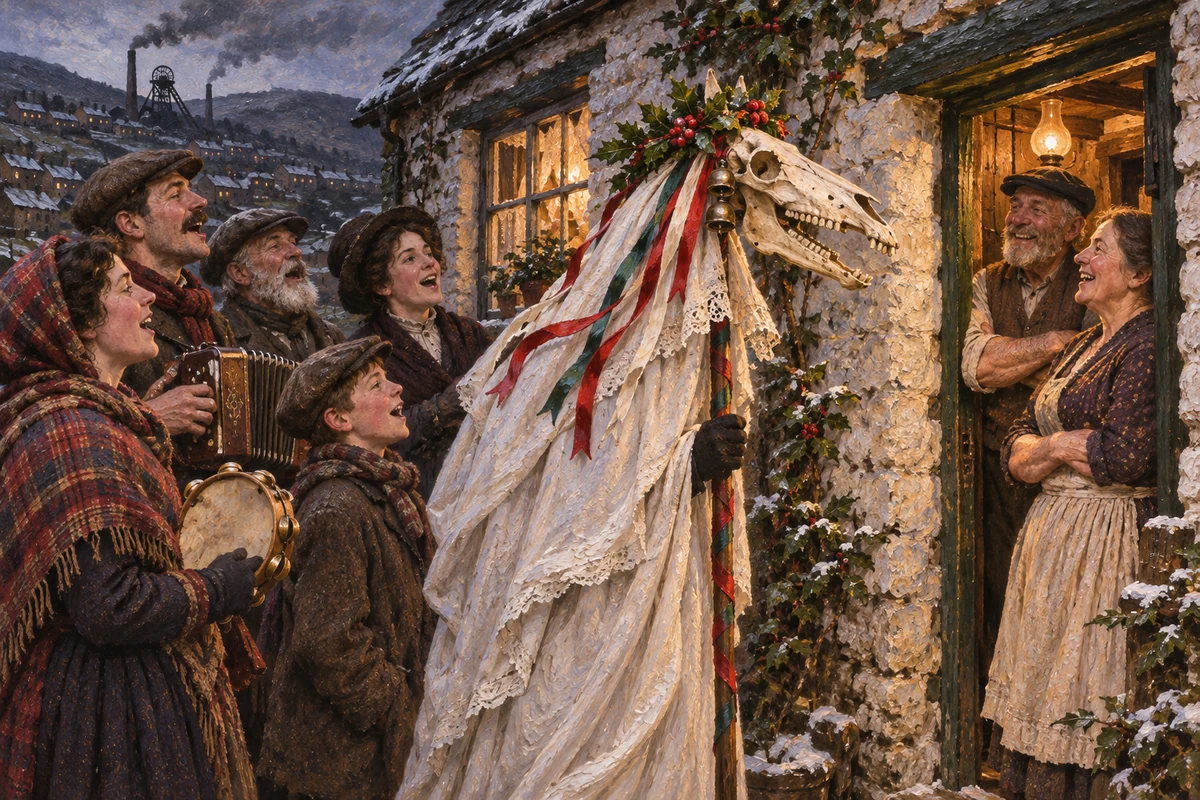
The party outside wants to come in. It has brought songs, a horse’s skull and a white cloth that reaches almost to the ground. You can answer through the closed door, but if you mean to keep them out, you’ll need a verse of your own.
The short answer
The Mari Lwyd is a Welsh winter visiting custom, particularly associated with south Wales. A group carried a horse figure from house to house or to pubs during the Christmas and New Year season. The party asked for entry in song. In the exchange known as pwnco, the people inside could reply with verses of their own. Admission might bring food and drink for the visitors, entertainment for the household and, according to tradition, good luck for the place that let the Mari in. Other stories about Welsh and British seasonal folklore include Welsh courtship lovespoons and the Gwyllion of Welsh folklore.
What came to the door
A horse’s skull was characteristic, although Museum Wales records other materials being used. A cloth concealed the carrier, who could make the head move and, on some figures, snap its jaws. Ribbons, rosettes and artificial eyes gave it a face suited to a celebration even when the underlying skull was unmistakable.
Museum Wales holds a Mari Lwyd from Llangynwyd, Glamorgan, dated to about 1900. Another Llangynwyd example in the collection has green glass eyes and decorations that include bells, tinsel and ribbon. A surviving figure shows how much work went into an object that would chiefly be seen in motion, with a group of people around it and a householder deciding whether to open the door.
The contest through the door
The Mari had company. A leader could direct the singing, and some parties included comic characters. The precise line-up varied. At the door, the group’s verses could be answered with excuses or challenges from the household. The exchange could be playful and improvised, and people on both sides had a part in keeping it going.
Once admitted, the party might continue singing or playing music. The Mari could snap at people while the leader pretended to restrain it. There could be something to eat and drink, and a farewell song before the group moved on. The title’s horse sings for supper through the people who bring it. Their performance earns the welcome. Related examples can be found in the secret-code theory about The Twelve Days of Christmas.
How far back can we follow it?
Museum Wales dates the earliest known account to 1798 and identifies the nineteenth and early twentieth centuries as the period in which the custom flourished. That is enough evidence to follow an established winter tradition. The date marks a surviving description, while the custom itself may have circulated earlier.
The figure’s striking appearance makes an ancient explanation tempting. A horse’s skull and a winter date are too little evidence on their own to establish a direct line to a specific pre-Christian rite. The records are clearest about the visits, the verses and the people who took part. The number of groups declined in the twentieth century, and Museum Wales records renewed interest and more groups performing in recent years.
The best way to understand the Mari is to stay at the door for the answer. The skull gets your attention. The reply from inside makes the visit a custom shared by the whole household.
Related curiosities
Why Did People Wassail Apple Trees?
Why Does a Spanish Village Throw Turnips at a Masked Monster?