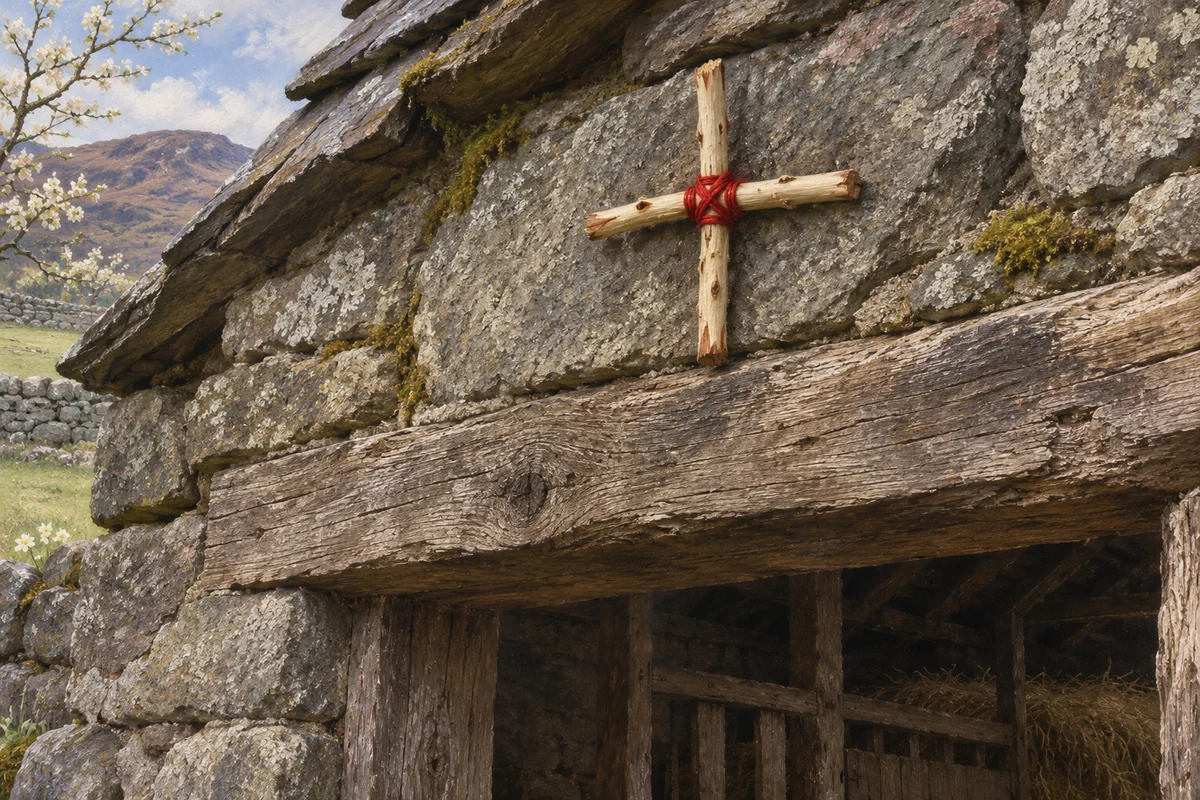
In Angus, an old account describes a piece of peeled rowan wrapped in red thread and placed above a cowshed door. The charm was small enough to overlook, which was just as well. The threat it was meant to guard against could arrive in a look.
The short answer
In parts of Scotland, people treated rowan wood as a safeguard against witchcraft, the evil eye and other dangers. Some bound a peeled twig with red thread and placed it above the door of a byre, or cowshed. Others used rowan crosses or carried a charm under their clothing. The records tell us what people hoped these charms would do and show how their use varied from place to place. Related examples can be found in blue eye charms against the evil eye and horseshoes as protective charms.
A twig above the cowshed door
In his 1893 study Scottish Charms and Amulets, George F. Black gathered accounts of rowan, also called mountain ash. For Angus, he cited an account from 1819 describing a piece of branch that had been cut, peeled and wound with red thread. It was put above the byre door on the eve of Rood Day, the observance that fell on 3 May. Its purpose was to avert the evil eye, the belief that a look could bring harm.
Black also cites an 1862 report from Aberdeenshire. On the same eve, people set up crosses of rowan to protect against evil spirits and witches. The Angus passage describes a bound piece of branch. The Aberdeenshire passage specifies crosses. Together they show how neighbouring traditions could share a tree and a date while differing in the details.
A charm you could wear
The byre door was only one place for rowan. Black cites an early nineteenth-century description of a red-threaded rowan cross placed between the cloth and lining of a garment. He also records a qualification from the folklorist Walter Gregor. In the version Gregor described to him, the thread must have no knot, or the charm would lose its power. That single instruction brings us close to the people making these things. Even the way the thread was fastened could matter.
Other examples brought the wood closer still to the animal it was meant to guard. Black cites accounts from Kirkcudbrightshire and Speyside of small pieces of mountain ash bound into cows’ tails against witchcraft. Around St Fillans in Perthshire, he records rowan over byre doors as late as 1887, in this case to keep cattle free from disease.
What the evidence actually says
The custom is well supported. Black identifies places, dates and earlier sources, and museum collections preserve related objects. The Museum of Witchcraft and Magic catalogues a small rowan cross with red ribbon and also describes red-threaded crosses collected in Yorkshire. Scottish records give the story its focus, while the Yorkshire examples show that the practice crossed the border.
Those sources tell us more about use than origin. The red thread appears often enough to be recognisable, including in a rhyme Black records linking it with rowan and witches. The surviving accounts leave open why red was chosen in the first place, when wood and thread first came together, and how far any one version travelled. They also show rowan used on its own, which helps explain why a charm’s shape or binding needs to be tied to a particular account.
Why the small details matter
A peeled twig above a door, a cross slipped into a coat and a piece of wood bound into a cow’s tail all put protection close to whatever mattered. A household could make such a charm from things close at hand. Where it went, when it was put up and even whether the thread was knotted depended on whose instructions you followed. Compare this with touching or knocking on wood for luck.
Related curiosities
What Is the Evil Eye—and Why Do People Wear a Blue Eye Charm?
Why Did People Hide Old Shoes in Their Chimneys?
Sources & further reading
- George F. Black, Scottish Charms and Amulets, Proceedings of the Society of Antiquaries of Scotland, 1893, especially pp. 477–478
- Walter Gregor, Notes on the Folk-Lore of the North-East of Scotland, 1881
- Museum of Witchcraft and Magic, Rowan or Bride’s Cross, object 1491
- Woodland Trust, Rowan (Sorbus aucuparia), identification and folklore