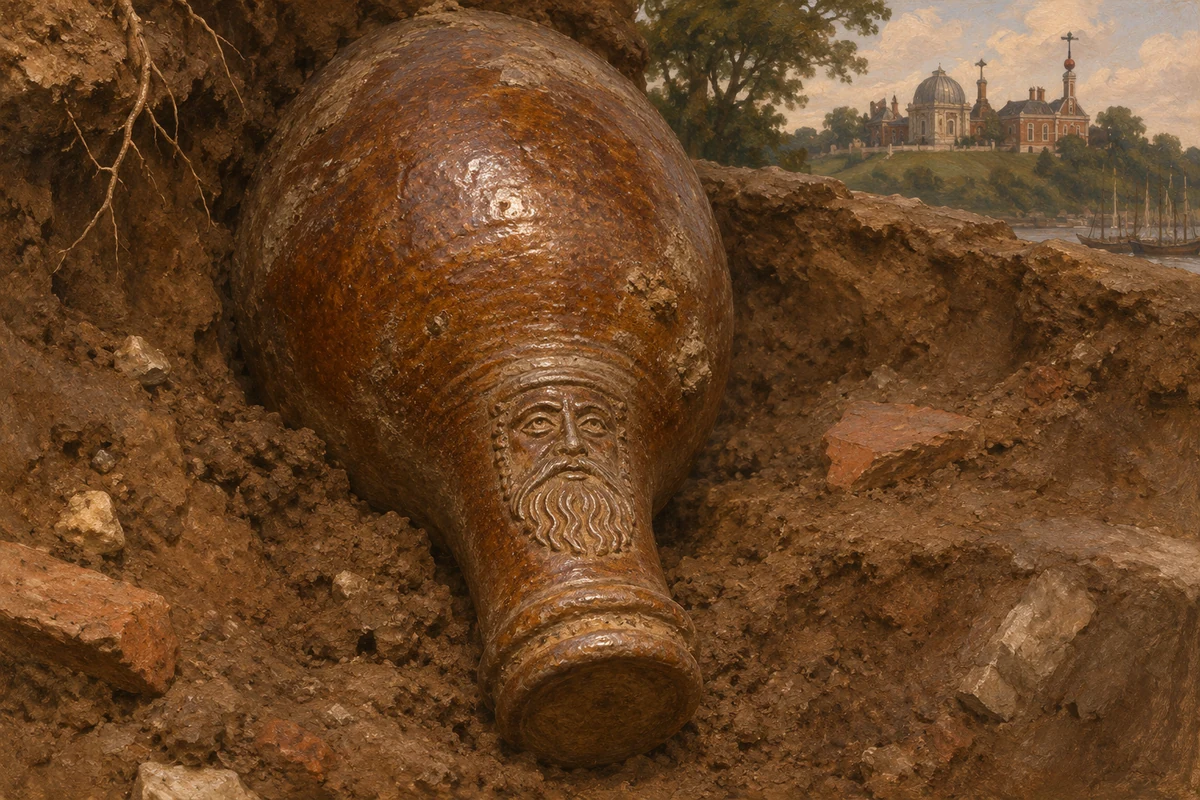
When a stoneware bottle came out of the ground in Greenwich in 2004, its cork was still in place. It rattled and sloshed. An X-ray offered the first clue to what someone had put inside.
The short answer
In seventeenth-century England, some people used bottles filled with pins, nails and other materials to treat illnesses they attributed to witchcraft. The idea was to turn the harm back on the person believed to have caused it. Some written accounts describe warming a sealed bottle. Archaeologists have also found examples buried or hidden, sometimes near a hearth or beneath a floor. The Greenwich bottle held human urine and a collection of sharp objects that make sense in light of those accounts.
A bottle with its contents intact
The Greenwich find was a stoneware vessel of a type commonly called a Bellarmine. It had been buried upside down. X-rays showed pins and nails lodged near the neck, while a CT scan showed liquid still inside. The team took a sample through the cork and identified it as urine. A nicotine metabolite suggested that it came from someone who smoked.
Once the bottle was opened, the team counted twelve iron nails and eight brass pins. One nail pierced a piece of leather cut into a heart. There were also hair and fingernail clippings. Because the bottle was still sealed when it was found, the team could study the liquid and objects together. Compare this with the grave opened in the Petar Blagojević case and the association of witches with Halloween.
The leather heart is tempting to read as a message about the person who put it there. Its shape and the nail are facts. Any more specific explanation of what the heart stood for is an interpretation.
A cure that was meant to send harm back
In 1671, Joseph Blagrave included a bottle remedy in his Astrological Practice of Physick. He instructed readers to seal up the patient’s urine with a little salt and three sharp objects, such as pins, nails or needles, and keep it warm. He thought this would make it painful for the suspected witch to pass water. He even discussed when the treatment would work best according to the position of the Moon.
It is easy to assume the liquid was supposed to come from the suspected witch. In Blagrave’s version it came from the patient. His explanation depended on a supposed connection between the person suffering and the person believed to have caused the suffering. Treating the contents of the bottle was meant to act on someone elsewhere. Another angle on belief, spirits and protective rites comes from the belief that a double foretold death.
What the evidence actually says
The broad interpretation is well supported. Historical recipes describe the use of urine and sharp metal objects against supposed witchcraft, and the Greenwich bottle contains both. The bottle’s burial and additional ingredients show that the surviving object differs from Blagrave’s written instructions. The two sources illuminate each other without telling us exactly what happened in Greenwich.
The Museum of London Archaeology records vessels found in hearths, under floors, in ditches and on riverbanks. That range is one reason to be careful with the familiar story of a bottle buried under every hearth to guard against witches. Some contemporary descriptions concern treatment after someone fell ill. A hidden vessel’s location alone rarely tells us whether it was intended as a cure, a safeguard or something else.
Why the Greenwich bottle matters
Someone chose a jar, gathered the ingredients, sealed it and put it into the ground. The archaeology recovers those actions. The written accounts help explain why such actions could seem worth taking when an illness felt beyond a household’s control. The rare thing about the Greenwich find is how much of that decision the cork kept together.
Related curiosities
Why Did People Hide Old Shoes in Their Chimneys?
What Is the Evil Eye—and Why Do People Wear a Blue Eye Charm?
Why Are Horseshoes Supposed to Be Lucky?
Sources & further reading
- Museum of London Archaeology, ‘Witch bottles’ concealed and revealed
- Samir S. Patel, Opening a Witch Bottle, Archaeology
- What is a ‘witch-bottle’? Assembling the textual evidence from early modern England
- Wellcome Collection, Joseph Blagrave’s Astrological Practice of Physick, 1671
- The Salisbury Museum, Witch Bottle, via Wessex Museums