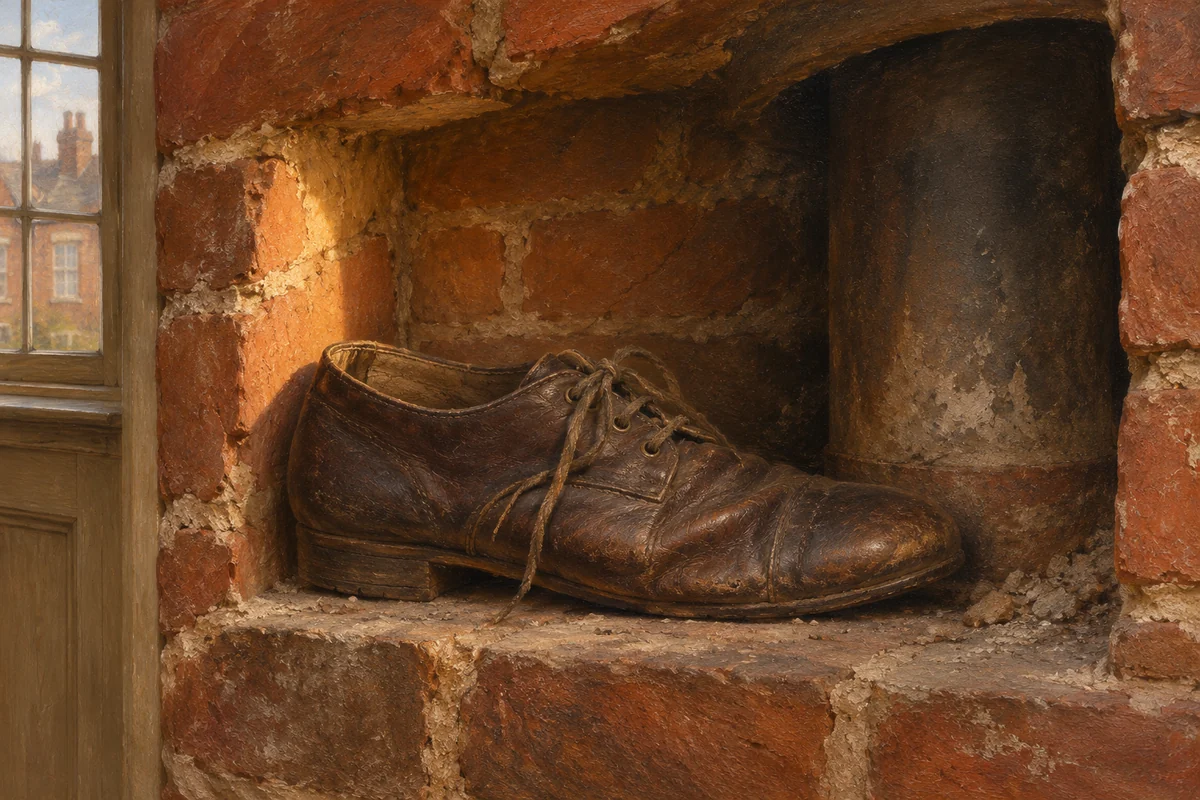
National Museums Scotland has a dark, heeled leather shoe with an unusual entry in its catalogue. It was concealed in a chimney in 1863. The shoe survives. The person who put it there left no explanation.
The short answer
People deliberately hid shoes in chimneys, under floors and in roof spaces. Many finds are single, worn shoes. A leading explanation is that they were put there to protect a household or bring good luck. The locations and objects support that interpretation, but a shoe alone seldom tells us what its owner hoped it would do.
The shoes people left behind
The chimney shoe in the Scottish collection is catalogued as V.2023.134. Another object, a child’s shoe dated to about 1810, was discovered during renovation in the roof at Bristo Port Buildings in Edinburgh. That second find prompted a public appeal for more examples in 1986. The resulting reports helped establish that the practice was widespread across the British Isles.
The finds need not be as simple as a lone shoe. London Museum holds a seventeenth-century leather shoe from a chimney recess at Lauderdale House in Highgate. It was recovered alongside another shoe, four chickens, plaited hemp, a candlestick and a glass vessel. The grouping gives us more to think about than a single object found loose under a floorboard. At the same time, there is no reason to assume that whoever assembled it had exactly the same intentions as the person who hid the Scottish chimney shoe. Related examples can be found in the taboo against walking under ladders and the superstition about saluting a magpie.
Why a chimney?
A chimney is an opening in a building, as a door or window is. It also gives access to awkward little spaces where a shoe could be placed and left undisturbed. Finds around hearths, openings and other boundaries have encouraged the idea that people were guarding vulnerable points in their homes. Someone concerned about harmful spirits or witchcraft might have thought about a house’s openings in much the way we think about its locks. Compare this with throwing salt over the left shoulder.
The same pattern allows more than one reading. The openings and voids around chimneys, roofs and floors also offered convenient places for concealment. Archaeologists have to ask how an object got there, whether it could have fallen or been thrown in, and what else was found beside it. A deliberately sealed recess tells a different story from a gap that collected rubbish for years.
Why use an old shoe?
One explanation starts with the shape of the leather. Over time a shoe takes the impression of the person who wears it. A well-worn shoe could therefore stand for its owner in a way a new one could scarcely do. Researchers have suggested that this connection made the shoe suitable for protective use. Another interpretation imagines the shoe as a decoy or trap for whatever was believed to threaten the house.
There is also evidence that people associated old shoes with good luck outside the home. National Museums Scotland cites an 1861 newspaper account of satin shoes being thrown after a wedding carriage as a lucky gesture. A much later recollection recorded by the museum came from a carpenter who said shoes were concealed for luck. These accounts make the idea of a lucky old shoe easier to understand, while leaving room for other motives and local traditions.
What the evidence actually says
In the twentieth century, Northampton Museum curator June Swann began gathering reports because too many shoes were turning up in improbable places to explain them all as accidents. The museum still keeps an international index of concealed shoes. Comparing recorded finds helps reveal where people put them and what they chose to hide. Their private reasons are harder to recover.
The ordinary condition of the objects is part of their appeal. A child outgrew a shoe. An adult wore down a heel. At some point, someone judged that a piece of leather which had finished its work outdoors still had a job to do indoors.
Related curiosities
Why Are Horseshoes Supposed to Be Lucky?
Why Is a Rabbit’s Foot Supposed to Be Lucky?
What Is the Evil Eye—and Why Do People Wear a Blue Eye Charm?
Sources & further reading
- National Museums Scotland — Footwear Lost and Found, including the 1863 chimney shoe and the Bristo Port find
- Northampton Museums and Art Gallery — Shoe collection and Concealed Shoes Index
- London Museum — Shoe from a chimney recess at Lauderdale House, object L21/1
- Historic England — Discovering Witches’ Marks, including concealed footwear
- Revealing the Ritually Concealed: Custodians, Conservators, and the Concealed Shoe — research article
Last checked: 25 November 2026.