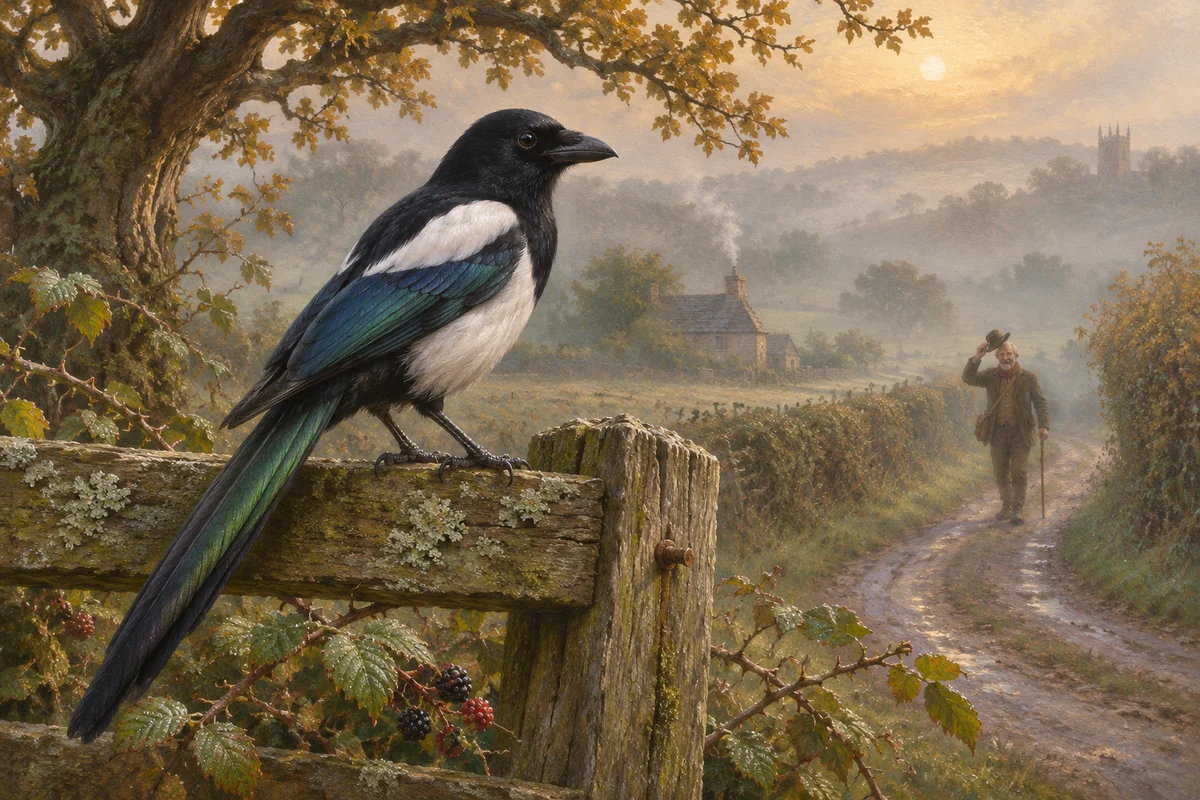
You can be halfway through an ordinary walk when a magpie lands on a fence and someone beside you says good morning to it. The bird may be the only one in sight. For people who grew up with the rhyme, that is precisely the problem.
The short answer
In a familiar British superstition, a single magpie foretells sorrow. Saluting it or addressing it politely is supposed to avert the bad luck. Both the rhyme and the gestures have a documented history, but older accounts disagree about what the number of birds meant and what a person ought to do about it. Another angle on charms and household superstitions comes from the indoor umbrella superstition.
When four magpies meant death
An eighteenth-century printed version appears in a note by Samuel Henley on the mention of magpies in Shakespeare’s Macbeth. Henley attributed the rhyme to the west of England. It counted just four birds. One meant sorrow, two meant mirth, three meant a wedding and four meant death.
That ending feels particularly strange if you learnt the version in which three and four stand for a girl and a boy. The resemblance is still clear. You count the birds, then match the number to an event. The verse could travel even as the details changed. Later versions extended the count to silver, gold and a secret, and the ITV children’s programme Magpie used a version of the rhyme as its theme.
When two brought trouble
Even the idea that a second magpie turns the luck around had its exceptions. T. F. Thiselton-Dyer’s English Folk-lore records a Lancashire belief that seeing two magpies together was unlucky. The same book gives a Lancashire rhyme in which two meant mirth. Apparently, a county could accommodate two readings of the same pair of birds. Related examples can be found in seven years of bad luck from a broken mirror and the taboo against walking under ladders.
The nineteenth-century collection Shropshire Folk-Lore records a similar disagreement around Wellington. One correspondent regarded a high-flying magpie as lucky and a perched bird as unlucky. Another considered a pair unlucky, while a rhyme collected in the area associated two with mirth. The bird’s position could matter as much as the count, depending on whose rule you followed.
How to answer an omen
In Shropshire Folk-Lore, lifting a hat is one of several responses. A Cheshire-born man was reported to remove his hat whenever he saw a magpie. Other accounts in the same collection describe a curtsey and a prayer, spitting, or even making the sign of the cross on a shoe. These are reported customs from particular places. They give us a sense of how differently people could react to the same bird.
In a modern British account recorded by the University of Southern California’s Digital Folklore Archives, the response is a salute and a greeting that asks after the magpie’s wife. There is a certain logic to the words. A bird that appears to be alone is treated as if it has a partner somewhere nearby. The greeting also turns a fleeting encounter into something you can respond to, which may help explain its appeal.
What the evidence actually says
We can document people lifting their hats in the nineteenth century and people greeting a lone magpie in more recent accounts. The old sources offer a family of practices, with enough differences to make a single origin difficult to establish. The greeting about the bird’s wife fits the modern rhyme, but that fit cannot tell us who started saluting magpies or why.
The custom has a quality that probably helps it survive. It takes a second, costs nothing and can be done with a smile. You can doubt that a bird has anything to say about your future and still find yourself bidding it good morning.
Related curiosities
Why Are Black Cats Considered Unlucky?
Why Do We Throw Salt Over Our Shoulder?
Sources & further reading
- Charlotte S. Burne, ed. — Shropshire Folk-Lore, pp. 223–24, digitised by the Bodleian Libraries
- T. F. Thiselton-Dyer — English Folk-lore, pp. 81–83, digitised by Darwin Online
- Birdfact — One for Sorrow: The Magpie Rhyme and Its History, with references for early print versions
- University of Southern California Digital Folklore Archives — One for Sorrow, Two for Joy, with an account of the greeting
- Oxford History — Early UK television themes, including the ITV Magpie theme
- Colchester Museums — Wicked Spirits? Superstitions and the magpie rhyme
Last checked: 25 November 2026.