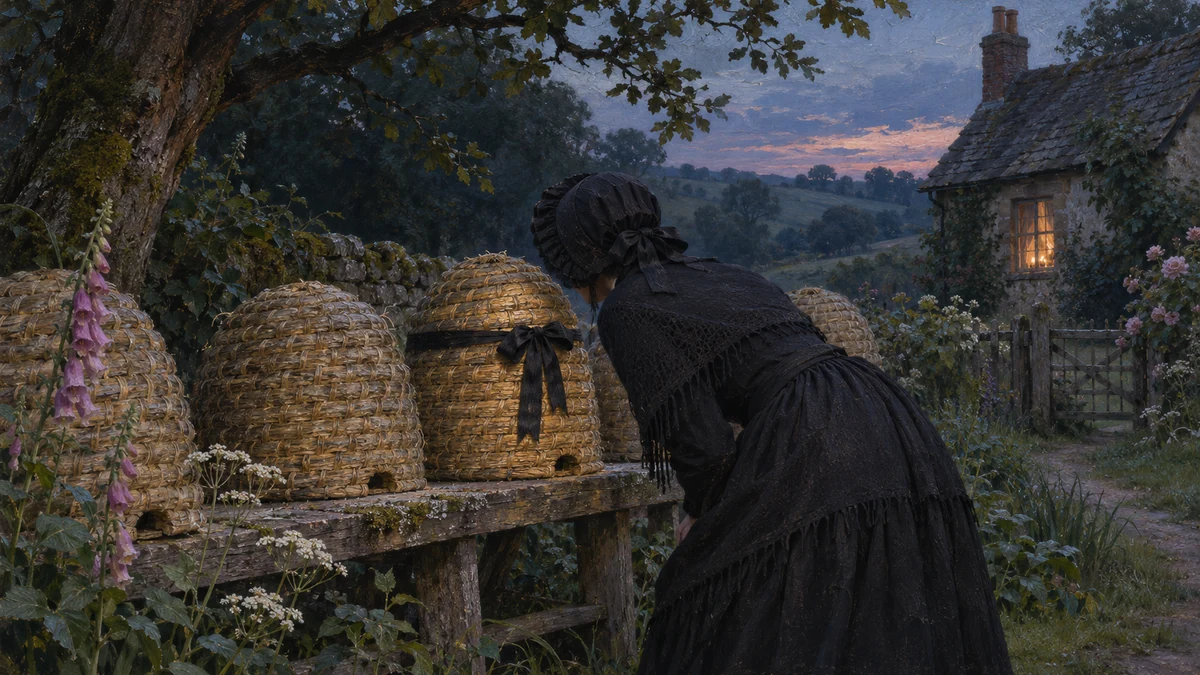
When someone died, a member of the household might walk out to the hives, knock and tell the bees. The custom is recorded in Britain, continental Europe and New England. Why bees, and why it mattered so much, is a harder question.
In September 2022, after Queen Elizabeth II died, royal beekeeper John Chapple went to the hives at Clarence House and Buckingham Palace. He said he placed black ribbons on the hives, told the bees that their mistress had died and introduced them to the idea of a new master, King Charles III. A practice usually associated with cottage gardens had found its way into the news from the palace.
The short answer
Some beekeeping households believed that their bees had to hear about a death. Otherwise the colony might sicken, die, stop making honey or leave. In some places the hives were told about weddings and other family news as well. The custom is well documented in the nineteenth century. Its beginnings are harder to trace. One plausible explanation is that the household treated its bees as part of the family circle and expected them to share its mourning.
How the bees were told
There was no universal script. In some accounts, someone close to the dead went to the hives and tapped before speaking. A house key could serve as the knocker. The words might be spoken quietly or sung, naming the dead person and asking the bees to stay. Black crape, a fabric associated with mourning, could be tied to the hive or its stand. Related examples can be found in mourning jewellery made with a loved one’s hair.
Some households included the hives in the funeral itself. Accounts describe hives shifted or lifted as a coffin was carried out, or a portion of the funeral food set out for the bees. At a wedding, the news could come with cake. The details varied, but in each case the family brought something from the ceremony to the hive.
The bees that would not thrive
In The Honey-Makers (1899), Margaret Warner Morley recounts a Norfolk story about a hive bought at auction after its keeper’s death. The bees, it was said, failed to thrive because they had never been put into mourning. Once a piece of crape was fastened to the hive, the story goes, they recovered. Other stories about protecting the dead and keeping their memory include stopping the clock after a death and covering mirrors after a death.
It is a story about what people believed they owed the bees. Even though the hive had changed hands, the old keeper’s death still mattered. The new keeper was expected to acknowledge a relationship that had started long before the auction.
From Bohemia to New England
In Božena Němcová’s Babička (The Grandmother, 1855), the dying grandmother calls Vorsa to her and asks her to tell the bees when she dies, lest they die out. She is putting her household in order, and the hives are among the things she worries about leaving behind.
In John Greenleaf Whittier’s 1858 poem “Telling the Bees”, a visitor returns to a New England farm after a year away. He watches a girl drape the hives in black and sing to the bees. At first he assumes the old man of the house has died. Then he hears her name Mary, the woman he came to see. In the poem, the bees hear the news before he does.
What the evidence actually says
Well documented. Literary and folklore accounts record people telling bees about a death, dressing hives in mourning and describing what they feared would happen if the bees were left out. Chapple’s account shows that the practice survived into the twenty-first century.
Plausible. The hives formed part of a household’s working life. Addressing the bees by voice, sharing funeral food and naming a new keeper are all consistent with treating the colony as part of the household. Those gestures help explain how the custom was understood by the people who kept it.
Speculative. Bees have been associated with souls and the dead in various traditions, but that parallel does little to establish how this particular custom began. The idea that it encouraged someone to check on the hives after a death is possible too, though the accounts give us little reason to call that its original purpose.
Why it lasted
After a keeper died, somebody still had to look after the hives. Telling the bees gave the family a way to mark the change. The words could say who had gone and who would be there to tend the colony next.
The ritual could also be small enough for one person to carry out alone. A knock on the hive, a dark ribbon and a few words were enough. In Whittier’s poem those words are a request as much as an announcement. Mary is gone. Stay.
Sources & further reading
- John Chapple’s account of the 2022 observance, reported by The Independent. Royal beekeeper informs Buckingham Palace bees that the Queen has died.
- Božena Němcová, The Grandmother (1855), chapter 17, in the 1891 English translation. Wikisource.
- John Greenleaf Whittier, “Telling the Bees” (1858). University of Toronto, Representative Poetry Online.
- Margaret Warner Morley, The Honey-Makers (1899), discussed in “Telling the Bees”, JSTOR Daily.
- Steve Roud, The Penguin Guide to the Superstitions of Britain and Ireland (Penguin, 2006).
- Diana Hubbell, “Why We Tell Bees About Death”, Atlas Obscura.