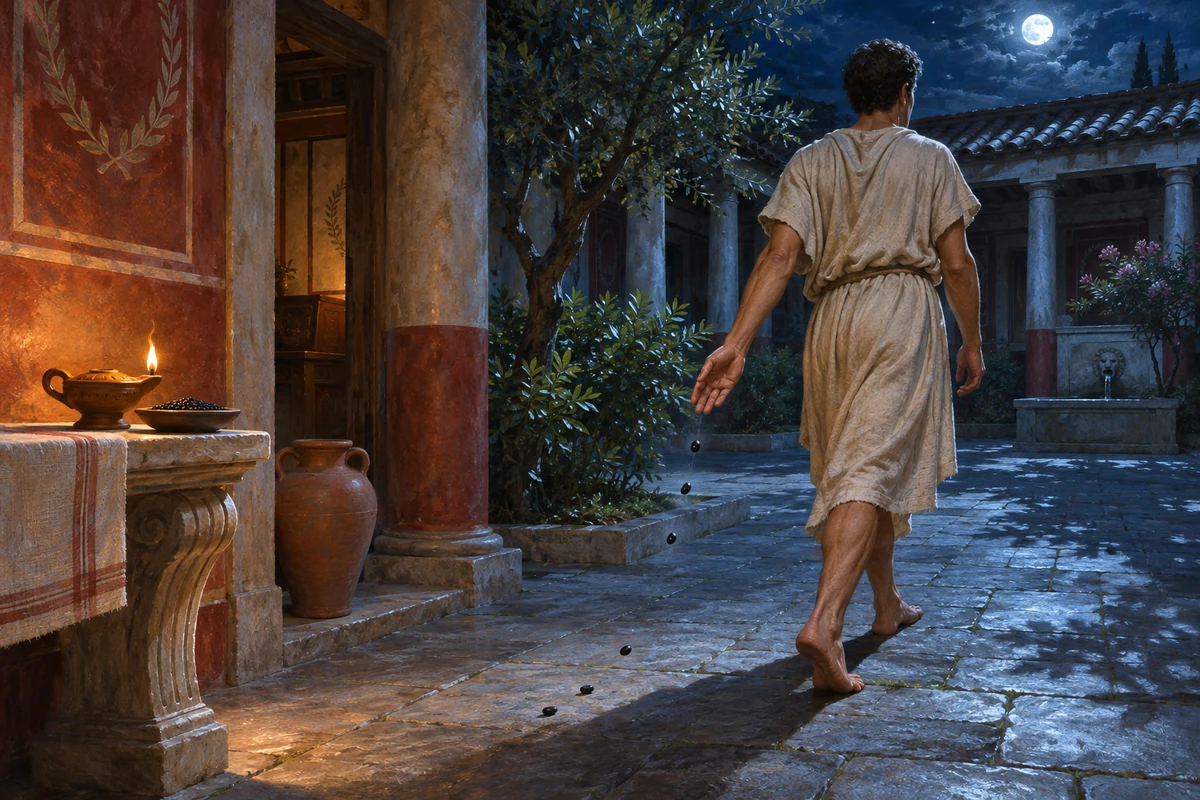
In Ovid’s account of a Roman night in May, the dogs have fallen quiet and the household is asleep. One person rises, washes their hands and throws black beans without looking back. Something behind them is supposed to pick the beans up.
The short answer
At Lemuria, a Roman observance held on 9, 11 and 13 May, some Romans performed rites for the dead. In the version described by the poet Ovid, black beans were cast with a spoken formula asking that the person and their household be spared. The person then struck bronze and told the ancestral spirits to leave. The words make the beans sound like something offered in exchange for the safety of the household. Ovid leaves the choice of black beans unexplained.
What happened at midnight?
The account comes from Book 5 of the Fasti, Ovid’s poem about the Roman calendar. No knots bind the person’s feet. Before throwing anything, they make a sign with the thumb enclosed by the fingers and wash their hands in spring water. Then they turn away and cast the beans.
As they throw, they say that with these beans they redeem themselves and their family. Ovid says the formula is repeated nine times without looking back. He adds that the shade is believed to gather the beans and follow unseen. The instruction to keep looking away gives the scene its tension. The only clue to what the spirit is doing comes from what the living person has been told to expect. Related examples can be found in the folklore of ghostly black dogs and the grave opened in the Petar Blagojević case.
The person touches water again, clashes bronze and calls on the ancestral dead to go. That dismissal, too, is said nine times. Only then do they look back. Looking back marks the point at which the person considers the rite complete.
A festival with three dates
Lemuria took place on three separate nights in May. The dates are supported by Roman calendar evidence as well as Ovid’s poem. Ovid also associates the observance with closed temples and an unfavourable time for marriage. The poem moves easily between one household and the wider calendar, showing how a public date could matter to people behind their own doors.
The rite itself suggests an uneasy relationship with the dead. Ovid describes an offering that a shade is expected to accept and then gives the person a formula for dismissing ancestral spirits. The dead are close enough to address as family and troublesome enough to ask to leave. Compare this with the Galician procession of the dead.
Did the festival begin with the ghost of Remus?
After describing the ritual, Ovid gives the name a story. The ghost of Remus appears to his grieving foster parents and asks them to persuade Romulus to honour him. Romulus establishes a day called Remuria, which in Ovid’s account becomes Lemuria over time.
This is evidence that a Roman poet linked the observance to Rome’s founding legend. The passage cannot independently date the festival or establish that its name really developed from Remus. It gives the ritual a memorable beginning in the poem. The historical beginning remains uncertain.
What the evidence actually says
The sequence in the Fasti is well documented as Ovid’s account. The words spoken over the beans and the shade’s supposed response are our best clues to the offering’s purpose. The poem gives no reason why the beans had to be black, and the calendar entries do not tell us whether households everywhere followed the same instructions.
That leaves something we can still recognise in the scene. A household faced an uncertain night with a set of actions small enough for one person to perform. Water, beans and a piece of bronze gave them something to do before it was time to turn around.
Related curiosities
Why Did Galicians Fear Meeting a Procession of the Dead?
Why Did People Cover Mirrors After a Death?
Why Did People Bury Bottles Full of Pins to Break a Curse?