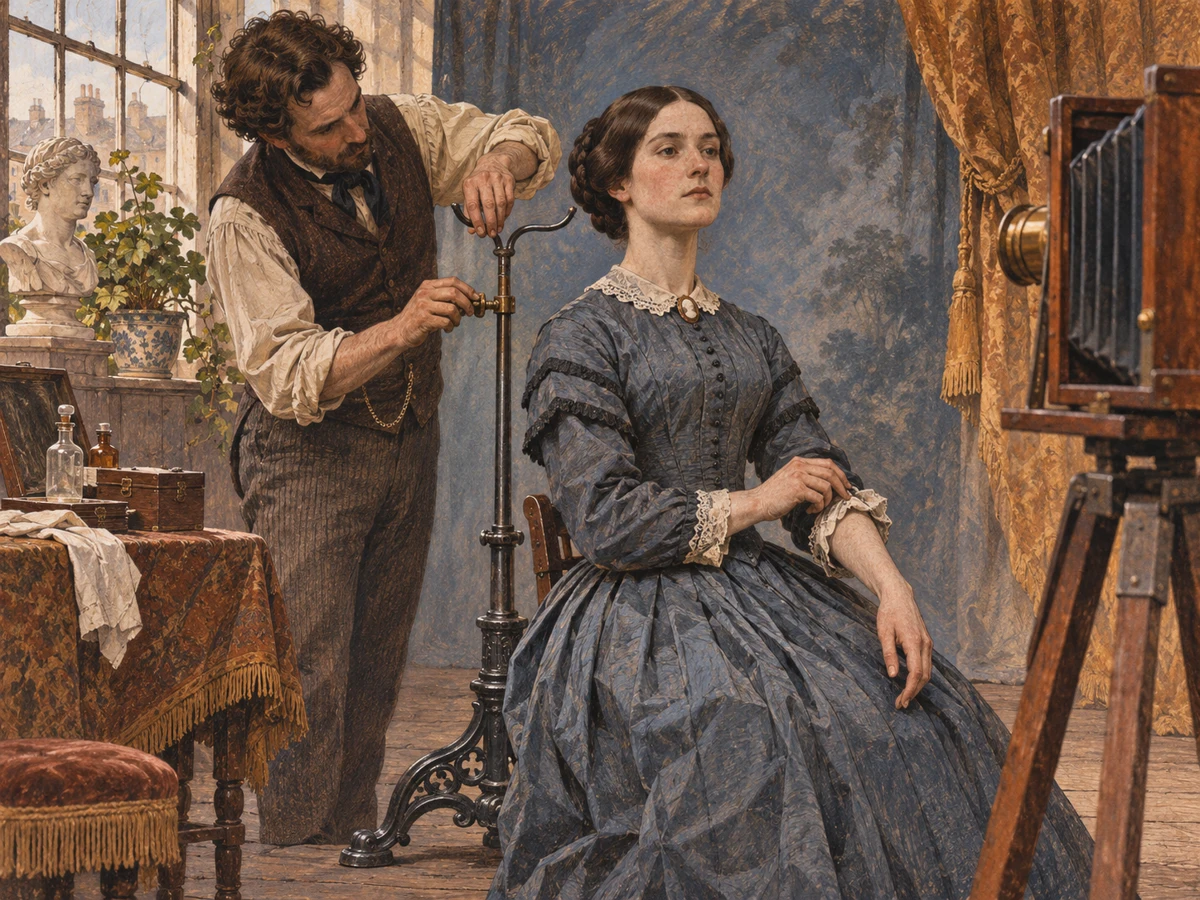
Content note: this article discusses family bereavement and links to museum photographs of deceased children. The illustration depicts a living sitter.
A metal stand behind a Victorian sitter is evidence that the photographer wanted a steady head. It tells you very little about whether the sitter was alive. Families did commission portraits after a death, but one supposed example circulated online shows Lewis Carroll, who lived for years after the shutter closed.
The man who lived to spoil the caption
In the photograph discussed by Atlas Obscura, a man sits with his head resting on one hand. An online caption invited readers to admire the photographer’s ingenuity in arranging a dead man’s arm to support his head. Once the sitter is identified as Carroll and the picture placed within his lifetime, the very same pose becomes easy to understand. A man was leaning on his hand.
It is a useful test because it has an answer independent of how the picture feels. A viewer can find the pose peculiar with or without the caption. Neither impression carries as much weight as a name and a date.
What the bit of iron actually did
For a portrait, stillness had to last as long as the exposure. The public introduction of the daguerreotype in 1839 was followed by substantial improvements in photographic speed. An exposure in a well-lit studio in the 1850s could take a few seconds. A child could turn towards a parent in much less time than that. Even an adult trying hard to keep still might sway.
A studio headrest gave the sitter a small point of contact behind the head. Its base sometimes peeps out from behind a skirt or trouser leg. Photographer and collector Mike Zohn drew attention to the design: the upright and its base could steady someone already supporting their own weight. They lacked the counterweight needed to balance the full weight of an upright body. A stand in the picture identifies a piece of studio furniture. It cannot identify a corpse.
Nor does a long exposure simply freeze a momentary blink. The surface receives light for the whole exposure. Movement during part of it may soften a feature. Closed eyes may be exactly that. A solemn expression, an unusually pale iris or a sharp face beside a blurred one all leave room for an ordinary photographic explanation.
Two museum labels, two different claims
Consider the Getty’s Postmortem of a Child, by Charles Durheim. Bedclothes fill the frame. The child lies horizontally, her hands folded across her middle. The museum identifies the photograph as a memorial portrait and explains how its arrangement evokes sleep. The quiet of the composition was part of what the photographer had to offer a bereaved family. Read the Getty’s catalogue entry.
Now compare the Smithsonian’s Portrait of a Seated Woman with a Baby on her Lap. Its catalogue acknowledges that a sleeping infant may put modern viewers in mind of post-mortem photography. It also discusses the practical value of photographing a baby asleep. The museum’s title stops at what it can identify. Changing that title to “mother holds dead baby” would turn a viewer’s association into a claim about a particular family. Read the Smithsonian’s catalogue entry.
Flowers, a bed, a parent’s arms: all occur in genuine memorial portraits. Families arranged children tenderly, sometimes with a small bouquet, and a photograph might preserve the only likeness they would have. Photographers could also retouch eyes. Retouching was a studio technique with more than one use. The case for identifying a memorial portrait is strongest when the image comes with a family inscription, a traceable history or a collection record that explains the attribution.
Before you share the picture
Look for the uncropped photograph. Is there writing on the mount or on the back? Follow the picture to the collection that holds it. Does its catalogue actually say post-mortem? Or has somebody added that judgement between the museum and your screen? A dealer’s asking price and a hundred repetitions of the same caption add nothing to the sitter’s biography.
There is a human cost to getting this wrong in either direction. Bereaved families made deliberate choices about photographing their dead, just as households made choices about stopping a clock or covering a mirror. They deserve to have those choices understood. An unidentified woman who simply sat for her portrait deserves the same courtesy. Sometimes the most faithful caption you can give her is also the shortest: a woman seated in a photographer’s studio.
Related curiosities
- Why Did Victorians Photograph Their Dead?
- Why Were Coins Placed on the Eyes of the Dead?
- Why Were Clocks Stopped When Someone Died?
- Why Did People Cover Mirrors After a Death?
Sources & further reading
- Getty Museum, Charles Durheim, Postmortem of a Child
- Smithsonian National Museum of American History, Portrait of a Seated Woman with a Baby on her Lap
- Nelson-Atkins Museum of Art, Postmortem of Young Girl, with bouquet and bedding
- Sonya Vatomsky, Atlas Obscura, reporting on posing stands, the Carroll photograph and invented captions
- Yale University Library, guide to the Stanley B. Burns collection of postmortem and memorial photography
- The Victorian Web, Postmortem Photography, including discussion of retouching
Last Checked: 27 November 2026