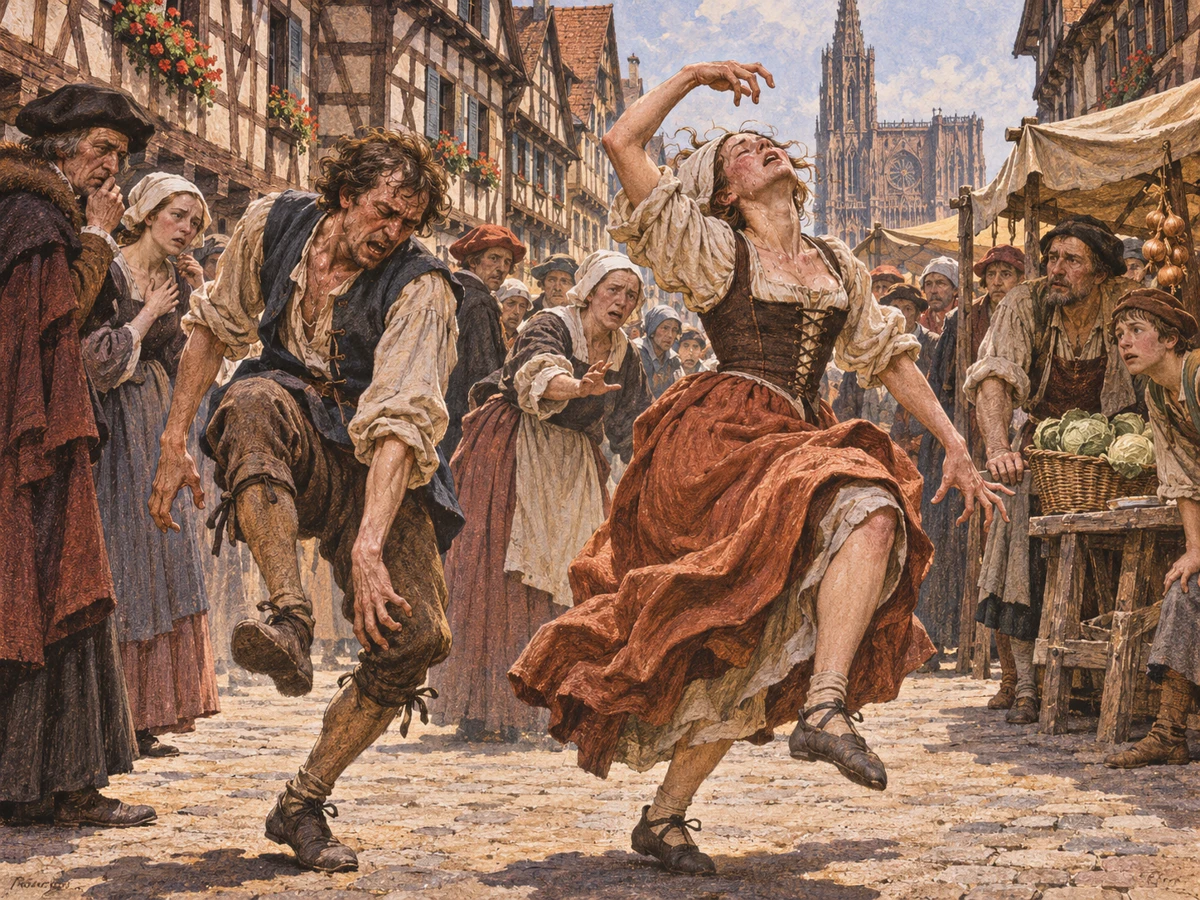
Strasbourg’s magistrates told their bishop that the trouble began with one woman dancing. Other people joined her, and soon the authorities were consulting doctors and arranging care. The dancing is among the better-documented oddities of 1518. For the famous claim that fifteen people died in a day, the evidence is considerably thinner.
What the magistrates had to deal with
Among the records from that summer is the predicament of a servant called Staden Jerg. The authorities wanted families whose children were dancing to keep them at home or help pay for their care. Jerg explained that he was too poor to keep his son at home. Could the boy stay with the others, or be taken to the saint?
Here is somebody we seldom meet in versions of the story that begin with a woman dancing herself bloody. We know little of the boy’s movements. We know something quite precise about his father: in the middle of an extraordinary outbreak, he had a perfectly ordinary difficulty paying for help. The record survives in the Strasbourg museums’ collection of extracts for their exhibition on the dancing fever.
The city’s letter to the bishop confirms that a woman was first. It gives her no name. “Frau Troffea”, the name by which she is now widely known, comes through a later account by Paracelsus. Historian Élisabeth Clementz points out that he did not even say where or when his Troffea lived. The exact day she stepped outside, how long she danced alone and the figure of four hundred dancers belong to reconstructions of varying certainty. The records support a spreading disturbance in the summer of 1518, involving dozens over a period of weeks.
Who told them to play music?
The doctors consulted by the city blamed the heat and the disposition of the stars. Their surviving advice is unusually domestic. Give the dancers barley water, bread or porridge. Avoid wine. Music could be provided, but the choice of instruments mattered: the advice favoured strings and small organs over drums and fifes.
That makes a curious contrast with the market-place band in the best-known telling. Writing around 1580, the Strasbourg chronicler Daniel Specklin described guild rooms set aside for dancers, facilities at the horse and grain markets, and hired people dancing alongside the afflicted to pipes and drums. His account gives us the spectacle. The earlier medical instructions let us hear the disagreement inside it.
The authorities also restricted dancing, and sufferers were taken to a place associated with St Vitus near Saverne. Religious and civic responses could coexist. To Staden Jerg, sending his son to the saint was a practical possibility, right alongside finding somebody to look after him.
Where are the fifteen deaths?
Specklin wrote that many danced to their deaths. He was writing roughly sixty years after the outbreak. The familiar figure of fifteen in a day circulates in later accounts. Neither a dated list of fifteen victims nor a daily tally appears in the contemporary municipal evidence assembled for the Strasbourg exhibition. Multiplying fifteen by the number of days the outbreak lasted would manufacture a statistic the sources never give us.
Historians have read the evidence differently. John Waller takes seriously the possibility that people danced to exhaustion and death. The surviving administrative papers answer a different set of questions exceptionally well. We can say what the doctors advised and where people were sent. They leave open how many, if any, died.
What might have set it off?
Reports of collective dancing around the Rhine went back at least to 1374. By 1518 St Vitus was familiar as a saint to whom people might turn over afflictions involving dance. Waller argues that hardship, fear and a shared belief about what the saint could do helped shape the form the distress took. In this interpretation, people could experience movements as involuntary while understanding them in terms their neighbours recognised.
Another suggestion invokes ergot, a fungus that can contaminate rye. Waller objects that the effects of poisoning make a poor explanation for sustained, coordinated dancing. Neither theory can be tested on a surviving patient. The magistrates’ appeal to the heat tells us what the doctors believed that summer. It supplies no retrospective diagnosis.
Look again at the famous engraving
Several figures strain forward while companions support them. It is an arresting image to put above a story about Strasbourg. Read the museum label, however, and the scene moves to Molenbeek, near Brussels. The Metropolitan Museum of Art identifies the engraver as Hendrick Hondius I, working after Pieter Bruegel the Elder, and dates the print to 1642. That is 124 years after the Strasbourg outbreak. See the engraving at the Met.
As with the footage behind the 1960s zombie dance, the caption does a surprising amount of the storytelling. For Strasbourg itself, the nearest we can get to an afflicted family is a few lines of municipal business. A father appeared before the authorities. His son had begun to dance. Who would take care of him?
The medieval calendar of unlucky days offers another glimpse of the significance people attached to the heavens. Centuries later, in American dance marathons, authorities faced quite a different question about people who kept on dancing.
Related curiosities
- Why Did People Dance Like Zombies in the 1960s?
- Why Did Medieval People Have a Calendar of Unlucky Days?
- Why Did 1930s Dance Marathon Couples Dance Until They Dropped?
Sources & further reading
- Élisabeth Clementz, La danse de 1518 à Strasbourg, critical study for the museum exhibition
- Musées de Strasbourg, 1518, la fièvre de la danse, especially pp. 11–12: municipal correspondence, doctors’ advice and later chronicles
- French Society for the History of Medicine, illustrated historical review of the Strasbourg evidence
- John C. Waller, In a spin: the mysterious dancing epidemic of 1518, Endeavour
- Metropolitan Museum of Art, Hondius after Bruegel, engraving of the Molenbeek pilgrimage
Last Checked: 27 November 2026