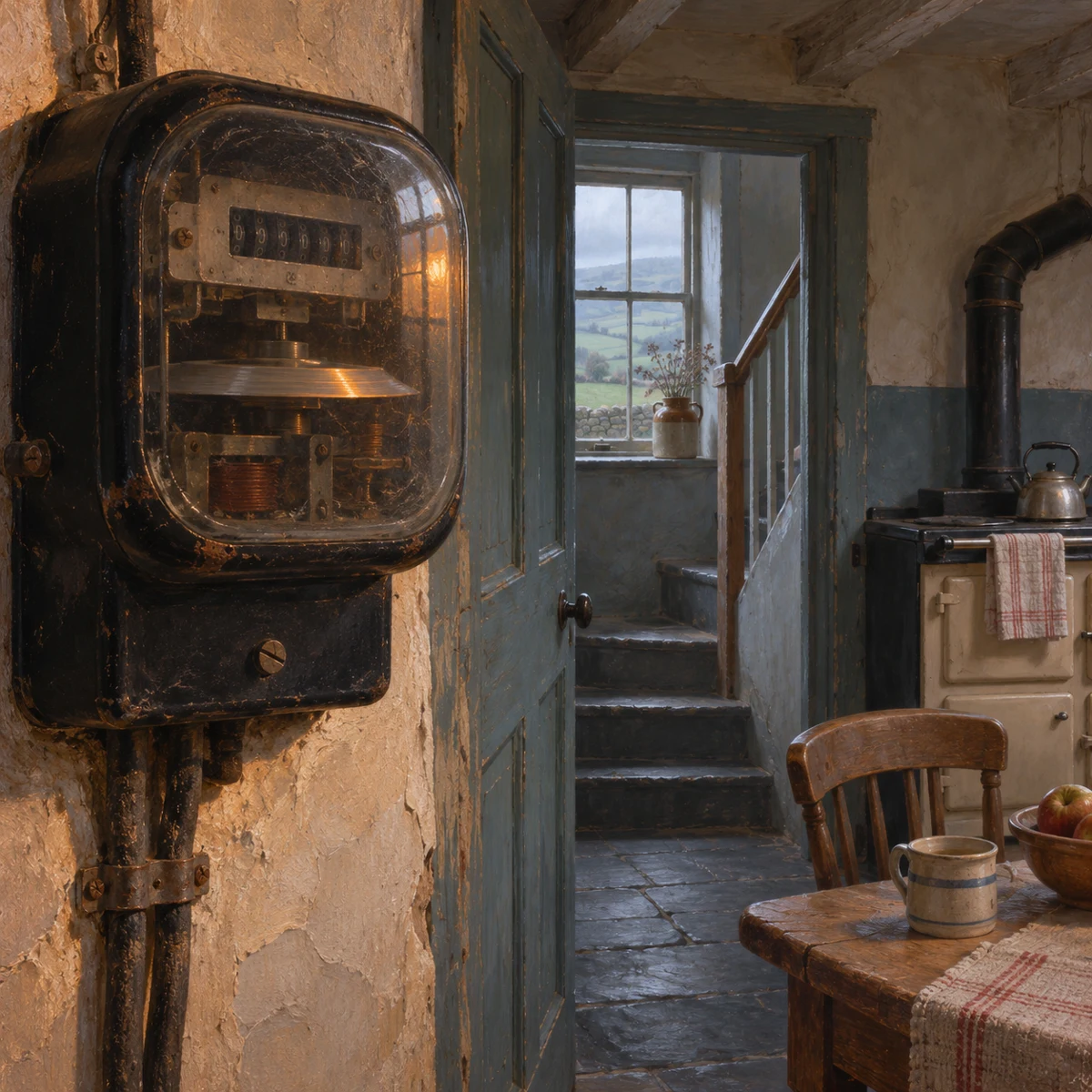
In December 1994, a Welsh artist explained to the South Wales Echo why he was refusing to pay his electricity bill. His family cooked and heated their home with oil. Yet the electricity was costing them £400 a quarter. Bill Rich suspected another occupant was running up the bill. He had already had the house exorcised.
The short answer
Heol Fanog, a farmhouse near Brecon in the foothills of Bannau Brycheiniog, became known as the Witch Farm through the experiences Liz and Bill Rich reported after moving there in 1989. Local papers covered the electricity dispute while the family still lived there. A book, a BBC radio investigation and eventually a television drama brought the story to people who had never heard of the house. Each drew on the family's testimony. The clearest opportunity to hear a different side came early, when a reporter asked the electricity company for its account.
Footsteps on the landing
Bill was an artist. He moved to Heol Fanog in May 1989 with Liz, who was pregnant, and his teenage son Laurence. The accounts place the first disturbances later that year. A sound recurs in the telling: heavy footsteps upstairs. Liz also described seeing an elderly woman in the nursery. In one recollection she saw the woman's face at the window as she came home from a walk with her son. What she remembered of the face was its sadness.
Someone outside the family recalled the footsteps too. A dog warden described hearing what sounded like a person running along the upstairs landing when she understood the house to be empty. Her choice of words matters. She could describe the sound with some precision. Who or what made it was another question.
The ghost with an electricity account
On 3 December 1994, the South Wales Echo printed Bill's explanation alongside the response from SWALEC, the electricity supplier. Bill said the charges had dropped after an exorcism and then begun to climb again. SWALEC said it had checked his meter twice, found it working properly and stood by its bills.
Almost a year later, on 22 November 1995, the Shropshire Star put the quarterly figure at £900. It reported that the company had reduced what Bill was being charged to about £1 a day while investigations continued. A spokeswoman said the company had found no evidence of ghosts using the supply.
This leaves a rather better historical record than most haunted houses can offer. We have two dated reports, different sums at different times, a named customer and an answer from the supplier. What we lack is the engineering report that would let a reader follow the tests and identify where the electricity went. A meter can record consumption perfectly well while leaving the person paying for it thoroughly baffled.
Who counted the exorcisms?
As the family sought help, clergy and spiritualists visited Heol Fanog. One visitor, Eddie Burks, spoke to the Echo in 1994. A retired civil engineer, he objected to being called a ghostbuster and distinguished what he did from a religious exorcism. In his understanding, he helped a troubled spirit discover what kept it in a place so that it could leave.
That distinction gets lost in the claim that Heol Fanog underwent more exorcisms than any other house in British history. Danny Robins repeats it in his BBC Radio 4 introduction to the case. Yet even a visitor whom the newspaper called an exorcist disputed what the word implied. To award the house a British record, someone would have to decide which visits counted and compare them with equivalent records elsewhere. The published accounts supply neither tally. “The Welsh Amityville” is easier to trace: it is a nickname used in coverage of the case.
The people who liked living there
One former resident, Bridget Buscombe, remembered Heol Fanog with particular affection. She also told the writer Mark Chadbourn about an evening when she was reading in bed and noticed her old spinning wheel turning in the corner. Alone in the house and unable to account for it, she got up and wedged it with a piece of paper. The incident stayed with her. So did her fondness for the place.
Later occupants contacted Robins after his radio series. As the researcher Mark Fox recounts, they had lived there for some 25 years and had experienced neither the extraordinary electricity use nor anything they regarded as supernatural. Their experience belongs in the history of Heol Fanog just as the Rich family's does. For one household, the house became frightening enough to call in strangers for help. For another, it was an uneventful place to spend a quarter of a century.
From a Welsh kitchen to BBC One
Chadbourn gathered testimony for his book Testimony. Robins interviewed Liz and other witnesses for his 2022 BBC Radio 4 series The Witch Farm, weaving their voices through dramatic reconstructions. His four-part BBC television adaptation followed in 2026, with Gabrielle Creevy as Liz and Michael Socha as Bill. The farmhouse interior viewers see on screen was built on a Welsh soundstage.
For readers coming to the case through the drama, the old newspaper accounts offer a way into the house that television can scarcely improve upon. In the same few column inches, a father explains why he believes an exorcism once brought his bills down, an investigator explains how he thinks spirits find peace, and an electricity company stands by its meter. For one day in December 1994, all three had to answer to the same reporter.
Further reading on reported apparitions includes the Gwyllion of the Welsh mountains, the folklore of seeing your own double and Galician accounts of a procession of the dead.
Related curiosities
- The Gwyllion — Why Did Welsh Travellers Fear the Women in the Mist?
- Why Was Seeing Your Own Double Believed to Foretell Death?
- Why Did Galicians Fear Meeting a Procession of the Dead?
Sources & further reading
- South Wales Echo, 3 December 1994, and Shropshire Star, 22 November 1995. Contemporary coverage reproduced by the Poltergeist Archive.
- Mark Fox, “Which Farm is The Witch Farm?” A comparison of testimony from the Rich family, visitors and other residents.
- BBC Radio 4, Danny Robins on the origins of The Witch Farm and the exorcism claim.
- Abergavenny Chronicle, the nursery sighting and the “Welsh Amityville” nickname.
- Nation.Cymru, the Welsh farmhouse ghost story and its reconstruction for television.
- Mammoth Screen, official production credits for The Witch Farm.
Last Checked: 26 November 2026