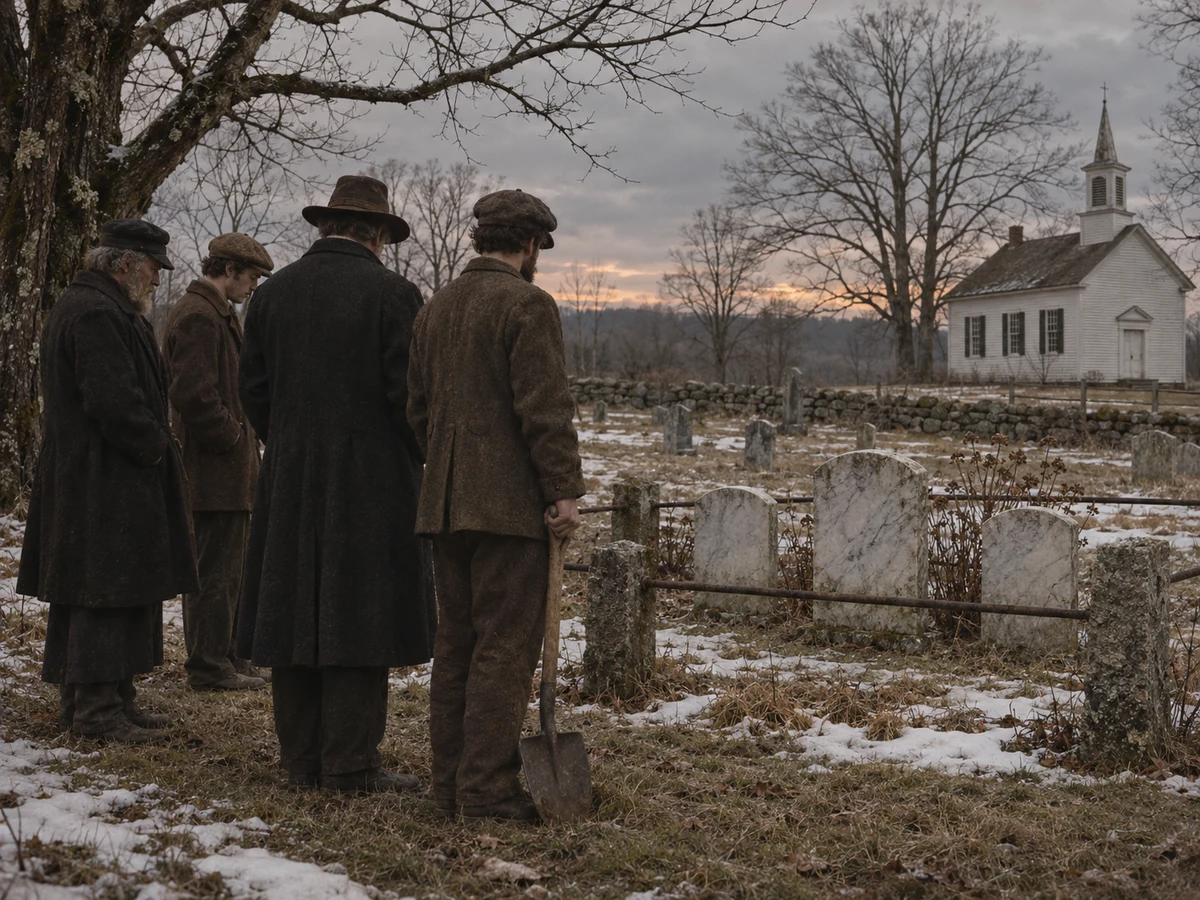
In 1892, neighbours in Exeter, Rhode Island, believed a dead member of the Brown family might be draining the life from a dying man. His nineteen-year-old sister had been dead for two months when they opened her coffin.
On Thursday, 17 March 1892, a small group went to Chestnut Hill Cemetery in Exeter, Rhode Island, to examine three members of the same family. The Providence Journal placed the visit in the afternoon. A doctor was there. The man whose family lay in the cemetery, George Brown, had given permission and stayed away.
His son Edwin was dying. Some of the neighbours believed one of the dead might still be taking life from him. They had persuaded George to let them look for a sign in the bodies of his wife and two daughters.
The illness that kept coming back
George’s wife Mary died of consumption in December 1883. Their daughter Mary Olive followed in June 1884. Later Edwin fell ill and went to Colorado, where he spent time in the hope of improving his health. By the winter of 1892, his sister Mercy Lena Brown, known as Lena, was dying of the same disease.
Exeter’s death record gives 17 January 1892 as the day Lena died. She was nineteen. Some modern accounts give 19 January, but the town record reproduced by the Rhode Island Historical Society supports the earlier date. The fuller Providence Journal account says her coffin had been placed in a tomb until spring. Other reports describe her as buried. Either way, she had been dead for about two winter months when the group came to examine her. Compare this with stopping the clock after a death.
By then Edwin was home, and his condition was worsening. The newspapers reported that George had little confidence in the old belief. His neighbours kept pressing him. After losing his wife and two daughters, he agreed to let them try.
What they found in the cemetery
Mary and Mary Olive had been dead for years. The condition of their remains gave the searchers little reason, by their own reckoning, to suspect either of them. Lena’s body was better preserved. There was still blood in her heart.
That detail often appears in retellings as fresh, liquid blood. The contemporary coverage is less tidy. One description mentions blood dripping during the examination, while a fuller account describes the blood in her heart as clotted and decomposed. Dr Harold Metcalf, who examined her, found the state of the body consistent with ordinary decomposition. Two months in winter cold could slow decay considerably, especially compared with the years the others had been buried.
The neighbours read it differently. In the local belief, blood still present in the heart could mean that the dead person was somehow sustaining herself at the expense of a living relative. Lena’s heart and liver were burned in the cemetery. According to the account later discussed by folklorist Michael Bell, Edwin was said to have drunk the ashes mixed with water. The burning is documented. His drinking the mixture is reported.
Edwin died on 2 May 1892, less than seven weeks after the exhumation.
What New England meant by a vampire
It is easy to picture the scene through the vocabulary of Gothic fiction. Carmilla had already been published. Dracula would appear five years later. In Exeter, the signs that mattered were the ones a family had been watching at home: another cough, another person wasting away, another death with the same symptoms.
Bell traced cases across New England in which a family or its neighbours opened a grave in the hope of halting consumption. The details differed from place to place. The Exeter episode is generally treated as the last known case in that regional tradition. Its participants may never have called Lena a vampire. The Providence Journal itself drew attention to the absence of the word from its correspondent’s account. Related examples can be found in the grave opened in the Petar Blagojević case and garlic in vampire folklore.
The exhumation was undertaken with the father’s permission, a medical examiner present and enough local knowledge for the story to reach the press within days. People could know about the practice, oppose it, and still find themselves under pressure to let it go ahead. George Brown’s reported scepticism is part of the story.
The name visitors remember
H. P. Lovecraft referred to the Exeter exhumation in The Shunned House. He gave the year and described the burning of a heart, leaving Lena unnamed. Later retellings made her the centre of the story. Visitors to Chestnut Hill Cemetery have been reported leaving flowers and small gifts at her grave.
By the time the men in Exeter opened Lena’s coffin, Robert Koch had already identified the bacterium that causes tuberculosis. He announced the discovery in Berlin in March 1882, ten years before the exhumation. The disease could spread through the air among people who spent their days together. Knowing its cause had yet to give a family like the Browns an effective cure.
The neighbours saw that something was passing from one member of the household to another. They went to the cemetery because they thought they could stop it there. The disease had already been in the house.
Sources and further reading
- Rhode Island Historical Society, Have Mercy…, with Exeter death records and contemporary newspaper clippings
- Michael E. Bell, Vampires and Death in New England, 1784 to 1892, with extracts from the Providence Journal
- Abigail Tucker, The Great New England Vampire Panic, Smithsonian Magazine
- IOPAR, Mercy Brown and the Exeter exhumation, a comparison of contemporary reports
- H. P. Lovecraft Historical Society, background to The Shunned House
- CDC, history of World TB Day and Koch’s discovery