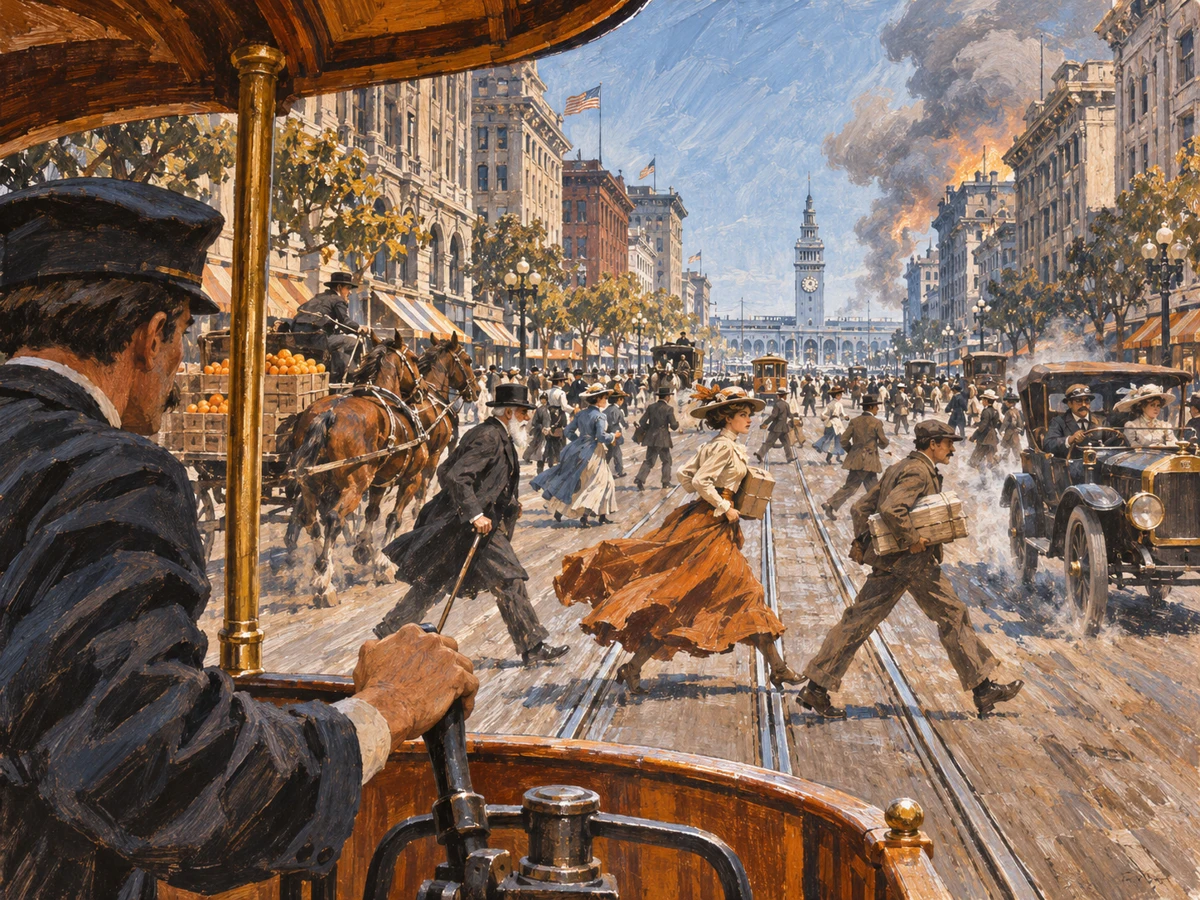
A man crosses the road in three seconds. Run the same strip of film through the projector a little faster and he makes it in two. That is why whole streets of people appear to scurry in early films: the speed at which the pictures were shown could differ from the speed at which they were taken.
Take a ride down Market Street
In the Miles Brothers’ 1906 film, the camera rides at the front of a San Francisco cable car. The tower of the Ferry Building stays ahead while a whole city gets across the tracks in front of it. Cars cut in, horses pull across the line and pedestrians judge their moment. Watch somebody walking at the edge of the picture. Their stride gives you a better feel for the pace than the speed of a car whose driver you cannot question. Watch the Library of Congress film.
There is a further joke in choosing this particular street to test our eyes. Film historian David Kiehn noticed that some of the motor traffic circles back into shot. The brothers had a bustling city to sell to exhibitors. A car that went round again could do the work of two. Even at a convincing speed, the film needs a little reading.
Where did the missing second go?
Imagine the operator made sixteen exposures each second. Three seconds of walking left forty-eight little photographs on the strip. Show sixteen in a second and those pictures last three seconds. Show twenty-four in a second and the very same forty-eight pictures last two. The walk appears 50 per cent faster. The man still takes exactly the same number of steps.
A modern screen can show that walk perfectly well at twenty-four frames a second. The trick is to allow three seconds for it, repeating some pictures to fill the extra spaces. The trouble comes when every original frame gets exactly one slot in the faster sequence. The faster screen itself is innocent.
Two people had a hand on the pace
On a hand-cranked camera the operator helped determine how much time a length of film represented. Sixteen frames a second makes a handy early example. It was never a speed shared by every operator, studio or decade. A cameraman could deliberately turn more slowly, a practice called undercranking. Played back faster, a comic stumble acquired an extra kick.
Then the film went to the cinema, where somebody else had charge of it. Silent-era cue sheets could specify speeds for exhibition. A projectionist and the musicians accompanying the picture had a pace to find together. By the later silent years some films were intended to run considerably faster than sixteen frames a second. Slow every old comedy to sixteen and you can take the snap out of a perfectly good gag.
Synchronised sound narrowed that freedom. Alter the speed of a film carrying its recorded soundtrack and the voices alter with it. Twenty-four frames a second became the usual theatrical sound speed. A silent shot copied one frame at a time into a sound film could therefore carry its accelerated gait into a documentary, and on into the next compilation to borrow the shot.
How do you give somebody their walk back?
Peter Jackson’s team faced the question shot by shot while making They Shall Not Grow Old (2018) from First World War footage. In the production notes Jackson recalled finding considerable variation even among material nominally associated with sixteen frames a second. Faces and bodies helped the team judge a plausible pace. Software could then generate intermediate pictures for a smoother modern presentation.
Those intermediate pictures are estimates. An archive can also preserve the original frames and repeat them to achieve an appropriate running time. One decision concerns how long a step should take. The other concerns what to show between the surviving views of the boot.
Old footage can mislead in the opposite direction too. The deliberate shuffling in the 1960s zombie dance belongs to the dancers. For a street film, try watching two things at once: the man stepping off the pavement and the horse passing behind him. If both appear to have the same urgent appointment, spare a thought for the projectionist.
Across the Atlantic, the Red Flag Act had regulated the pace of early motoring, and Britain’s first number plates gave cars another detail that can help date a street scene.
Related curiosities
- Why Did People Dance Like Zombies in the 1960s?
- Why Did Someone Have to Walk in Front of Britain’s Early Motor Vehicles With a Red Flag?
- Was “A 1” Really Britain’s First Car Number Plate?
Sources & further reading
- Library of Congress, A Trip Down Market Street Before the Fire, film and catalogue record
- David Kiehn, National Film Registry essay on the Miles Brothers’ film
- Screen Heritage UK, Moving Image Collections Handbook, film speeds and copying
- Canadian Educational, Sponsored and Industrial Film Project, film technology primer
- They Shall Not Grow Old, production notes and Jackson’s account of timing
- Frame.io, the restoration team’s account of the workflow
Last Checked: 27 November 2026