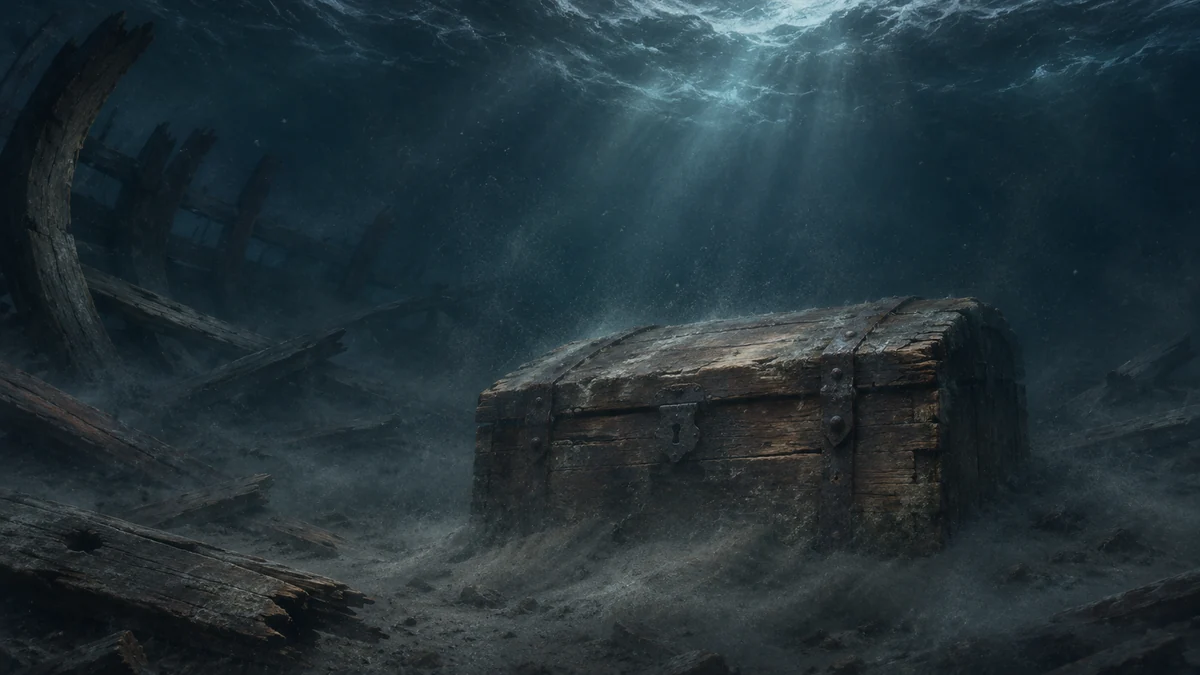
For three centuries, sailors and storytellers have sent the drowned to Davy Jones’s locker. The phrase appears twice in a voyage account published in 1726. Who Davy Jones was remains a mystery.
In a voyage account published in 1726, some pirates offer to give their captive a few things before he goes. A man named Russel objects. If they help him, he says, he’ll toss the lot of them into Davy Jones’s locker. Nobody on deck asks him what he means.
The short answer
Davy Jones’s locker is the bottom of the sea, imagined as the resting place of drowned sailors and sunken ships. The earliest known printed examples are in The Four Years Voyages of Capt. George Roberts (1726). In 1751, Tobias Smollett described Davy Jones himself as a sea-fiend who appeared before disasters. The origin of the name is uncertain.
The pirates’ threat
The Four Years Voyages was published in London as Captain George Roberts’s own account. It has sometimes been attributed to Daniel Defoe, but Defoe scholars have disputed that attribution. The book gives us a dated record of the expression, while the authorship and the status of the reported conversation are harder to establish.
The threat comes on page 89. An earlier passage, on page 41, tells of goods heaved into “David Jones’s Locker” and adds a short gloss for readers, “the Sea”. One passage applies the expression to things thrown overboard. The other makes it a threat against people. Together, they suggest that the expression was already familiar in nautical speech by 1726. How long sailors had been saying it is anyone’s guess. Related examples can be found in the taboo against setting sail on Fridays and the sailor’s belief in the protective power of a caul.
A ship’s locker was a place to stow things, whether personal belongings or equipment and supplies. Call the sea a locker and it becomes a place that takes possession of whatever goes over the side. In Russel’s threat, the implication is that the men would go down with it.
A fiend in the rigging
Smollett’s The Adventures of Peregrine Pickle gives Davy Jones a face, or at least a very convincing disguise. A prank leaves the retired naval officer Commodore Trunnion convinced he has seen the fiend. He recalls saucer eyes, three rows of teeth, horns and a tail, with blue smoke coming out of the creature’s nostrils.
The narrator explains why Trunnion finds the apparition so alarming. In sailors’ lore, Davy Jones rules the evil spirits of the deep. He can take different shapes and appears in the rigging before hurricanes, wrecks and other calamities. At that moment in the novel, seeing him is frightening because of what might happen next. Compare this with the albatross in sailors’ lore and poetry.
The suspects
Jonah. In the biblical story, a storm threatens the ship carrying Jonah until the sailors throw him overboard. A “Jonah” came to mean someone thought to bring bad luck, especially aboard a ship. The proposed leap from Jonah to Jones has an obvious maritime appeal, but the early examples offer no evidence of the change.
Saint David or the devil. Some accounts connect Davy with Wales’s patron saint and take Jones as a Welsh surname. Others hear a form of devil in the name. The West Indian word duppy, meaning a ghost or spirit, has also been suggested. Each explanation relies on an association or resemblance. The surviving early uses supply no link to any of them.
A pirate or a publican. One story gives the name to a pirate. Another imagines a London innkeeper who drugged sailors and shut them in lockers until they could be taken aboard ship. Both stories give the name a human owner. Neither supplies documentary evidence tying that owner to the expression.
What the evidence actually says
Well documented. The 1726 book uses the locker to mean the sea. Smollett’s novel records the figure of the sea-fiend in 1751. These are early literary records of the saying and the character.
Uncertain. The name may have circulated among sailors well before its first appearance in print, but the records give us no secure derivation. Jonah, Saint David and the other candidates remain conjectures.
Why it lasted
By 1892, John Tenniel could draw Davy Jones surrounded by wreckage for Punch and expect readers to recognise him. The accompanying verse makes him the voice of the deep, counting wrecks as tribute. The name had travelled from sailing talk and adventure books into a Victorian cartoon about the sea’s appetite for ships.
So what was in the locker? In the earliest account, some goods thrown overboard. In the pirate’s threat, there was room for the whole company. The image takes something familiar aboard ship, a place to put things away, and makes it as vast as the sea.
Sources & further reading
- The Four Years Voyages of Capt. George Roberts (London, 1726), pp. 41 and 89. Digitised edition.
- Stephen Goranson, American Dialect Society mailing list. Both 1726 citations and the note on disputed authorship.
- Tobias Smollett, The Adventures of Peregrine Pickle (1751). Project Gutenberg.
- Dave Wilton, Wordorigins.org. Davy Jones’s locker.
- Michael Quinion, World Wide Words. Davy Jones’ locker.
- John Tenniel, Punch, 10 December 1892. Davy Jones’s Locker.