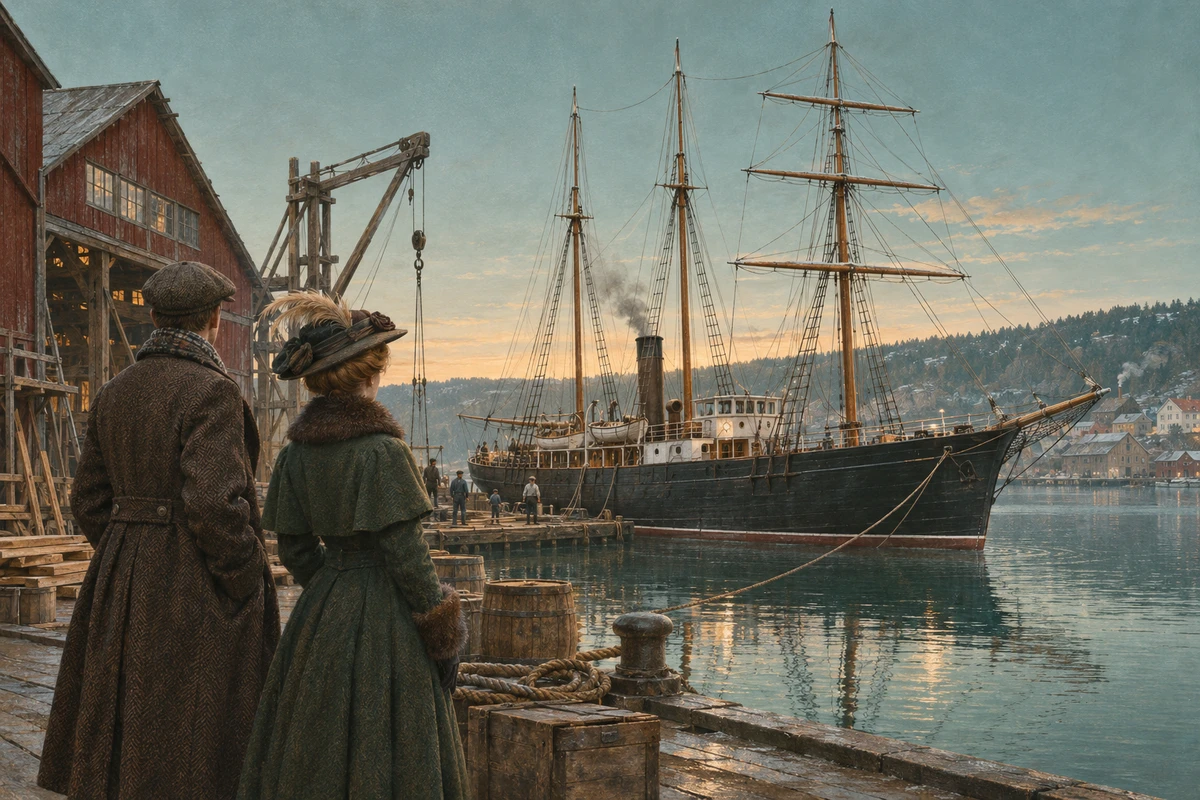
The ship Shackleton took towards Antarctica was built with a very different passenger in mind. Under her original name, Polaris, she was meant to take wealthy customers into the Arctic. The business failed before the plan could become the ship’s career.
The short answer
Arctic tourism and hunting were central to the plans for Polaris. Her backers also intended to offer the vessel for polar expedition charters. Launched in Norway in December 1912, she became available when the venture ran into financial trouble. Shackleton acquired her in 1914 and renamed her Endurance.
A holiday at the edge of the ice
The men behind the scheme knew polar waters. Lars Christensen was a Norwegian shipowner. Adrien de Gerlache had led the Belgian Antarctic expedition of 1897–99. With other investors, they commissioned a wooden three-masted vessel at the Framnæs yard in Sandefjord. She combined sails with a steam engine and was launched on 17 December 1912.
The Arctic programme envisaged summer voyages in waters such as the Greenland Sea and around Svalbard. Wealthy customers could pay to go hunting for polar bears and walruses. That gives “cruise ship” a rather different meaning from the one it has today. The appeal of the trip was the chance to go somewhere remote and come home with a story, and hunting was part of the attraction. Expedition charters offered another possible use for the same ship.
The distinction between the Arctic summer and the Antarctic pack mattered. Near the ice edge the ship might encounter individual floes and have room to manoeuvre. A ship held fast for months could face prolonged pressure across its entire hull. Both were polar operations, but the designers could reasonably expect different demands from each.
The sale that sent her south
De Gerlache ran into financial difficulty and the tourism venture collapsed. Shackleton, meanwhile, needed ships on opposite sides of Antarctica for his proposed crossing. Endurance would take the crossing party to the Weddell Sea. Aurora would operate from the Ross Sea side, where its party would lay supply depots for the final leg. A newly built wooden steam vessel with some capacity to handle ice was an attractive prospect for the first job. Compare this with wheeled bathing machines.
How much changed hands is harder to pin down. The Dutch Cultural Heritage Agency’s MaSS database gives £11,600 (225,000 kroner). The Royal Geographical Society gives £12,860. The Falklands Maritime Heritage Trust gives £14,000 as the agreed price. Shackleton himself wrote in South that the ship cost the expedition £14,000 equipped. An equipped expedition cost can cover more than the hull purchase, but the published accounts do not establish how to reconcile all three figures.
What survived the change of name
Shackleton chose Endurance from his family motto, Fortitudine Vincimus, usually rendered “By endurance we conquer.” One small trace of the ship’s first identity survived the change. When the wreck was found in 2022, the survey team saw a five-pointed star below the name Endurance on the stern. Their expedition report identified it as the Polaris emblem. Related examples can be found in the structural weaknesses of Endurance and the discovery of the Endurance wreck.
There is a temptation to read the ship’s fate backwards from that last voyage, as though the builders had always been preparing her to force a way into the Antarctic. The plans for Polaris put the story back in its original order. She was a working proposition for seasonal Arctic voyages until the money ran out, just as another man needed a ship for a much longer journey.
Related curiosities
- Why Is Renaming a Ship Considered Bad Luck?
- Why Did Ships Carry Carved Figureheads?
- How Did Vikings Cross the Atlantic Without a Magnetic Compass?
Sources and further reading
- Endurance Conservation Management Plan (2024), original owners, launch and intended charters.
- Dutch Cultural Heritage Agency, Endurance
- Royal Geographical Society, Documenting Shackleton’s Endurance
- Falklands Maritime Heritage Trust, Endurance shipwreck
- Ernest Shackleton, South, digitised by the Library of Congress
- Jukka Tuhkuri, “Why did Endurance sink?”, Polar Record (2025)
- Endurance22 expedition blog, 9 March 2022