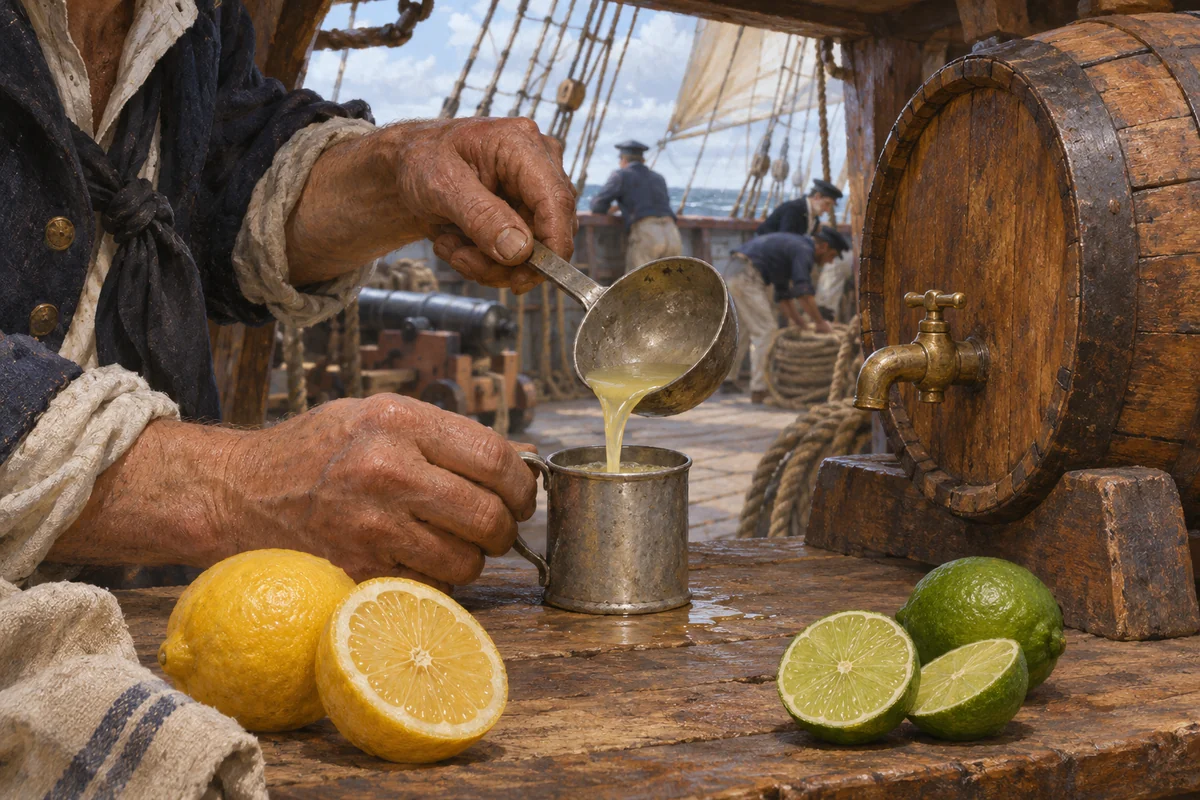
“Limey” sounds like a nickname with a simple explanation. British sailors drank lime juice, so people named them after it. But when the Admiralty made citrus juice a regular provision against scurvy in 1795, the fruit behind that decision was the lemon.
The short answer
The Royal Navy adopted a lemon-juice ration against scurvy in 1795. In the nineteenth century it switched to limes, which Britain could source from its Caribbean possessions. The later ration became associated with British ships and sailors in the slang “lime-juicer”, eventually shortened to “Limey”. Merchant shipping helped carry the association beyond the Royal Navy. Related examples can be found in the Royal Navy’s farewell to its rum ration and the Royal Navy’s bell-bottom trousers.
The experiment aboard HMS Salisbury
Long voyages could leave crews living on provisions that kept well but supplied little vitamin C. Scurvy could bring painful gums, weakness and bruising. In severe cases sailors died. Naval surgeons could describe the symptoms in detail, but they had no way to identify a vitamin that would only be recognised much later.
In 1747, surgeon James Lind tried several remedies on twelve sailors with scurvy aboard HMS Salisbury. He divided them into pairs and gave each pair a different treatment. The two men who received oranges and lemons improved most conspicuously. There was enough fruit for only six days, a small detail that points to the difficulty of making the treatment a dependable part of life at sea.
People had used citrus against scurvy before Lind. His trial gave the remedy an unusually clear comparison with alternatives. Even Lind remained unsure about the disease’s wider causes, and the concentrated preparation he explored as a practical answer lost much of what made fresh juice useful.
How a remedy became a ration
The Admiralty’s 1795 decision came nearly half a century after Lind’s trial. By then naval physicians including Gilbert Blane had helped make the case for supplying lemon juice as a regular provision. A ship could carry juice more conveniently than enough whole fruit for a long voyage. Getting a usable supply aboard and issuing it regularly were part of the achievement.
The records can be confusing because “lime juice” has sometimes been used loosely in accounts of the early policy. The distinction matters here. The original provision was lemon juice. Later supplies increasingly came from limes grown in British Caribbean territories.
What changed when the fruit changed?
A lemon and a lime both taste sharply acidic. Before the role of vitamin C was understood, it was easy to treat that shared sourness as a sign that one would work as well as the other.
The limes used in the later ration generally supplied less vitamin C than the lemons they replaced. Storage and processing could reduce the amount further. The result depended on the fruit, what happened to the juice before it was issued and how much the crew actually received. A bottle marked as the right provision could still deliver less protection than expected.
Scurvy aboard the British Arctic expedition that sailed in 1875 shows how slowly the puzzle was resolved. An Admiralty inquiry pointed to the absence of lime juice among sledging parties and also considered cold, damp and the air below decks. The inquiry reflects the explanations naval medicine still had to sort through.
How “lime-juicer” became “Limey”
Citrus requirements extended beyond warships. The Merchant Shipping Act of 1867 required lime or lemon juice to be provided on specified long voyages. Maritime slang could call a British vessel or sailor a “lime-juicer”. “Limey” later became a wider nickname for British people and could be used mockingly.
The broad link between the nickname and the ration is well supported. The exact route through ships, crews and ports is harder to pin down. Some accounts emphasise the Navy, while others trace the slang through ships carrying emigrants under merchant shipping rules. In either setting, what outsiders noticed was the lime juice. The lemon ration came first, but the lime got the name. Compare this with the Royal Navy’s seated loyal toast.
Related curiosities
Why Did Royal Navy Sailors Hold a Funeral for Their Daily Rum?
Why Did Royal Navy Sailors Wear Bell-Bottom Trousers?
Why Were the Navy’s Shortest Watches Called Dog Watches?
Sources & further reading
- Royal College of Surgeons of England — The Many Forms of Sea Sickness
- The James Lind Library — Who Was James Lind, and What Exactly Did He Achieve?
- A. W. Beasley, Journal of the Royal Society of Medicine — Putrid Gums and ‘Dead Men’s Cloaths’: James Lind Aboard the Salisbury
- Medical History — ‘Cleanse or Die’: British Naval Hygiene in the Age of Steam, 1840–1900
- U.S. Naval Institute, Proceedings — Limes, Lemons, and Scurvy
- Collins English Dictionary — Limey
Last checked: 25 November 2026.