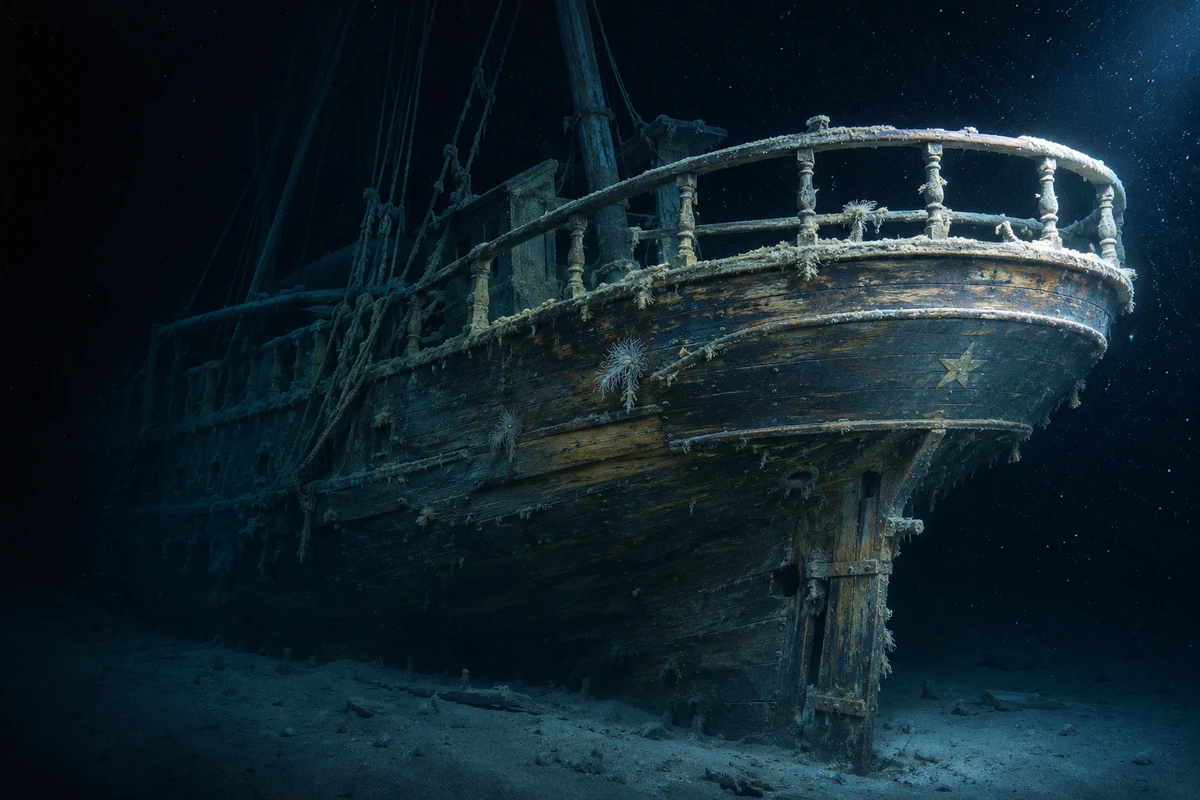
On 5 March 1922, whalers and sailors gathered at Grytviken to bury Ernest Shackleton. On 5 March 2022, a search team found his most famous ship nearly three kilometres beneath the Weddell Sea. The coincidence was a matter of the calendar. The small distance between the wreck and the captain’s old position took considerably more skill.
The short answer
Shackleton was buried on South Georgia on 5 March 1922. Endurance22 located the wreck on 5 March 2022 at 16:05 GMT, four days before publicly announcing the find. The wreck was upright at a depth of 3,008 metres. The conservation plan puts it about five nautical miles from the sinking position Captain Frank Worsley had calculated in 1915.
A funeral on South Georgia
Shackleton died aboard Quest on 5 January 1922, while on another expedition. His wife Emily wished him to be buried on South Georgia. At Grytviken on 5 March, a small church service was followed by a procession to the whalers’ cemetery. Six Shetland men carried the coffin, and whalers and sailors sang a Norwegian funeral hymn.
The island already held a place in the Endurance story. In 1916, Shackleton and five companions had reached South Georgia in the lifeboat James Caird to seek help for the men left on Elephant Island. Worsley navigated that voyage. The less celebrated piece of navigation came some months earlier, when the crew watched their ship go down. Other stories about polar travel and navigation include the structural weaknesses of Endurance and the Arctic tourism plans for Polaris.
How to mark a wreck from drifting ice
On 21 November 1915, the men watching Endurance sink were camped on sea ice. The ship drifted with the pack, and so did their camp. To place the wreck on a chart, Worsley needed to know where the camp had been when the ship sank and estimate how far away the ship had been at that moment.
Bad weather prevented useful celestial observations on the day. Worsley had fixes from 18 and 22 November. He worked back from the later observation, estimating how the floe had moved and allowing for the distance and direction from his camp to the ship. Every part of the calculation could introduce a small error. So could the time kept by his chronometer, particularly when working out longitude. The entry he left in his diary, 68°39′30″ S, 52°26′30″ W, looks precise on the page. It was the best position he could reconstruct from observations and estimates.
What the search found
The modern survey located the wreck at approximately 68°44′21″ S, 52°19′47″ W. The initial expedition announcement described it as just over four nautical miles south of Worsley’s position. The later conservation plan gives an overall separation of about five nautical miles, or roughly nine kilometres. The overall distance includes the shift east as well as south. Related examples can be found in Viking navigation without a magnetic compass.
In the survey lights, the team could read the name across the stern and see the star beneath it. More than a century after the last men watched her disappear, the ship’s identity was almost the easiest thing to establish. Getting close enough to see it had required modern underwater survey equipment, a search beneath difficult ice, and old coordinates good enough to tell the expedition where to begin.
The date and the distance
The anniversary puts the funeral and the find into a single sentence. Worsley’s entry deserves a longer look. His camp was moving, his observations bracketed the time he needed, and his ship disappeared before he could get a fresh fix. What survived was a calculation another expedition could still use, across a gap of more than a hundred years.
Related curiosities
- How Did Vikings Cross the Atlantic Without a Magnetic Compass?
- Why Is Renaming a Ship Considered Bad Luck?
- Why Did Ships Carry Carved Figureheads?
Sources and further reading
- South Georgia Museum, Death of Shackleton, funeral and burial.
- Endurance22 expedition blog, 9 March 2022, first-hand discovery account.
- Endurance Conservation Management Plan (2024), wreck coordinates and distance.
- Falklands Maritime Heritage Trust, History of Shackleton’s Endurance, Worsley’s recorded position.
- Marcel de Vos and colleagues, “Understanding the drift of Shackleton’s Endurance” (2023), observations and drift estimates.
- Canterbury Museum, Navigation of the James Caird on the Shackleton Expedition