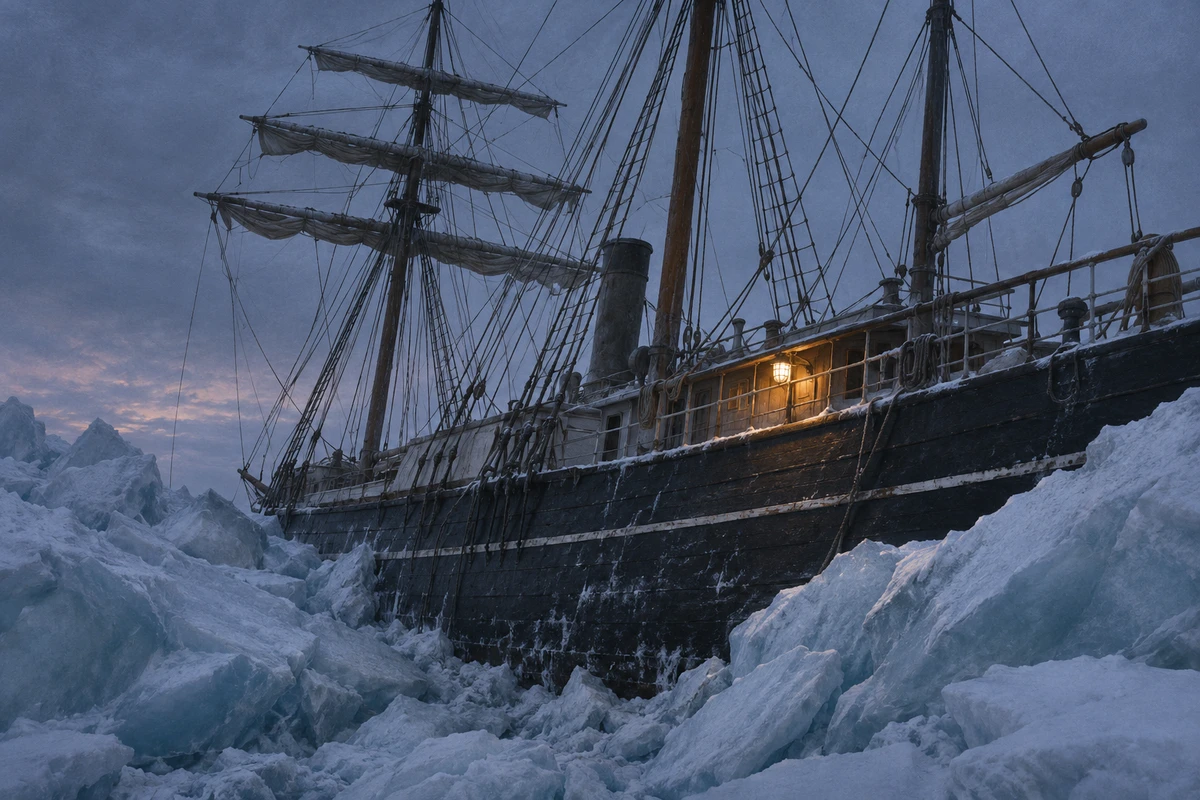
Shackleton was still in Buenos Aires when he told his wife he would trade his new ship for the old Nimrod, comfort aside. More than a century later, an engineer went looking for the weakness he had noticed.
The short answer
In a 2025 study in Polar Record, Aalto University engineer Jukka Tuhkuri compared Endurance with other early polar ships and read the crew’s diaries alongside the vessel’s plans. He found that the ship had weaker deck beams and frames than some of her contemporaries, a long machinery compartment that interrupted the lower deck, and no diagonal beams to reinforce the hull. His reconstruction identifies sustained ice pressure as the cause of the loss, with failure of the keel as the final blow. Compare this with the Arctic tourism plans for Polaris and the discovery of the Endurance wreck.
The warning at the dock
The first sign of trouble came in a harbour. In Buenos Aires in 1914, a gale pressed Endurance against the dock wall. Shackleton watched how she behaved and told Emily that her construction was weaker than Nimrod’s. He still expected her to get through ice safely. He had led the 1907–09 Antarctic expedition in Nimrod, an old whaler, and had a practical basis for the comparison.
The letter records his judgement without describing exactly what moved or gave way. Tuhkuri suggests Shackleton may have seen the sides or decks flex, or heard something crack. The paper also documents Shackleton’s earlier advice to add diagonal reinforcement to another polar ship, Deutschland. He understood what that timber was for. Another angle on polar travel and navigation comes from Viking navigation without a magnetic compass.
The weakness below the funnel
A ship can have formidable planking and still be vulnerable to pressure across the hull. At the edge of the ice, a vessel might take a blow from a floe and have room to move away. In closing pack ice, floes press on both sides at once. The hull needs internal structure to hold its shape.
The steam engine and boiler occupied a long space amidships. The lower deck stopped at that compartment, leaving fewer crosswise supports to oppose a squeeze in a particularly exposed stretch of hull. Diagonal timbers of the kind fitted to some other polar vessels would have given the structure additional stiffness. Tuhkuri’s comparisons put the emphasis on how all those pieces worked together. Thick outer timbers could only do so much when the structure behind them began to deform.
The trouble with the rudder story
Endurance was caught in the Weddell Sea pack in January 1915. She drifted with the ice, taking repeated bouts of pressure. By 27 October she was leaking badly and the expedition moved onto the floe. She sank on 21 November.
The rudder and stern suffered real damage, and the rudder survives on the seabed beside the wreck. That makes it an easy piece of evidence to point to. The diaries, however, record a succession of damaging squeezes. Tuhkuri reads the final accounts as evidence that the ice tore away the keel. In his reconstruction, the rudder damage belongs to the wider failure of a wooden hull under compression. The wreck photographs support parts of that reconstruction, while much of the sequence still has to be recovered from what the men saw and wrote.
Why the legend stuck
A ship that stayed afloat through months in the pack had earned a reputation for toughness. The subsequent rescue of all 28 members of the Weddell Sea party gave the name Endurance a meaning that outlived the ship. Those months afloat also gave her crew a long, close view of what the ice did to the vessel. Their diaries put the machinery space, the beams and the keel back into a story usually told from the lifeboats.
Related curiosities
- Why Is Renaming a Ship Considered Bad Luck?
- Why Did Ships Carry Carved Figureheads?
- How Did Vikings Cross the Atlantic Without a Magnetic Compass?
Sources and further reading
- Jukka Tuhkuri, “Why did Endurance sink?”, Polar Record (2025), including the letter to Emily and the comparison of polar hulls.
- Aalto University’s account of the study
- Ernest Shackleton, South, digitised by the Library of Congress
- Endurance Conservation Management Plan (2024)